

|
|
|
|
Site Details Related Information EDM @ BNL Ph: (631) 344-3881 
|
Hadronic Electric Dipole Moments
The standard model of particle physics is a very successful theoretical framework,
which describes all confirmed observations to date. However, the model leaves
important questions concerning the physical nature of observed processes unexplained,
although it provides an accurate description of them. Among the not yet understood
phenomena are the reasons for parity violation, the particle masses, the violation
of the CP symmetry. CP violation is the only known mechanism that could explain the
matter-antimatter asymmetry found in the universe. In order to obtain a deeper insight,
speculative models have been suggested which often are connected to observable deviations
from standard theory predictions, particularly violations of assumed symmetries or yet
unknown properties of particles.
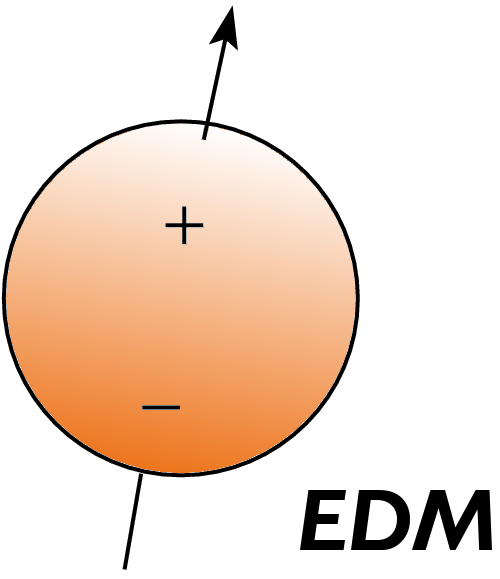
The electric dipole moments (EDM) of fundamental particles are excellent probes of physics
beyond the standard model (SM), e.g. SUSY, since they allow for values within experimental
reach whereas the SM predictions are several orders below them.
A permanent EDM has not been observed so far for any of them. It would violate both parity (P) and time reversal (T) invariance. If CPT is assumed to be a valid unbroken symmetry, a permanent EDM would hence be a signature of CP violation. The standard model of particle physics predicts a CP violating EDM in fundamental particles at the multi loop level of amplitude more than five orders of magnitude below the sensitivity of present experiments. Therefore searches for a permanent particle EDM render excellent opportunities to test models beyond standard theory where in some cases they predict effects as large as the presently known experimental bounds. ...probe the Proton and Deuteron EDM in a storage ringThe Storage Ring EDM collaboration is working on a new method capable of reaching a sensitivity of 10-29 e·cm for the proton and deuteron bare nuclei. The collaboration aims at improving the sensitivity on the deuteron and proton EDMs by several orders of magnitude using a new method: "EDMs in storage rings". This method is based on the highly innovative approach of minimizing the g-2 precession (i.e. the change in the angle between the particle spin vector relative to its momentum vector) in the horizontal plane by using a radial electric field.
The proton EDM (pEDM) proposal to DOE is available here: 2011 proton EDM proposal to DOE.
The deuteron EDM (dEDM) proposal as submitted to the BNL PAC in April 2008 is in
2008 deuteron_EDM_proposal.
The neutron equivalent sensitivity of the dEDM and of other nuclei is given in
neutron equivalent sensitivity. The method is applicable to other particles as well, like the muon (the J-PARC LOI is available from Muon EDM), 3He nucleon, etc.
Last Modified: May 31, 2013 |
|
|

