Near-Sensor Processing in Extreme Environments


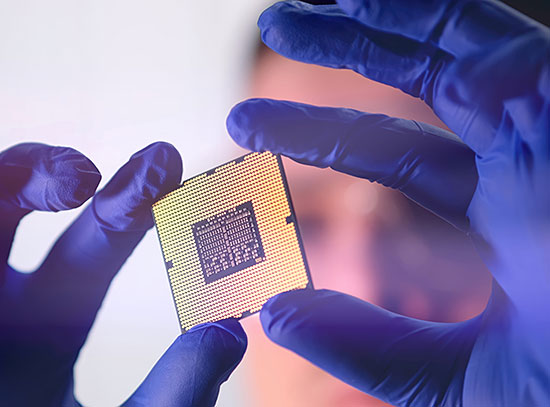
The Brookhaven Lab team — supported by partners from national labs, academia, and industry — is developing a cutting-edge research platform, envisioned as an incubator of innovation. The team will study and optimize microelectronics circuits that can handle large quantities of data, such as those produced in complex multi-modal detectors that are expected to operate at ever increasing rates, with near-sensor processing. El-Pho builds on key initiatives in the field of microelectronics research, such as electro-photonic detector units, on-the-fly data pre-processing, and electro-photonic processor architectures.
Project objectives
- Deliver an electro-photonic ecosystem platform that integrates hardware and software design tools with high-density, heterogenous integration technology.
- Provide the highest operational efficiency and signal transmission speeds by utilizing non-Von-Neumann architectures and parameterized component databases for real-time near-sensor data processing.
- Achieve inovations through the inclusion of standardized hardware and software tools, efficient intra-domain converters, high density electrical and vertical photonic interconnect technologies, and smart interconnects that combine processing with data movement.
- Transform Application-Specific Integrated Circuits (ASICs) into Application-Specific Electro-Photonic Integrated Circuits (ASEPICs) capable of thriving in extreme environments.
- Accelerate both linear matrix operations and data analysis, pattern matching, and control tasks in ASEPIC.
- Eenable complex and highly granular detector systems, which are being developed for applications that demand low latency while processing high volumes of data with fine temporal structures.
- Provide possible implementations of domain-specific accelerators for photonic readout and event-driven multiplexing of sensitive detectors.
- Propose inter-domain platform will be advantageous for both fusion environments with very high neutron fluxes and cryogenic environments associated with superconducting magnets, while the accelerators will efficiently solve various graph traversal problems.
Research Thrusts
Electro-photonic Detector Units
Devices, interfaces, and system characterization and modeling; application-driven device wavelength optimization.
On-the-fly Data Pre-processors
Design and fabrication of photonic perceptron components, integration of photonic and electronic systems, and development of photonic ADC architecture.
Electro-photonic Processor Architectures
Processor operations, beyond-von Neumann architectures; functional simulator development.
-

Grzegorz (W.) Deptuch
(631) 344-7514, gdeptuch@bnl.gov
-

Shresht Joshi
(631) 344-8976, joshis@bnl.gov
-

Project News
Partner Institutions
Industry Collaborator
Industry Liaison