


Facility
The Atmospheric Radiation Measurement (ARM) user facility’s centralized calibration laboratory at the Center for Aerosol Measurement Science (CAMS), Brookhaven National Laboratory (BNL), is a dedicated calibration and research facility for atmospheric aerosol instrumentation. Located within BNL’s Environmental Science department, the lab provides traceable calibration services for condensation particle counters (CPCs) and scanning mobility particle sizers (SMPSs) deployed across ARM’s global Aerosol Observing Systems (AOS), with the goal of ensuring high-quality and internally consistent aerosol measurements across the network.
One area of the facility is dedicated to calibrating Condensation Particle Counters (CPCs), the instruments that measure the total number concentration of aerosol particles in the atmosphere. The calibration follows the ISO 27891 standard and relies on a well-characterized aerosol generated in-house: silver nanoparticles are produced using high-temperature tube furnaces, then size-selected by a reference Mobility Particle Size Spectrometer (MPSS) and counted by a reference aerosol electrometer. By comparing each field CPC against these reference instruments, the laboratory establishes a traceable chain from the field measurement back to national and international standards.
CPC Calibration
One area of the facility is dedicated to calibrating Condensation Particle Counters (CPCs), the instruments that measure the total number concentration of aerosol particles in the atmosphere. The calibration follows the ISO 27891 standard and relies on a well-characterized aerosol generated in-house: silver nanoparticles are produced using high-temperature tube furnaces, then size-selected by a reference Mobility Particle Size Spectrometer (MPSS) and counted by a reference aerosol electrometer. By comparing each field CPC against these reference instruments, the laboratory establishes a traceable chain from the field measurement back to national and international standards.
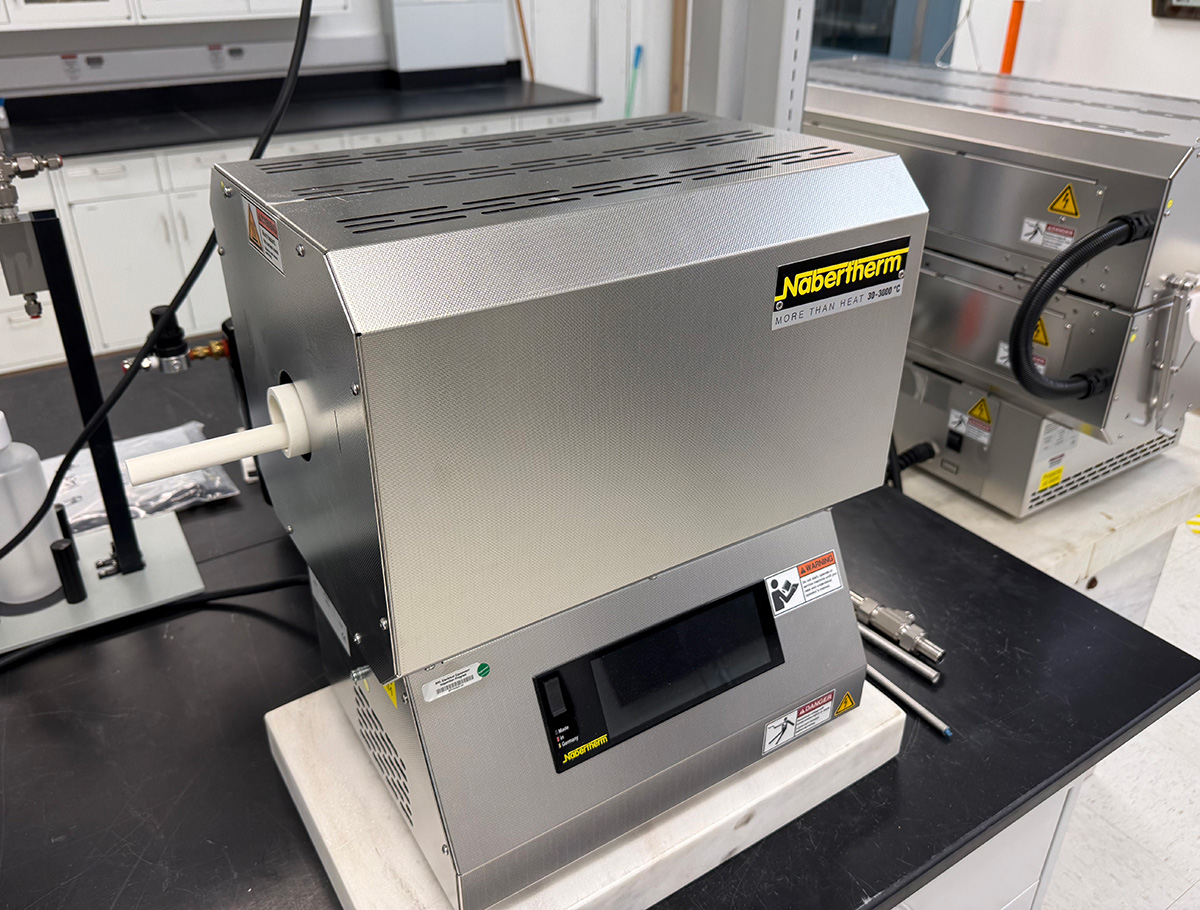
High-temperature furnaces for calibration aerosol generation.
SMPS Calibration
The second area of the facility handles calibration of Scanning Mobility Particle Sizer (SMPS) systems, which measure the size distribution of atmospheric aerosol particles. Following CEN/TS 17434 recommendations, the lab draws outdoor air through a PM2.5 inlet into a mixing chamber, conditions it through Nafion dryers, and distributes it via a sample manifold to allow side-by-side comparison between the instrument under test and a reference MPSS. Sizing accuracy is verified using polystyrene latex (PSL) sphere standards of known diameter. A calibrated transfer standard is also being prepared for use in field calibrations at ARM sites.
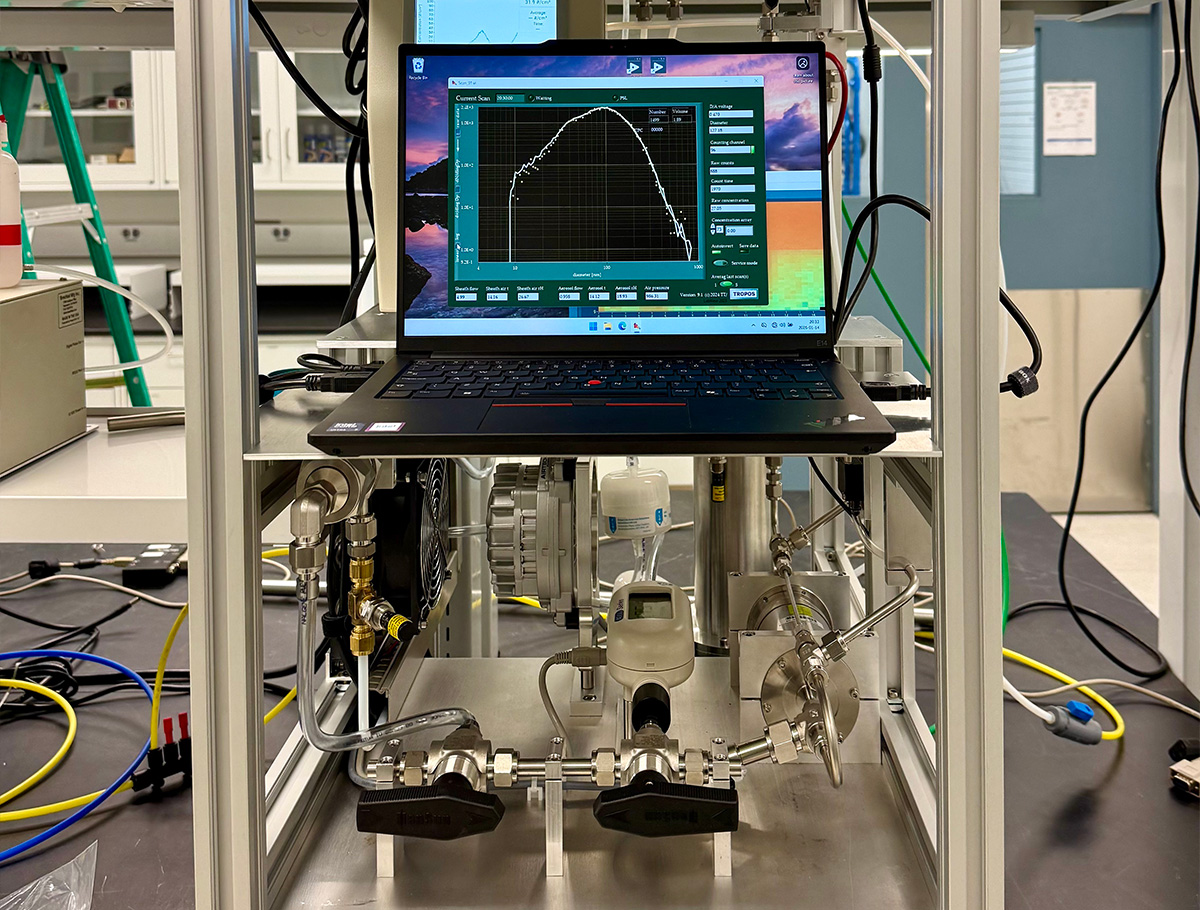
MPSS for SMPS calibration
Lab Infrastructure
The laboratory maintains controlled conditions to support repeatable, high-quality calibrations. Temperature is held near 22 °C, and the lab is equipped with a house vacuum system, nitrogen gas lines, and dedicated data acquisition connected to the department’s server infrastructure. The facility also includes outdoor space for accommodating larger measurement platforms, including a replica of the ARM AOS sampling stack for realistic testing configurations.
Standards and Traceability
Calibration procedures at the ARM centralized calibration laboratory at CAMS are designed to establish metrological traceability to national measurement institutes (including NIST) through well-defined calibration chains. The lab works in close partnership with the World Calibration Centre for Aerosol Physics (WCCAP) at TROPOS in Leipzig, Germany, and participates in the EU Horizon CARGO-ACT project, which coordinates best practices between European (ACTRIS) and U.S. (ARM, NOAA, NASA) research infrastructures. These partnerships ensure that the laboratory’s calibrations are aligned with international standards and intercomparison procedures.
Current Status
The laboratory is in the final stages of commissioning. Both calibration areas have been built out and key systems – including the tube furnaces, aerosol electrometer, and the SMPS calibration system – have been individually tested and validated. Additional reference instrumentation is arriving in early 2026. Once fully operational, the laboratory will support annual calibration cycles for the ARM aerosol instrument fleet, with capacity for guest instruments and collaborative measurement campaigns.
