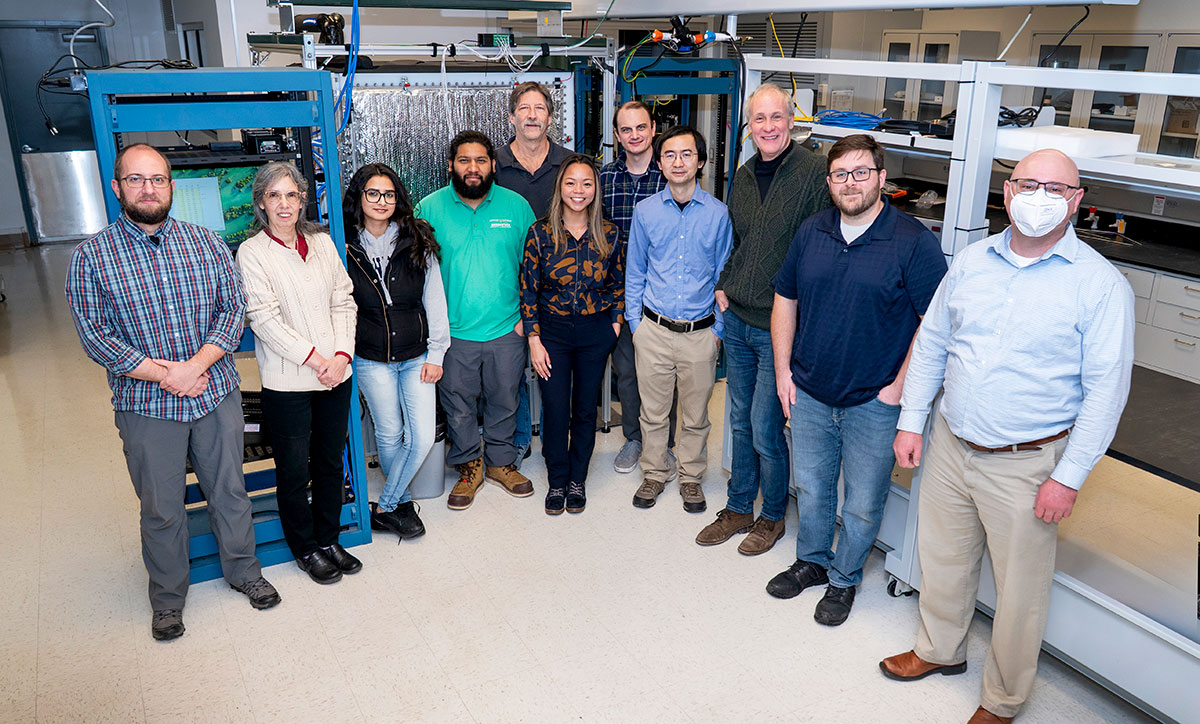
Clouds play a critical role in Earth's climate, weather systems, and water cycle, yet many of the small-scale processes that govern their behavior remain poorly understood. The cloud chamber enables researchers to investigate how aerosols influence cloud formation, why some clouds produce precipitation while others do not, and how cloud properties respond to changes in temperature, humidity, and turbulence. Because experiments can be repeated under identical conditions, the chamber provides a powerful platform for testing scientific theories, improving atmospheric models, and advancing our understanding of cloud microphysics.
Collaborate with us
Beyond cloud science, the chamber offers a versatile testbed for new research applications and collaborations across disciplines. Interested in using the cloud chamber for your research? Contact us to learn more.
How it works

Create a convective, supersaturated environment
Heat the chamber base containing water and cool the top to generate supersaturated environment

Introduce aerosol particles
Aerosol particles serve as “seeds” upon which water vapor condenses onto

Allow cloud droplets to form and grow
Continued uptake of water vapor by particles results in particle size growth producing droplets

Observe and measure cloud evolution and dynamics
Quantify droplet growth and cloud dynamics using cloud probes, laser and cameras
Watch as a cloud forms in the chamber. Scientists use a green laser to see the process.
Advancing sensing technologies, improving cloud models
The cloud chamber serves as an opportunity to test innovative measurement technologies, including advanced optical, lidar, and radar techniques that can observe cloud processes without disturbing them. These capabilities support the development of new approaches for studying aerosols, cloud droplets, and precipitation.
Ultra-high-resolution lidar
A new type of lidar — a laser-based remote-sensing instrument — can observe cloud structures at the scale of a single centimeter. This capability for studying cloud tops with resolution that is 100 to 1,000 times higher than traditional atmospheric science lidars enables pairing with measurements in well-controlled chamber experiments in a way that has not been possible before.
THz radar for cloud and rain research
THz radar uses high-frequency radio waves to detect tiny water droplets and other particles inside clouds with exceptional detail. By comparing radar measurements with direct observations, researchers showed that this technology can accurately track the early stages of cloud and rain formation. These capabilities could help scientists better understand how clouds develop and produce precipitation.
Exploring a next-generation cloud chamber
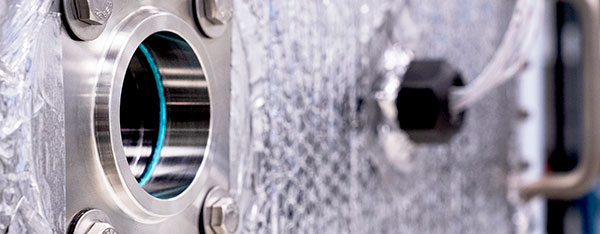
Scientists are developing new cloud chamber concepts that will allow researchers to create larger, longer-lived clouds and study atmospheric processes with unprecedented precision. The work integrates engineering, instrumentation, and computational modeling to guide the design of future cloud research facilities.
Building better models
Using measurements from a controlled cloud chamber, researchers compared different modeling approaches and found that the choice of model can significantly affect the simulated cloud properties. These studies help identify sources of uncertainty in cloud simulations and support the development of more accurate models for weather forecasting and atmospheric research.
Workforce Development and Collaboration
Experiments conducted using this unique environment create engaging opportunities for science education and workforce development.
The cloud chamber is the result of a close collaboration among Brookhaven scientists, engineers, technicians, and support staff, drawing on expertise in atmospheric science, instrumentation, engineering, and modeling. The project also builds on collaboration with Michigan Technological University and a broader community of researchers working to address fundamental questions about clouds and their role in the Earth system.