A Successful, Sustainable Catalyst for Ethanol Dehydrogenation
Brookhaven researchers and their U.S. and international collaborators crafted a novel, three-metal catalysis approach to convert ethanol to a critical chemical feedstock
July 29, 2026

Ethanol is an alcohol used in a huge number of industrial and household applications. When dehydrogenated — in this case, stripped of some of its hydrogen atoms — it yields another important compound: acetaldehyde, which is used to make resins, dyes, perfumes, and synthetic flavors, among many other products. But currently available catalysts for ethanol dehydrogenation suffer from deactivation, poor performance over time, and unwanted side reactions.
A good catalyst is essential to a reaction because it can improve a product and allow it to be made cheaper and faster. At the U.S. Department of Energy’s (DOE) Brookhaven National Laboratory, a collaboration of Brookhaven researchers and international scientists has developed a catalyst that facilitates ethanol dehydrogenation quicker and with less waste than other catalysts, such as metals like copper and nickel. These catalysts suffer from several major issues, including tending to clmp together or breaking down the ethanol too much.
“Our catalyst solves an important problem in chemistry because it completes a selective dehydrogenation: Instead of stripping away all of the hydrogen atoms, it removes just the ones necessary," said chemist Anatoly Frenkel, who holds a joint appointment with Brookhaven and Stony Brook University and co-led the paper on the work, which appears in the journal Angewandte Chemie.
In addition to its promising performance, this ethanol-based catalytic system is, notably, more sustainable than other methods used to produce acetaldehyde, which involve petrochemicals. Ethanol, on the other hand, can be produced from biomass, such as food waste, crop residues, and forestry byproducts.
Three’s a catalyst
The system developed here is unusual for thermal catalysis, in which heat assists the process, in that it consists of three metals — platinum, chromium, and silver — instead of just two or one. Rather than being dispersed within the silver and all elements remaining as single atoms, the platinum and chromium atoms pair up in dumbbell-like structures, with the sea of silver acting as a bulk host material.
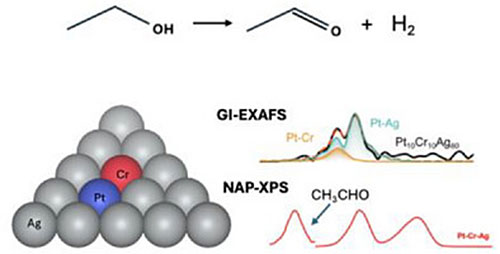
The trimetallic alloy of platinum (Pt), chromium (Cr), and silver (Ag) features active Pt-Cr pairs that enable ethanol dehydrogenation. X-ray studies confirm that the Pt-Cr pairs form throughout an Ag matrix and demonstrate the pairs' high activity and selectivity to catalyze ethanol dehydrogenation.
“Systems like this one, in which two different metals form a ‘dimer’ structure like our dumbbells, supported by a bulk third metal, tend to have broader functionalities and greater stability — each metal takes on a different key role,” Frenkel said. “But they have not been well explored, and detecting the dimers and studying those roles is exceedingly difficult.”
To understand the system’s behavior, the group used a variety of methods. These included theoretical modeling, microscopy, and X-ray techniques at two synchrotron facilities: Brookhaven’s National Synchrotron Light Source II (NSLS-II), a DOE Office of Science user facility, and the MAX IV synchrotron laboratory in Sweden.
Theory guides experiment
The group began their investigation with crucial theoretical work, which they used to guide the design of the catalyst. According to their calculations, the platinum/chromium/silver system would achieve selective dehydrogenation.
“Prior quantum chemical calculations and surface science experiments by our collaborators showed that platinum-chromium pairs form preferentially in silver and exhibit electronic structures distinct from isolated platinum and chromium sites, enabling unique surface chemistry,” said Jason Weaver, a chemist at the University of Florida and the paper’s first author. “These insights motivated us to test whether trimetallic platinum-chromium-silver alloys could sustain ethanol dehydrogenation under practical reaction conditions and to directly identify the presence and catalytic role of platinum-chromium pair sites.”
The group turned to a series of experiments, using samples prepared by Jürgen Biener, a scientist at DOE’s Lawrence Livermore National Laboratory and a co-author of the paper.
At the Quick X-ray Absorption and Scattering (QAS) beamline at NSLS-II, members of the group used an X-ray method that provides information about the bulk of the sample. This technique, known as X-ray absorption fine structure (XAFS), provided precise measurements relating to the behavior of the platinum, chromium, and silver atoms as well as their respective neighbors. The data, which was analyzed by Shuting Xiang, a graduate student in Stony Brook’s Materials Science and Chemical Engineering department and the paper’s second author, revealed that the platinum and the chromium were indeed paired.
Having proven that the platinum-chromium dumbbells were present in the sample’s bulk, the group now needed to show that they existed on the surface. They shipped the samples to MAX IV, where they were studied by Weaver and two colleagues, Lund University’s Jan Knudsen and Malmö University’s Lindsay Merte, with a type of XAFS method that is sensitive to surface details and can be used in real-time reaction conditions. This work helped them understand the local environment and behavior of each metal, a necessary step before they could piece together a complete picture of the system.
“These surface studies were critical for connecting all components of our work,” Frenkel said. “This was a very important and novel aspect of the study, as most experimental methods focus on the bulk of the catalyst, while chemical transformations that we investigated occur on the surface.”
Importantly, the work at MAX IV also included another technique, ambient-pressure X-ray photoelectron spectroscopy (AP-XPS). This is also a surface-sensitive technique, but it allows the sample to be studied under active conditions and is therefore a very useful tool for understanding the full structure-function nature of chemical reactions. In this case, the AP-XPS work confirmed that the only samples that did perform well were those that contained the platinum-chromium dumbbells.
"AP-XPS allows us to look at reacting molecules in the gas and on the surface at the same time and relate this to what the metals are doing,” Merte said. “Combining this with the local bonding information from surface sensitive XAFS gives a really complete picture of the state of the catalyst and how this affects its performance.”
The experimental work also included reactivity studies and scanning transmission electron microscope (STEM) at Brookhaven’s Center for Functional Nanomaterials, another DOE Office of Science user facility. The STEM work provided additional information on the distribution and local atomic environment of the platinum and chromium atoms within the silver host.
When reconciled, the full suite of approaches directly link the platinum-chromium dimers, embedded in silver, to the enhanced activity of the platinum-chromium-silver alloy versus that of two-metal alloys.
“The success of this study showcases that some scientific problems can only be solved when you bring together theorists and experimentalists, applying multiple approaches in a coordinated way,” Frenkel said.
This research was supported by the National Science Foundation, the DOE Office of Science, the National Research Foundation of Korea, and the Rowland Institute at Harvard University. It was conducted by researchers from Brookhaven Lab, Stony Brook University, the University of Florida, Lund University (Sweden), Malmö University (Sweden), Universidad Nacional del Litoral (UNL) y CONICET (Argentina), Tulane University, Lawrence Livermore National Laboratory, the University of Pennsylvania, and Tufts University.
2026-23079 | INT/EXT | Newsroom