Brookhaven Lab to Lead $14M AI Project for Nation's Electric Grid
Funded through the Genesis Mission Phase II Request for Application, Brookhaven Lab will lead a three-year effort to develop a next-generation grid foundation model
September 1, 2026
 enlarge
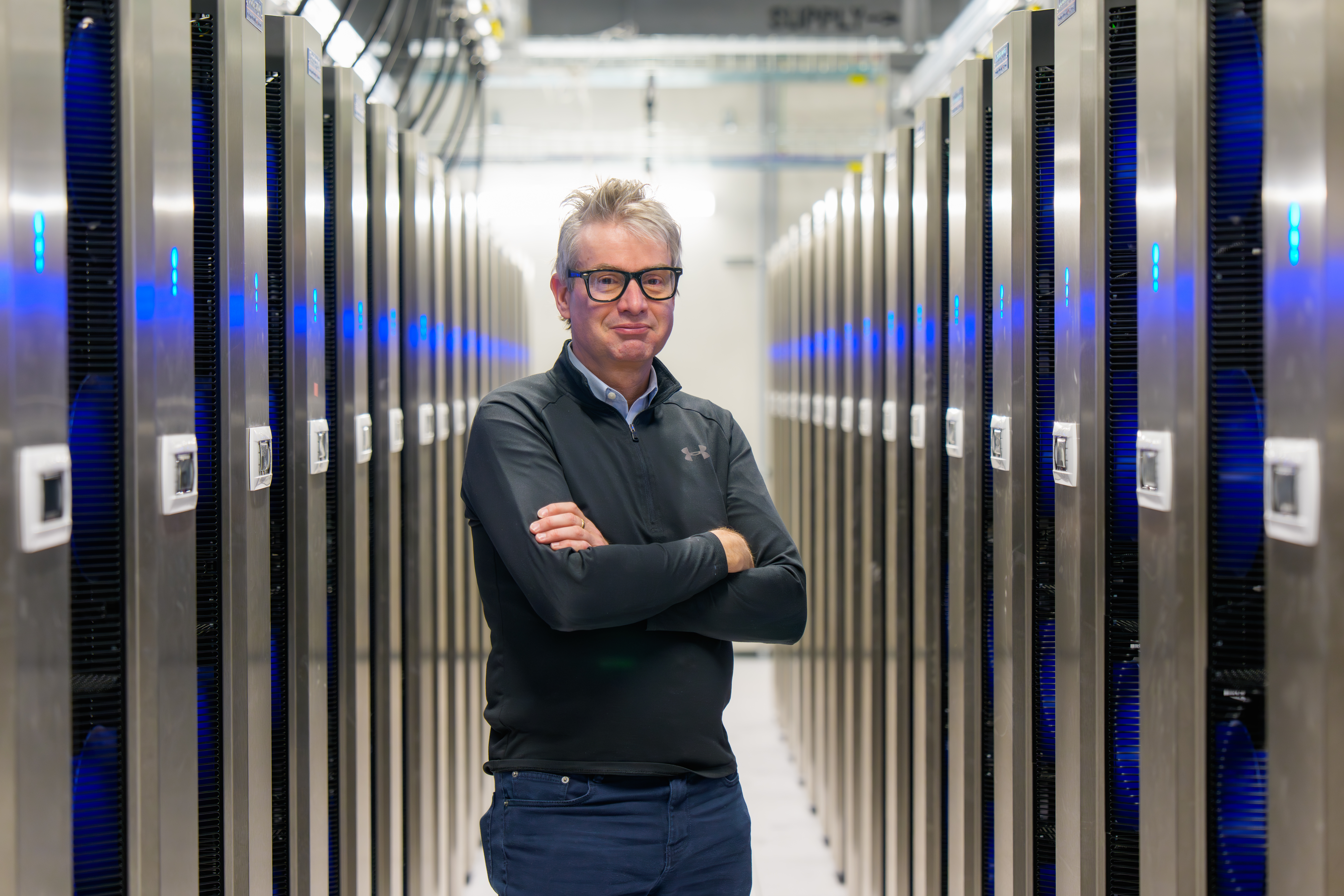
Hendrik Hamann, chief AI scientist for Innovation, Science, and Security at Brookhaven Lab and joint appointee at Stony Brook University, is the principal investigator for "Foundation Models for the Electric Grid: From Proof of Concept to Real-world Impacts." This $14.2 million Genesis Mission Phase II project, led by Brookhaven Lab, will support researchers in developing an AI system that can rapidly simulate scenarios for adding new loads to the electric grid. (Timothy Kuhn/Brookhaven National Laboratory)
UPTON, N.Y. — The U.S. Department of Energy’s (DOE) Brookhaven National Laboratory has been selected by DOE to lead a $14.2 million project through the Genesis Mission Phase II Request for Application (RFA). The award to Brookhaven and its collaborators will support three years of research to develop a next-generation grid foundation model (GridFM), an artificial intelligence (AI) system that can rapidly simulate scenarios for adding new loads to the electric grid. With the goal of building a model that can simulate 1 billion scenarios in 24 hours, the project aims to significantly accelerate grid expansion planning with optimal accuracy, affordability, and efficiency in operations.
The funding was announced today at Brookhaven Lab by DOE Assistant Secretary for the Office of Electricity (OE) Catherine Jereza. OE is administering the funding for this Genesis Mission project, called “Foundation Models for the Electric Grid: From Proof of Concept to Real-world Impacts.” $3.9 million of the total project funds will be allocated to Brookhaven, with the rest being shared by collaborating institutions.
“This project represents a bold step forward to supercharge scientific discovery using artificial intelligence to modernize America’s electric grid,” Assistant Secretary Jereza said. “By providing utilities enhanced AI tools, they can plan and operate the grid faster, more reliably, and more cost-effectively to help meet the demands of a growing economy while delivering affordable, reliable power for homes and businesses while unleashing American energy dominance.”
“This award reflects DOE’s confidence in Brookhaven Lab to bring together science, artificial intelligence, and strong partnerships to address challenges of national importance,” said Brookhaven Lab Director John Hill. “As electricity demand continues to grow, we need new approaches to strengthen, expand, and efficiently operate the nation’s electric grid. We’re proud to lead this effort and to work with an outstanding team to turn innovation into real-world impact for America’s energy future.”
The GridFM Genesis Mission Phase II project led by Brookhaven Lab includes collaborators from the National Laboratory of the Rockies, the Massachusetts Institute of Technology, the University of Illinois at Urbana Champaign, Stony Brook University, Cornell University, the University of Texas Arlington, GE Vernova Research, IBM Research, NVIDIA, Accenture Federal Services, Amazon Web Services, Alvarez and Marsal, Microsoft, the New York Power Authority, Alabama Power, the Long Island Power Authority, National Grid, Con Edison, New York Independent System Operators, the New York State Energy Research and Development Authority, Great River Energy, the National Rural Electric Cooperative Association, LF Energy, the Advanced Energy Center, the Horizon Institute for Public Service, and the GridFM Corporation.
The GridFM initiative, on a larger scale, is a community project spanning industry, academia, and government, with contributions from more than 150 organizations. The initiative is strengthened by collaboration between utilities — which provide operational data and system experience — and researchers and technology providers, who provide AI expertise and computing resources. Open-source development of GridFM is administered and managed in partnership with the Linux Foundation Energy.
“AI is often seen as a growing burden on the electric grid, but through the Genesis Mission we have an opportunity to turn that challenge into an advantage,” said Hendrik Hamann, chief AI scientist for Innovation, Science, and Security at Brookhaven Lab, joint appointee at Stony Brook University, and principal investigator for the project. “By bringing together the right partners and scaling AI and grid foundation models for the electric grid, we can accelerate planning, improve operations and efficiency, and help build a more affordable, resilient energy system.”
The Genesis Mission is a historic national initiative led by DOE, which is building the world’s most powerful integrated science discovery platform. By uniting government, industry, academia, and philanthropy, it is accelerating breakthroughs in energy, scientific discovery, and national security through a new platform that combines AI, supercomputing, quantum systems, and advanced scientific instruments.
Brookhaven is advancing the goals of the Genesis Mission by improving AI for science and society across the Lab’s research initiatives. In July, DOE awarded Brookhaven seven Phase I Genesis Mission projects supporting AI research for microelectronics, nuclear and high energy physics, computational science, and atmospheric science. The Lab is also contributing to 29 additional Phase I projects led by other National Laboratories, research universities, and private industry. Now, as the leader of a Phase II RFA project, Brookhaven Lab is expanding its contributions to this historic mission and helping to further ensure the nation’s energy security.
“Assistant Secretary Katie Jereza’s visit and the announcement of Genesis Phase II underscore that Long Island is at the forefront of America’s scientific and energy innovation," said U.S. Rep. Nick LaLota. "BNL's work strengthens our energy security, fuels technological breakthroughs, and helps ensure the United States remains the world’s leader in scientific research. In Congress, I’ll continue fighting for targeted investments that advance our national security, strengthen our economy, and deliver long-term value for taxpayers. I’m excited to see Genesis Phase II build on Brookhaven’s remarkable legacy of innovation."
Brookhaven National Laboratory is supported by the Office of Science of the U.S. Department of Energy. The Office of Science is the single largest supporter of basic research in the physical sciences in the United States and is working to address some of the most pressing challenges of our time. For more information, visit science.energy.gov.
Follow @BrookhavenLab on social media. Find us on Instagram, LinkedIn, X, and Facebook.
2026-23136 | INT/EXT | Newsroom