Polymer Enables Low-Loss Energy Storage at High Temperatures
June 17, 2026
 enlarge
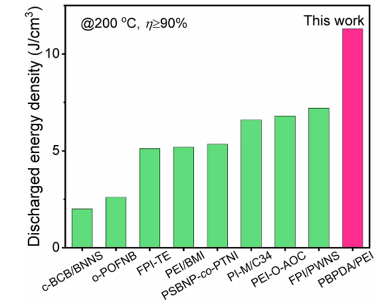
The energy storage performance of a new PBPDA/PEI blend containing equal amounts of each material (50/50 by weight) at a charge/discharge efficiency of 90% at 200°C compared with the current leading polymer and composite materials reported in previous studies.
The Science
By combining two polymers, researchers create a plastic-based dielectric material that stores large amounts of energy with very little loss, even at temperatures as high as 250°C.
The Impact
This new material could enable smaller, lighter, and more reliable capacitors for high-temperature applications like hybrid vehicles and aerospace electrification.
Summary
As electronics, electric vehicles, and energy systems get smaller and more powerful, they need better capacitor materials that can store more energy in less space. Polymer dielectrics, plastic-like insulating materials that are able to store electrical energy when exposed to an electric field, have shown a lot of promise. However, it has been challenging to find one that not only stores a significant amount of electrical energy, but can also remain stable at high temperatures (above 150°C) and resist electrical failure.
Many high-temperature polymer dielectrics have limited energy-storage performance because they have a low dielectric constant. Their molecular dipoles are locked in place within a rigid, glass-like structure and cannot easily respond to an electric field. Researchers have tried improving them by changing polymer structures, adding nanoparticles, or modifying surfaces, but success has been limited. Adding large amounts of fillers can increase energy storage, but it often makes materials brittle, less flexible, and more prone to electrical losses and breakdown.
In this study, researchers developed a new, all-polymer nanocomposite made from polyetherimide (PEI) and poly(4,4′-biphthalic anhydride-1,4-bis(4-aminophenoxy) benzene) (PBPDA). Because the polymers don’t naturally mix well, they spontaneously organize themselves into a complex 3D nanostructure throughout the material. This self-assembled structure provides several advantages, such as a high dielectric constant, very low energy loss, reduced charge leakage, and the ability to withstand strong electric fields without breaking down. They achieved notably high energy storage performance, delivering 18.7 J/cm³ at 150°C, 15.1 J/cm³ at 200°C, and 8.6 J/cm³ at 250°C. These values rank among the highest ever reported for polymer-based dielectric materials operating at such high temperatures.
To characterize structural changes, small angle X-ray scattering and wide-angle X-ray diffraction experiments were performed at the Complex Materials Scattering (CMS) beamline located at the National Synchrotron Light Source II (NSLS-II), a U.S. Department of Energy (DOE) Office of Science user facility at DOE’s Brookhaven National Laboratory. They found that when the two polymers are combined, they self-organize into nanoscale domains. Strong interactions at the interfaces between these domains alter polymer packing and structural ordering, producing a more organized material than either polymer alone.
This same design strategy can also be applied to other types of polymer blends, showing that it is both versatile and adaptable. This research helps address the growing need for advanced electrical energy storage technologies and introduces a new way to create high-performance polymer materials that work across a wide range of temperatures.
Download the research summary slide (PDF)
Related Links
Paper: Giant energy storage and dielectric performance in all-polymer nanocomposites
Contact
Q. M. Zhang
The Pennsylvania State University
qxz1@psu.edu
Publications
Li, L., Rui, G., Zhu, W., Guo, Y., Huang, Z., Wu, S., Casalini, R., Wang, Q., Liu, Z., Colby, R. H., Kim, S. H., Lu, W., Bernholc, J., Zhang, Q.M. Giant energy storage and dielectric performance in all-polymer nanocomposites. Nature 651, 377–382 (2026). https://doi.org/10.1038/s41586-026-10195-2
Funding
Q.M.Z. acknowledges the support of the Office of Naval Research under grant nos. N00014–23–1–2247, NSF DMR and Polymers Program (DMR-2413150) and the Harvey F. Brush Chair endowment in the College of Engineering of Penn State. L.L. was supported by the Office of Naval Research under grant no. N00014–23–1–2247. W.Z. was supported by the Office of Naval Research under grant nos. N00014–23–1–2247 (before September 2024 and in the summer of 2025), NSF DMR and Polymers Program (DMR-2413150) (between 1 September 2024 and 15 May 2025). W.L. and J.B. were supported by ONR grant no. N00014–23–1–2244. Supercomputing resources at the Oak Ridge Leadership Computing Facility were provided through the Innovative and Novel Computational Impact on Theory and Experiment (INCITE) program. Y.G. and S.H.K. were supported by Axalta Coating Systems. R.C. acknowledges the support of the Office of Naval Research (N0001425GI00541).
2026-23035 | INT/EXT | Newsroom