Abundant Catalyst Converts Methane into Valuable Liquid Chemicals
Low-cost sulfur-tolerant compound could convert wasted natural gas into easily transportable commodity chemicals and fuels
June 30, 2026
 enlarge
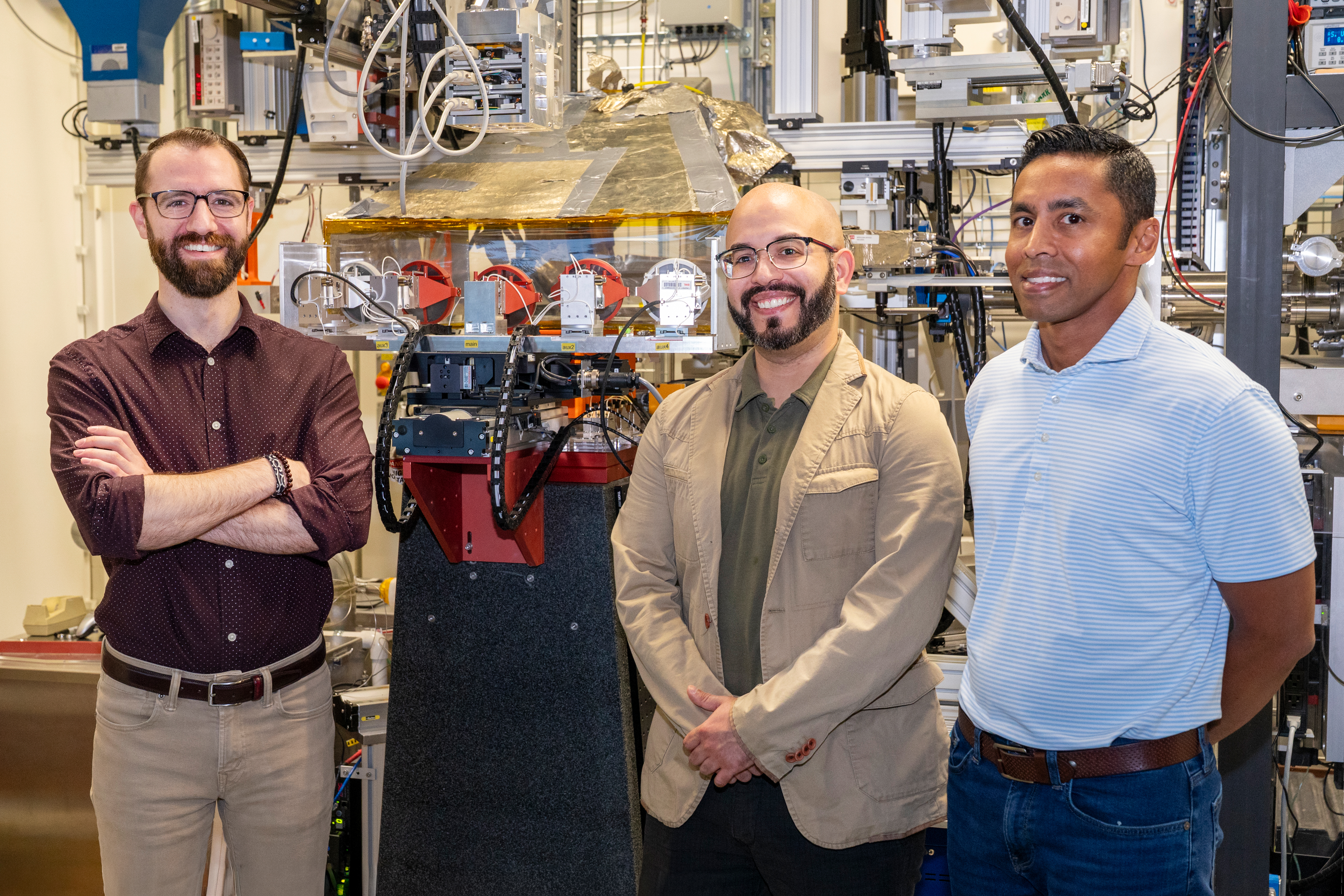
Steven Farrell, Juan Jimenez, and Sanjaya Senanayake stand at the Inner Shell Spectroscopy (ISS) beamline at the National Synchrotron Light Source II. They used X-ray spectroscopy at this beamline to reveal structural and electronic characteristics of molybdenum atoms in a molybdenum disulfide catalyst they developed to convert methane to valuable liquid chemicals. (David Rahner/Brookhaven National Laboratory)
UPTON, N.Y. — Scientists at the U.S. Department of Energy’s (DOE) Brookhaven National Laboratory and their collaborators have demonstrated a promising new approach for converting methane — the primary component of natural gas — into liquid chemicals that are precursors for many industrial chemicals and fuels. The research, described in a paper just published in Advanced Functional Materials, shows how molybdenum disulfide (MoS2), an earth-abundant industrial catalyst, can be used with minimal tweaking to selectively convert methane into methyl peroxide and other liquid oxygenate compounds at temperatures below 212 degrees Fahrenheit (100 degrees Celsius). Methyl peroxide is a precursor for making methanol, an energy-dense liquid fuel that can be transported easily.
“The fact that this catalyst is an earth-abundant, domestically sourced material could change the game for converting natural gas into liquid chemicals,” said Brookhaven Lab chemist Sanjaya Senanayake, a corresponding author on the publication. “The catalyst achieves very high yields and high specificity for making important precursors for methanol and a wide range of other industrial processes.”
The project is part of a long-term strategy of the Catalysis: Reactivity and Structure group in Brookhaven Lab’s Chemistry Division to develop methane-conversion catalysts and processes. This group includes co-authors Senanayake, chemist Juan Jiménez, and research associate Arephin Islam — all co-authors on the new publication.
What exactly is a catalyst? Steven Farrell explains. (David Rahner/Brookhaven National Laboratory)
Molybdenum disulfide is of particular interest because of the presence of sulfur in the catalyst’s composition. It is expected to be resistant to the high sulfur levels often found in raw natural gas, which can poison traditional methane-conversion catalysts.
“We are developing a wide portfolio of different materials that can handle the whole gamut of different natural gas compositions found within the U.S. and internationally,” said Jiménez, a co-leader of the project. “Every well has different compositions of gas, and they all require different catalytic systems,” he said.
That variety “is the ‘natural’ in natural gas,” said Steven Farrell, lead author on the study, who is a Goldhaber Distinguished Fellow at Brookhaven Lab’s National Synchrotron Light Source II (NSLS-II). “We don't really have control over what we pull out of the ground, but we want to have control over what we make of it. This catalyst gives us a lot of flexibility in how we use our energy resources,” Farrell said.
The work addresses a longstanding challenge in energy science: how to efficiently transform methane into transportable liquid products. Although methane is abundant and energy rich, it is difficult and costly to utilize without access to large-scale infrastructure. As a result, methane produced at remote oil- and gas-producing sites is often vented or burned off to mitigate hazards. An efficient process for converting that methane to a readily transportable liquid would enable this resource to be harvested.
“This catalyst captures essentially what is waste or unusable and makes it usable,” Farrell said.
Watching the catalyst transform in real time
 enlarge
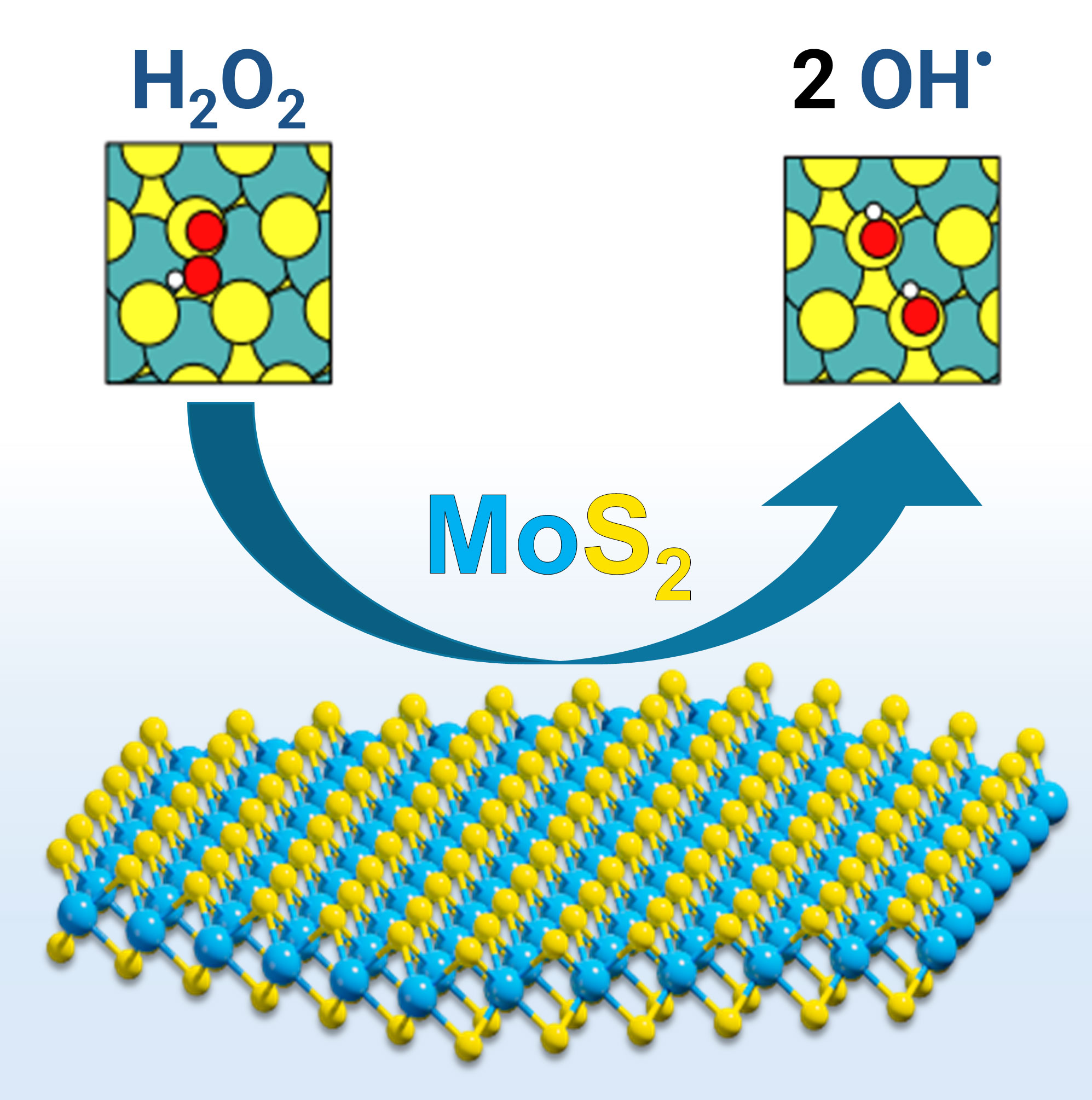
This image shows how the catalyst — made of regularly arrayed molybdenum (blue) and sulfur (yellow) atoms — scavenges hydroxyl radicals (OH groups) released when hydrogen peroxide (H2O2) breaks down. These hydroxyl radicals interact with methane (not shown) in solution, overcoming the strong carbon-hydrogen bonds to form liquid methyl peroxide or methanol. (Brookhaven National Laboratory)
The reaction appears surprisingly simple. When combined with methane and diluted hydrogen peroxide in water at 167 degrees Fahrenheit (75 degrees Celsius), the MoS2 catalyst converted methane into liquid oxygenates with complete selectivity toward the desired product family. Its activity is competitive with, and in some cases exceeds, that reported for more costly methane-conversion catalysts made from precious metals such as palladium or rhodium.
“We took off-the-shelf MoS2 and, with only very minor treatment, made an incredibly active catalyst,” said Jiménez. “You don’t need a sophisticated synthesis to create an incredibly active catalyst.”
But sophisticated tools — specifically a suite of beamlines at NSLS-II, a DOE Office of Science user facility at Brookhaven Lab — played a key role in the scientists’ ability to understand what was happening with the catalyst as the reaction was taking place. This atomic-level understanding will be essential for efforts to scale up production to levels relevant for industrial use.
The studies were challenging because the reaction involves materials in three different phases: gaseous methane, solid molybdenum disulfide, and liquid hydrogen peroxide solution.
“It’s not easy to have all three together in the same system,” Farrell said. “It’s kind of like carbonating soda where you have to put the methane in the solution in order to maintain your reactants together.”
 enlarge
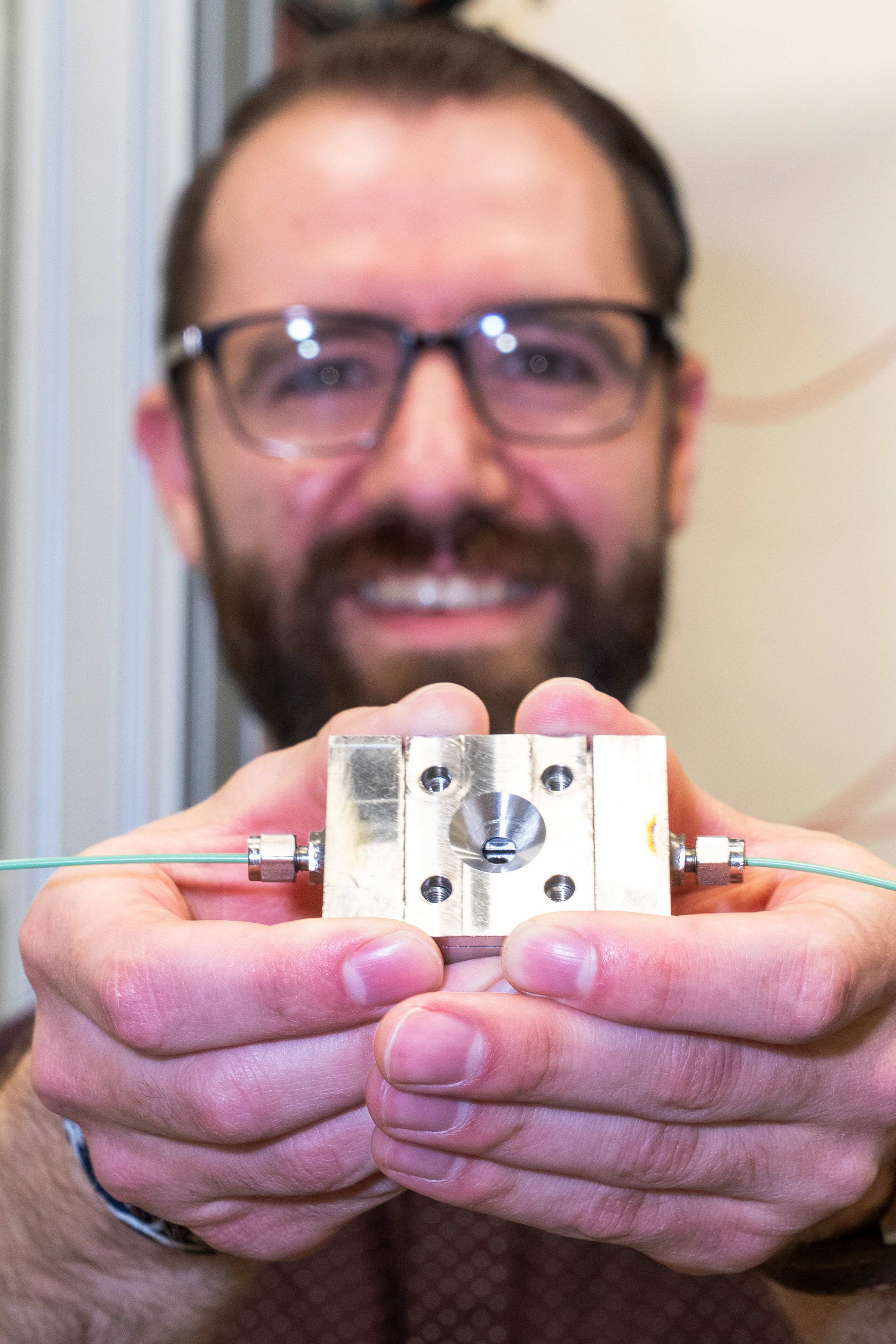
Steven Farrell holds a reaction chamber designed to bring the "triphasic" reactants together by flowing liquid hydrogen peroxide solution infused under pressure with methane gas over the solid molybdenum disulfide catalyst. X-ray transparent windows in the chamber allowed scientists to use X-rays to monitor the reaction in real time at the National Synchrotron Light Source II. (David Rahner/Brookhaven National Laboratory)
The team used X-ray spectroscopy to monitor the atomic-level action inside pressurized reaction vessels built recently at two NSLS-II beamlines — the Inner Shell Spectroscopy (ISS) beamline, where Farrell works, and the Tender Energy Spectroscopy (TES) beamline. This technique and the two different beamlines allowed them to track the arrangement and electronic properties of both the molybdenum and sulfur atoms in the three-phase reaction environment in real time.
“The X-rays at each beamline are tuned to a specific energy needed to track each of these elements,” said Farrell, who spearheaded the synchrotron studies. NSLS-II co-authors Akhil Tayal, Jorge Moncada, Eli Stavitski, A.M. Milinda Abeykoon, and Dominik Wierzbicki also contributed to these studies. “We’re looking at very, very small atomic ranges — just a couple of neighboring atoms,” Farrell said.
Such changes would be undetectable by methods that only look at the catalyst before and after the reaction.
The spectroscopy studies revealed that, as the reaction progresses, “the molybdenum disulfide catalyst becomes more metallic; its electrons become more mobile and they want to interact more,” Farrell said.
In addition, the team used NSLS-II’s Pair Distribution Function (PDF) beamline to examine the catalyst’s long-range structure — “the whole neighborhood,” Farrell said.
“For catalysts, we don’t want them to break down or change over time,” Farrell said. “It’s good to see that, even when we run this catalyst, the ‘neighborhood’ looks the same before and after. We’re not demolishing houses or moving things around. That means the catalyst is robust, sturdy, and reusable.”
Radical activation
A key discovery was the important role played by the hydrogen peroxide (H2O2).
“Originally, we just thought the peroxide was acting as an oxidant, providing the oxygen to convert methane into methyl peroxide,” Jiménez said. “But using some elaborate techniques such as electron paramagnetic resonance performed at Ames National Laboratory, we discovered that hydroxyl radicals, reactive -OH groups produced when peroxide naturally breaks down, are a key intermediate that drives the chemistry.”
The hydroxyl radicals have free electrons that make them highly reactive, attacking everything indiscriminately, Jiménez explained. But, as it turns out, the MoS2 catalyst is a powerful antioxidant. It generates and scavenges the OH radicals and makes them react with the nearest molecule, which in this reaction is methane (CH4). In addition to supplying oxygen, the radicals provide the reactive electrons that help activate the methane and pry apart the strong carbon–hydrogen bonds.
“This work shows that if you design the catalyst just right, you get a selective system; you can control the reactive nature of the radicals and direct it,” Jiménez said. “Instead of having it attack everything, you direct it to just make a singular product.”
 enlarge
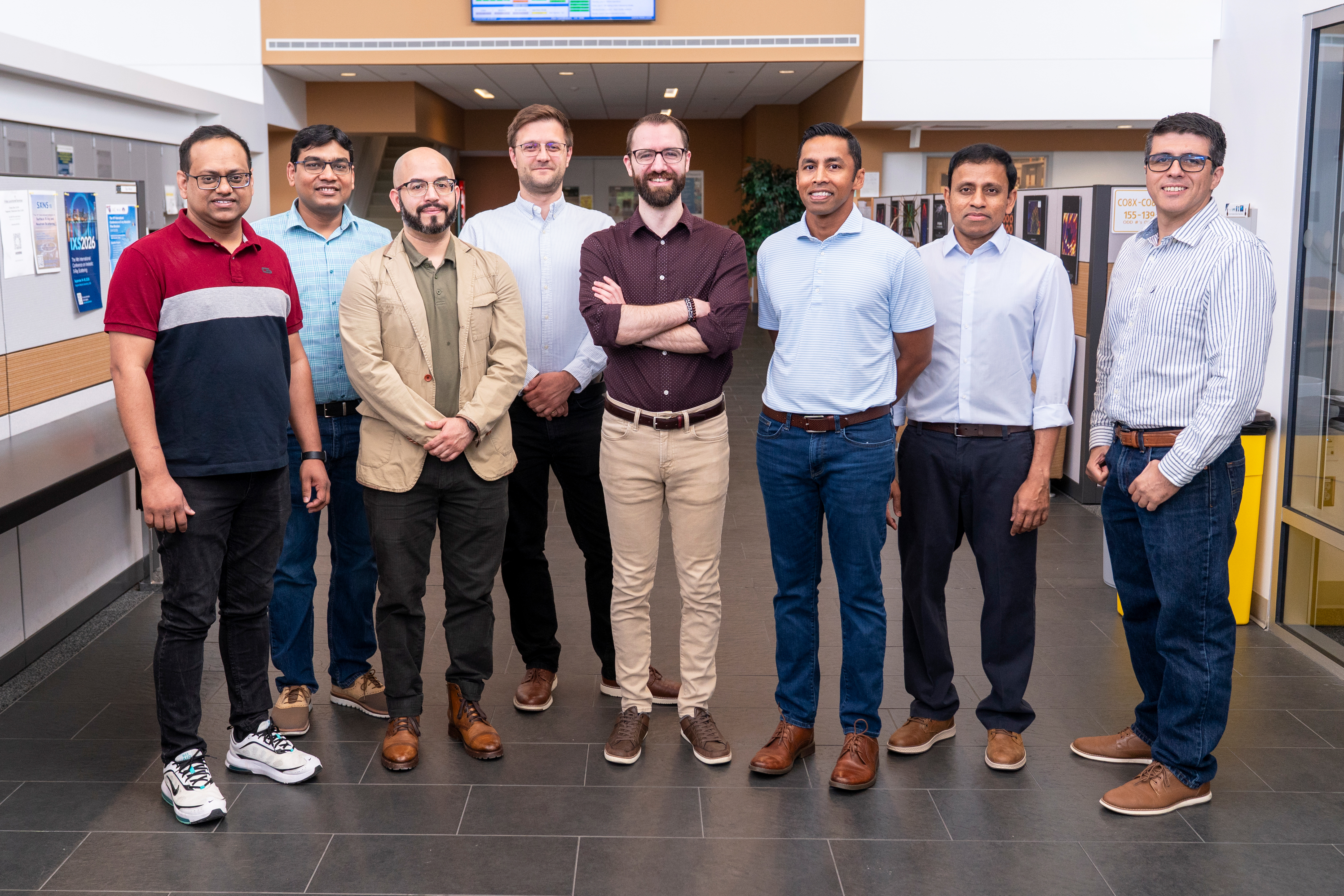
Members of the research team at the National Synchrotron Light Source II (NSLS-II). Pictured left to right are Arephin Islam (Chemistry Division), Akhil Tayal (NSLS-II), Juan Jimenez (Chemistry), Dominik Wierzbicki (NSLS-II), Steven Farrell (NSLS-II), Sanjaya Senanayake (Chemistry), Milinda Abeykoon (NSLS-II), and Jorge Moncada (NSLS-II). (David Rahner/Brookhaven National Laboratory)
A multidisciplinary collaboration
This project leveraged expertise and capabilities at multiple institutions in the U.S. and in Europe.
Researchers from Brookhaven National Laboratory led the catalysis studies and advanced synchrotron characterization. Scientists from DOE’s Ames National Laboratory and Iowa State University carried out in situ magnetic resonance measurements that identified the critical radical species involved in the reaction. Researchers at DOE’s Oak Ridge National Laboratory performed Raman spectroscopy studies that helped verify the catalyst’s structural stability. Investigators from the Universitat Politècnica de Catalunya and the University of Barcelona contributed advanced microscopy and theoretical modeling that explained how the catalyst changes under reaction conditions. Additional contributions came from the University of California, Berkeley and New York University.
The researchers say the findings establish a foundation for designing new methane-conversion catalysts that combine low cost, sulfur tolerance, and high activity. A provisional patent application covering the use of this catalyst for converting methane to oxygenates has been filed by Brookhaven Science Associates, the company that manages Brookhaven Lab on behalf of DOE.
“Our goal is to understand the fundamental chemistry well enough to create practical solutions,” Senanayake said. “This study shows that earth-abundant materials can compete with precious metals when we understand how to harness their dynamic behavior during a reaction.”
The research was supported by the DOE Office of Science, a Goldhaber Distinguished Fellowship at Brookhaven Lab, and additional funding sources listed in the scientific paper.
Brookhaven National Laboratory is supported by the Office of Science of the U.S. Department of Energy. The Office of Science is the single largest supporter of basic research in the physical sciences in the United States and is working to address some of the most pressing challenges of our time. For more information, visit science.energy.gov.
Follow @BrookhavenLab on social media. Find us on Instagram, LinkedIn, X, and Facebook.
2026-23014 | INT/EXT | Newsroom