Development of DNA as an Electronic Memory Storage Device
June 17, 2026
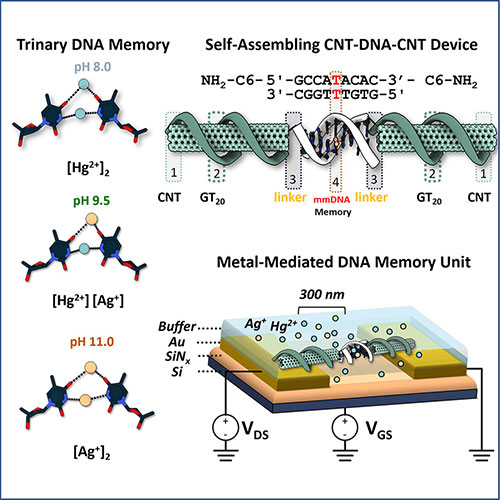
Illustration of the pH-mediated metal switching on the nanofabricated platform. The metal ion exchange defines the memory mechanism, which was shown to be writable, readable, and erasable.
The Science
Researchers showed how DNA molecules can switch between different memory states by using time-resolved X-ray crystallography to directly observe metal ions moving within a DNA structure.
The Impact
This work shows that DNA can function as an electronically controlled memory device, with X-ray studies providing clear evidence of the atomic-scale changes that make the memory rewriting process possible.
Summary
As silicon-based memory nears its physical limits, DNA offers immense storage density but has lacked electronic integration. This work presents a fully electronic memory device from a single DNA molecule. Instead of using the genetic sequence, information is stored by electrically swapping individual metal ions at the DNA’s core, switching the molecule between distinct, readable states. This direct electrical control of a molecule’s atomic structure creates a rewritable memory, paving the way for molecular-scale systems compatible with modern electronics.
In this work, in situ X-ray diffraction experiments at NSLS-II Beamlines FMX, AMX and NYX and APS Beamline 17-ID were performed on DNA crystals containing the memory-device sequence. Structures were determined along a complete pH cycle (8.0 → 9.5 → 11.0 → 9.5 → 8.0), enabling direct observation of the structural transitions associated with metal-ion exchange. Time-resolved crystallography revealed that increasing pH from 8.0 to 9.5 gradually displaced the O4-coordinated Hg²? ion, generating a mixed-metal intermediate state, while further increasing pH to 11.0 rapidly converted the base pair to the fully Ag?-coordinated configuration. Reverse pH changes restored the original structures, demonstrating reversible reconfiguration. Sensitive diffraction data using Hg anomalous scattering enabled identification and refinement of Hg²? and Ag? occupancies within the DNA base pair, providing direct atomic-scale evidence for the transmetalation process responsible for the distinct memory states.
The crystallographic studies established a direct structure–function relationship between metal-ion occupancy and electrical conductance states, confirming that reversible metal exchange can be used as a reliable molecular switching mechanism for electronically addressable, multi-state DNA memory. This device further represents the first field-effect transistor made directly from DNA.
Download the research summary slide (PDF)
Related Links
- Paper: Electrical control of a metal-mediated DNA memory
- Hot Takes: Chemistry Researcher Simon Vecchioni on Making a Transistor Out of DNA
Contact
M.P. Anantram
University of Washington
anant@uw.edu
Joshua Hihath
Arizona State University
jhihath@asu.edu
Simon Vecchioni
New York University
sv1091@nyu.edu
Publications
B. Liu, B. Lu, A. De, K. Kim, L. Perren, K. Woloszyn, G. Petrova, R. Li, C.-f. Yang, C. Mao, A. S. Botana, Y. P. Ohayon, J. W. Canary, R. Sha, M. P. Anantram, S. Vecchioni, and J. Hihath, “Electrical control of a metal-mediated DNA memory,” Matter 9(1), 102470 (2026). https://doi.org/10.1016/j.matt.2025.102470
Funding
The authors acknowledge support from the National Science Foundation Growing Convergence Research (NSF-2317843), Future Manufacturing (NSF-2328217), Chemical Measurement and Imaging (NSF-2239226), and the Keck Foundation. This work was further supported by the Office of Naval Research (N000141912596) and the Office of Basic Energy Sciences in the Department of Energy (DE-SC0007991). This research used Beamlines 17-ID-1 (AMX) and 17-ID-2 (FMX) and 19-ID (NYX) of the National Synchrotron Light Source II, a U.S. Department of Energy (DOE) Office of Science User Facility operated for the DOE Office of Science by Brookhaven National Laboratory under Contract No. DE-SC0012704. The Center for BioMolecular Structure (CBMS) is primarily supported by the National Institutes of Health, National Institute of General Medical Sciences (NIGMS) through a Center Core P30 Grant (P30GM133893), and by the DOE Office of Biological and Environmental Research (KP1605010).
2026-23037 | INT/EXT | Newsroom