


Identifying and Mitigating Vortex Loss in Tantalum Devices
Researchers identified a performance-limiting mechanism in superconducting quantum devices and demonstrated optimization strategies
April 6, 2026
 enlarge
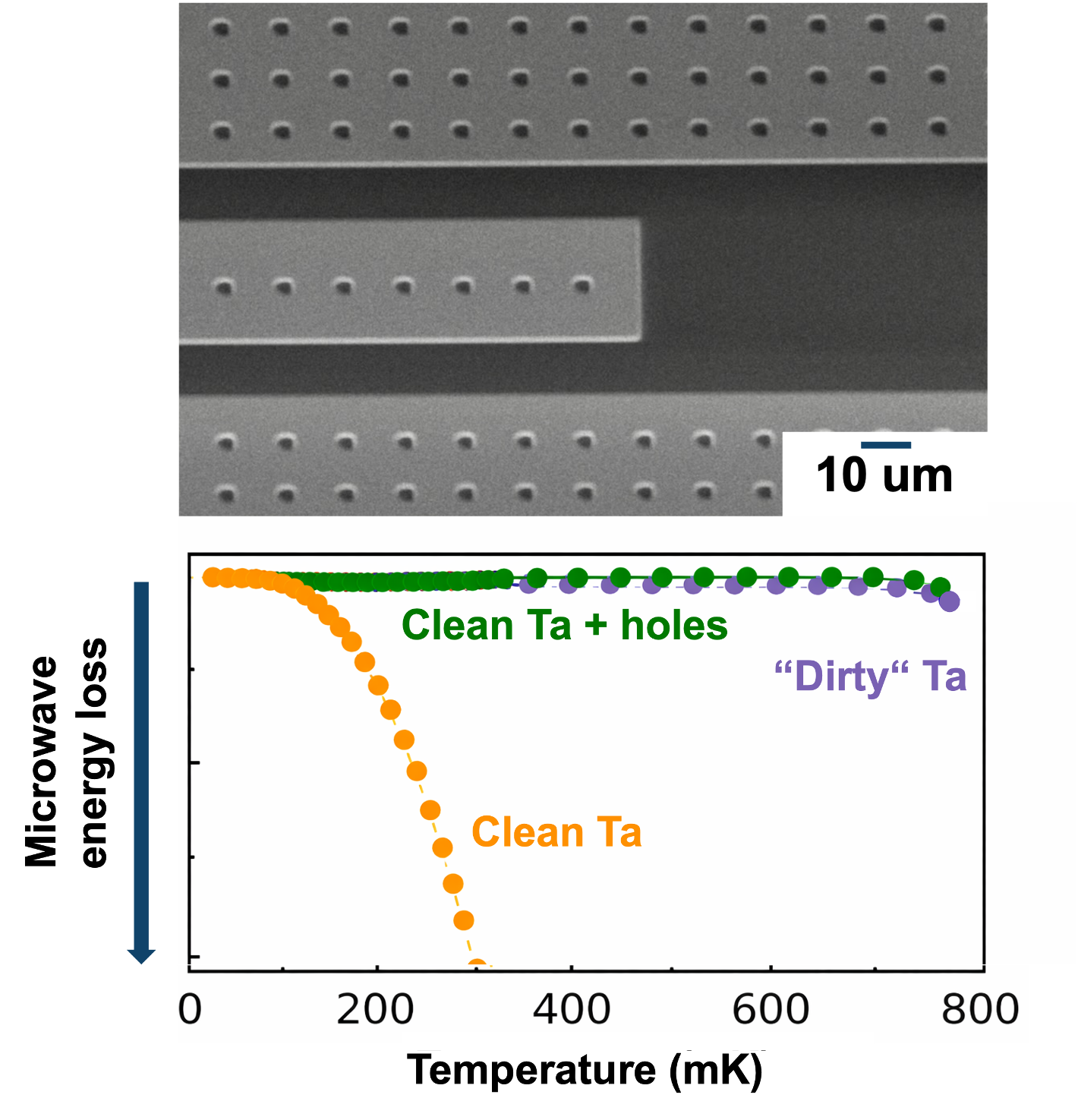
Perforating clean-limit Ta films with microfabricated holes suppresses vortex motion-induced microwave loss.
Scientific Achievement
C2QA researchers identified vortex motion as a source of thermally activated microwave loss in tantalum superconducting resonators. They showed that subtle structural variations associated with growth conditions can modify vortex pinning, and that pinning can be deliberately introduced via microfabrication.
Significance and Impact
Tantalum has enabled millisecond-scale qubit coherence, highlighting the importance of identifying material mechanisms that limit device performance. This study demonstrates the power of correlating microwave responses with detailed material characterization, to identify microscopic sources of loss and inform strategies for performance.
Research Details
- Combined microwave measurements with detailed investigation of structural and transport properties
- Measured vortex depinning current and flux-flow behavior in superconducting clean- and dirty-limit films
Collaborating Institutions
- Princeton University
- Brookhaven National Laboratory
Publication
Faranak Bahrami, Matthew P. Bland, Nana Shumiya, Ray D. Chang, Elizabeth Hedrick, Russell A. McLellan, Kevin D. Crowley, Aveek Dutta, Logan Bishop-Van Horn, Yusuke Iguchi, Aswin Kumar Anbalagan, Guangming Cheng, Chen Yang, Nan Yao, Andrew L. Walter, Andi M. Barbour, Sarang Gopalakrishnan, Robert J. Cava, Andrew A. Houck, and Nathalie P. de Leon
Vortex motion induced losses in tantalum resonators
PHYSICAL REVIEW B 113, 054505 (2026), Editors’ Suggestion
DOI: https://doi.org/10.1103/4ny9-9n5b
Acknowledgements
We thank K. A. Moler, L. Glazman, and M. Devoret for fruitful discussions. This work was primarily supported by the U.S. Department of Energy, Office of Science, National Quantum Information Science Research Centers, Co-design Center for Quantum Advantage (C2QA) under Contract No. DESC0012704. The authors acknowledge the use of Princeton’s Imaging and Analysis Center (IAC), which is partially supported by the Princeton Center for Complex Materials (PCCM), a National Science Foundation (NSF) Materials Research Science and Engineering Center (MRSEC; DMR2011750), as well as the Princeton Micro/Nano Fabrication Laboratory. Use of the NSLS-II (NIST beamline 6-BM) was supported by the DOE Office of Science User Facility operated for the DOE Office of Science by Brookhaven National Laboratory under Contract No. DE-SC0012704. The scanning SQUID measurements were supported by the DOE “Quantum Sensing and Quantum Materials” Energy Frontier Research Center under Grant No. DE-SC0021238.
Princeton University Professor Andrew Houck is also a consultant for Quantum Circuits Incorporated (QCI). Due to his income from QCI, Princeton University has a management plan in place to mitigate a potential conflict of interest that could affect the design, conduct and reporting of this research.
Nathalie de Leon, Princeton University professor, is a visiting faculty researcher with Google Quantum AI. As a result of her income from Google, Princeton University has a management plan in place to mitigate a potential conflict of interest that could affect the design, conduct and reporting of this research. Her academic group also has a sponsored research contract with Google Quantum AI.
2026-22889 | INT/EXT | Newsroom