Physicist Mary Bishai Named AAAS Fellow
Recognition honors distinguished contributions to neutrino physics
March 26, 2026
 enlarge
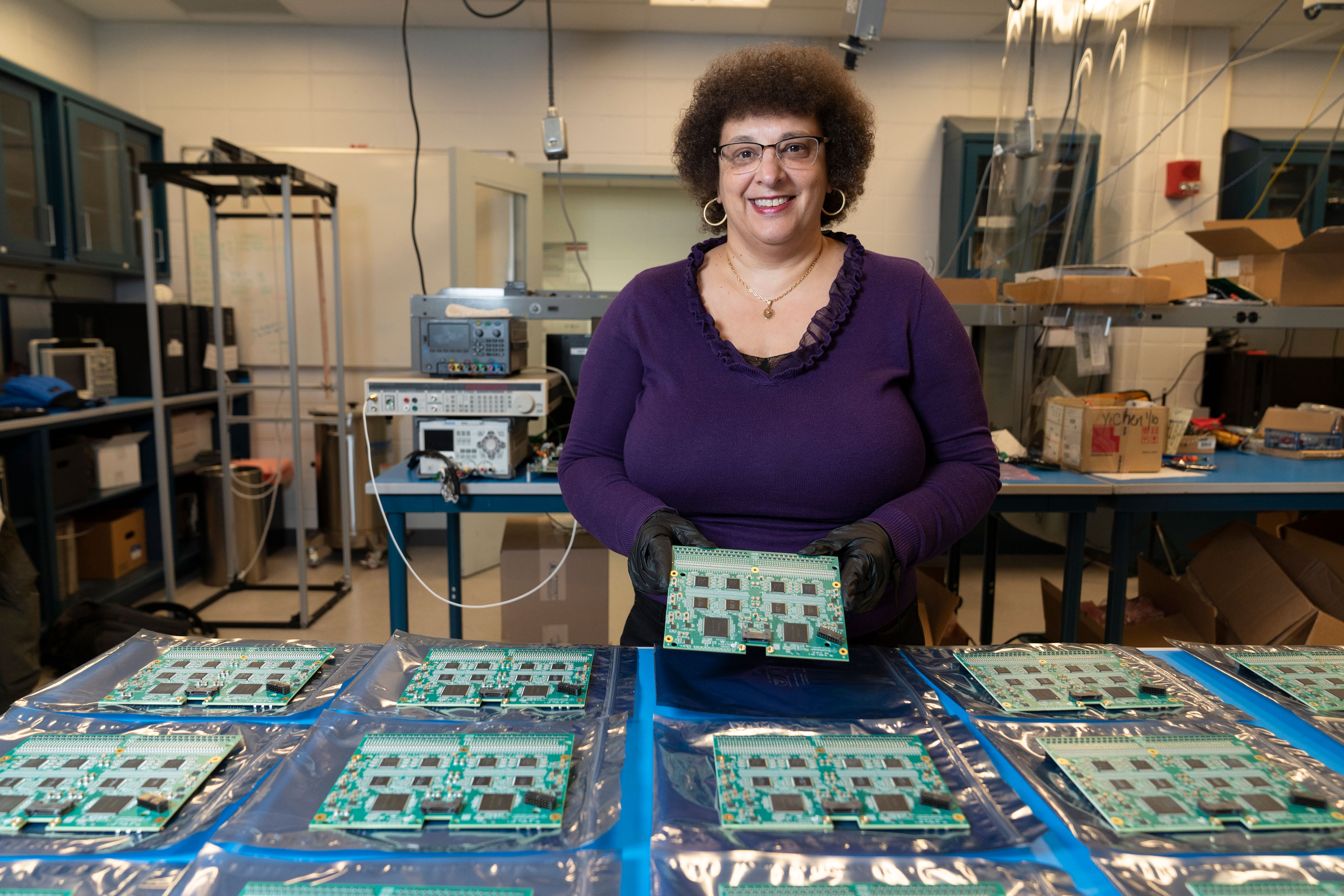
Mary Bishai, a distinguished scientist at Brookhaven National Laboratory, has been named a Fellow of the American Association for the Advancement of Science in recognition of her contributions to neutrino physics. She is displaying microelectronics developed at Brookhaven Lab for the Deep Underground Neutrino Experiment. (Jessica Rotkiewicz/Brookhaven National Laboratory)
UPTON, N.Y. — The American Association for the Advancement of Science (AAAS) has recognized Mary Raafat Mikhail Bishai, a physicist at the U.S. Department of Energy’s (DOE) Brookhaven National Laboratory, as a 2025 AAAS Fellow. Each year, AAAS bestows this honor on select members whose “efforts on behalf of the advancement of science, or its applications, are scientifically or socially distinguished.” Each member of the 2025 class of AAAS Fellows will be acknowledged with a certificate and a rosette and invited to participate in a scientific forum to be held later this spring.
Bishai is being honored for her contributions to studies of neutrinos, subatomic particles that may hold clues to some of the biggest mysteries in modern physics. Specifically, the AAAS citation notes her “exceptional leadership of the U.S. accelerator neutrino program and world-leading contributions to the physics of accelerator neutrino beams and neutrino oscillations.”
“It is a great honor to receive this recognition,” Bishai said. “The wonder and excitement of the science of particle physics inspired me as a young person to pursue a career in science, and I hope to pass that on and use my work to further inspire more young people to pursue careers in science and engineering.”
Bishai’s work throughout her career has focused broadly on the physics of flavor — identifying and tracking different types, or flavors, within a family of particles such as quarks or neutrinos.
She started with an interest in so-called third-generation quarks with the whimsical name of “beauty.” Unlike the quarks that make up the protons and neutrons of ordinary stable nuclear matter, beauty quarks are unusually heavy. They are produced only fleetingly in high energy collisions of protons at accelerator facilities such as the former Tevatron at DOE’s Fermi National Accelerator Laboratory (Fermilab), where Bishai began her research career. Bishai’s work to understand the production rate of beauty quarks has earned more than 1,000 citations.
During those studies, Bishai became fascinated with neutrinos, another family of subatomic particles that are tiny cousins of electrons. Like quarks, neutrinos come in different flavors, but these quirky particles uniquely have the ability to change identities among three types. Tracking the shape-shifting behavior of these elusive ghostlike particles has become Bishai’s life’s work since joining Brookhaven Lab in 2004.
As a member of the Brookhaven Lab accelerator neutrino group, Bishai joined an experiment at Fermilab called the “Neutrinos at the Main Injector/Main Injector Neutrino Oscillation Search,” which used an accelerator to create an intense beam of neutrinos tracked by two detectors, one nearby about half a mile away and another located nearly 460 miles away in Minnesota. Bishai helped to commission the neutrino beamline and precisely characterize its data. Her studies of these and other accelerator-produced neutrino beams helped reveal how beamline components — including magnetic focusing elements, targets, and their geometric arrangements and materials — can affect neutrino beam quality.
Bishai later contributed to plans for another long-baseline neutrino experiment jointly sponsored by Fermilab and Brookhaven that was designed to track the shapeshifting of accelerator-produced neutrinos over even longer distances. The goal of studying these so-called oscillations is to look for clues to big mysteries in physics, including how these particles might relate to the predominance of matter over antimatter in the universe. In 2023, Bishai was elected as co-spokesperson for the Deep Underground Neutrino Experiment (DUNE), an international collaboration of over 1,500 scientists that will carry out this research. DUNE will utilize what is known as the Long Baseline Neutrino Facility, located at both Fermilab and the Sanford Underground Research Facility, 800 miles away in South Dakota. She continues to play an active role in the collaboration where her work is critical to advancing the field of neutrino physics towards a comprehensive understanding of neutrino oscillations and their relevance to understanding fundamental laws of physics.
Throughout her career, Bishai has also planted the seeds of inspiration for the next generation of neutrino hunters by mentoring high school and undergraduate students in the U.S. and serving as a role model and instructor for students around the world. She’s also served on several leading committees of the U.S. particle physics community, including the High Energy Physics Advisory Panel that advises DOE and the National Science Foundation on future directions for the field and the American Physical Society’s Division of Particle and Fields Executive Committee.
Bishai earned her Bachelor of Arts in physics at the University of Colorado, Boulder in 1991. She received her Master of Science and Ph.D., both in physics, from Purdue University in 1993 and 1999, respectively. She was a research associate at DOE’s Fermilab in 1998 until she joined Brookhaven as an assistant physicist in 2004. She rose through the ranks and is currently classified as a distinguished scientist. She served as DUNE Collaboration co-spokesperson from 2023 to 2025 and has been a scientific collaborator on many other leading experiments in the field of experimental particle physics including MicroBooNE, the Daya Bay Reactor Neutrino Experiment, the Main Injector Neutrino Oscillation Search, Collider Detector at Fermilab experimental collaboration, and the CLEO experiment. She was elected a fellow of the American Physical Society in 2015, and she was named a DOE Distinguished Scientist Fellow in 2024.
Brookhaven National Laboratory is supported by the Office of Science of the U.S. Department of Energy. The Office of Science is the single largest supporter of basic research in the physical sciences in the United States and is working to address some of the most pressing challenges of our time. For more information, visit science.energy.gov.
Follow @BrookhavenLab on social media. Find us on Instagram, LinkedIn, X, and Facebook.
2026-22740 | INT/EXT | Newsroom