Advancing the future of neutrino research: Argonne hosts DUNE Software and Computing Week
Global experts convened at Argonne to advance software and computing for the Deep Underground Neutrino Experiment
March 24, 2026
 enlarge
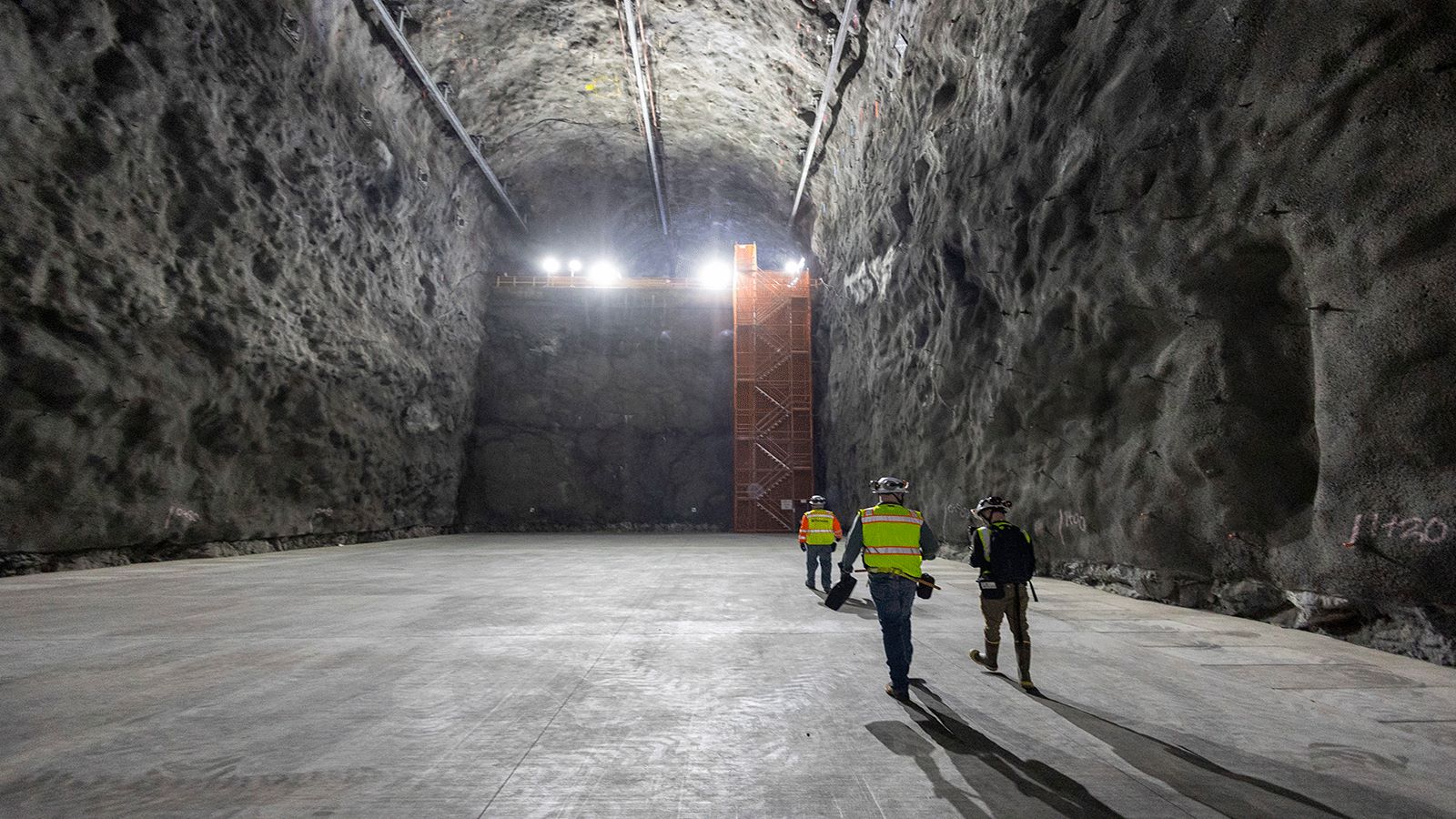
One of the enormous caverns located a mile underground at the Sanford Underground Research Laboratory in South Dakota, which will house the far detector modules to be used in the Deep Underground Neutrino Experiment (DUNE). (Image by Destyn Humann/Fermi National Accelerator Laboratory.)
Editor’s note: The following feature story was originally published by the U.S. Department of Energy’s (DOE) Argonne National Laboratory. To learn more about the role that DOE’s Brookhaven National Laboratory plays in the Deep Underground Neutrino Experiment (DUNE), visit the Lab’s DUNE website or contact Stephanie Rucco (srucco@bnl.gov, 631-344-8671).
With the data collection slated to begin in about three years, a recent meeting of particle physicists, software developers and computational scientists involved in the Deep Underground Neutrino Experiment (DUNE) collaboration was another important opportunity to review progress, discuss ongoing work and plan future projects. Dune Core Software and Computing Week 2025 at the U.S. Department of Energy’s (DOE) Argonne National Laboratory brought together 50 scientists from among more than 200 institutions worldwide who are studying neutrinos — tiny particles that are difficult to detect and understand.
Experts invigorated their collaboration-wide coordination while focusing on developments such as the new DUNE-specific Phlex software framework. Institutions represented included DOE’s Fermi National Accelerator Laboratory (Fermilab), Brookhaven National Laboratory and Lawrence Berkeley National Laboratory. Andrew Olivier, Barnali Chowdhury, Peter van Gemmeren, Esteban “Steve” Rangel and Xiaoyong Jin were on hand to represent the Argonne scientists who contribute to the physics of DUNE and tackle its software and computing challenges.
Advancing neutrino science through collaboration
DUNE is one of the most ambitious experiments ever designed to study neutrinos. It aims to answer big questions about the universe, such as why there is more matter than antimatter. The experiment, expected to start collecting data in 2029, will use two detectors: one near the neutrino beam source at Fermilab in Batavia, Illinois — the host lab for DUNE — and another, larger detector supported by Fermilab’s Long-Baseline Neutrino Facility and located a mile underground at the Sanford Underground Research Laboratory in Lead, South Dakota. These detectors will help scientists search for new subatomic phenomena and better understand neutrinos.
DUNE relies on advanced software and computing tools to process the large amounts of data its detectors will produce. Argonne’s expertise in high energy physics and computing made it an ideal host for this event.
“With deep expertise in high energy physics and some of the most powerful facilities and tools, Argonne is uniquely positioned to support DUNE’s mission,” said Peter van Gemmeren, a principal computational scientist at Argonne and event organizer.
Highlights of the week
DUNE Core Software and Computing Consortium leader Michael Kirby of Brookhaven kicked off the week with a status session that included a reminder of the experiment’s timeline: DUNE is expected to start collecting data without a neutrino beam in 2029 and with a beam in 2031.
“The DUNE Core Software and Computing Consortium is tackling some of the most complex challenges in modern physics. By bringing together experts from around the world, we are not only advancing the tools and technologies needed for DUNE but also fostering collaboration that will drive innovation and discovery for years to come,” Kirby said.
In multiple sessions, attendees worked through critical issues like data management, workflow integration and software development. Kyle Knoepfel from Fermilab presented Phlex, a new software framework that will improve data processing for DUNE. The experiment will handle much larger individual data records compared with current collider experiments — such as processing data-rich movie files that consist of gigabytes of data instead of megabyte-resolution photographs. This will require an innovative processing framework tailored to DUNE’s unique data structure.
Argonne scientists Chowdhury and van Gemmeren shared updates on FORM, the data input/output and storage infrastructure that Argonne is developing to support the Phlex processing framework. Amit Bashyal from Brookhaven and Meghna Bhattacharya from Fermilab discussed integrating compute accelerators, an area where Argonne computational scientists will contribute their expertise.
Another important discussion, led by Steven Timm from Fermilab and Andrew McNab from the University of Manchester in the United Kingdom, focused on managing computing resources, including quotas and priorities.
Participants topped off their week with a consortium board meeting and a presentation by Norman Buchanan, Ana Paula Vizcaya Hernandez and Mike Clymer from Colorado State University on ProtoDUNE, a 770-ton prototype of DUNE being operated at CERN (the European Center for Nuclear Research) to validate DUNE technologies. ProtoDUNE is being used to study interactions of certain particles such as pions and protons, subatomic particles that scientists use to test and calibrate detectors. By studying how these particles behave in liquid argon, researchers can better understand how the detector will respond when it eventually captures neutrino interactions.
Participants also got a look at the Aurora supercomputer, which will play a key role in processing DUNE’s data. Aurora is housed at the Argonne Leadership Computing Facility (ALCF), a DOE Office of Science user facility.
Building connections and future pathways
The event provided opportunities for professional development and networking. Early-career scientists also had the chance to present their work and connect with leaders in the field.
“Workshops like this break silos and promote active exchange and networking between different collaborations and areas of research,” van Gemmeren said.
The DOE Office of High Energy Physics supports the DUNE collaboration.
The Argonne Leadership Computing Facility provides supercomputing capabilities to the scientific and engineering community to advance fundamental discovery and understanding in a broad range of disciplines. Supported by the U.S. Department of Energy’s (DOE’s) Office of Science, Advanced Scientific Computing Research (ASCR) program, the ALCF is one of two DOE Leadership Computing Facilities in the nation dedicated to open science.
Argonne National Laboratory seeks solutions to pressing national problems in science and technology by conducting leading-edge basic and applied research in virtually every scientific discipline. Argonne is managed by UChicago Argonne, LLC for the U.S. Department of Energy’s Office of Science.
The U.S. Department of Energy’s Office of Science is the single largest supporter of basic research in the physical sciences in the United States and is working to address some of the most pressing challenges of our time. For more information, visit www.energy.gov/science.
2026-22867 | INT/EXT | Newsroom