Ward Melville, Bay Shore Students Earn Top Spots at Brookhaven Lab Bridge Competition
Top two students qualify for International Bridge Contest
April 15, 2026
 enlarge
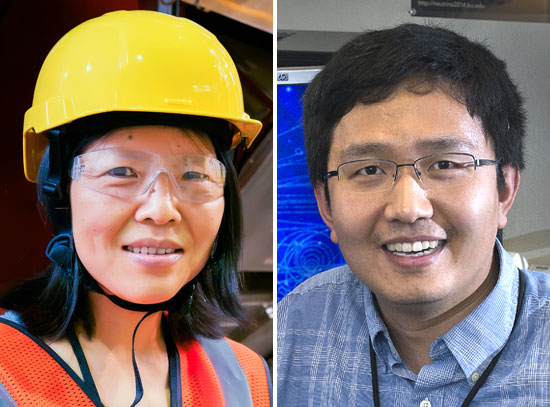
Amanda Liang, left, and William Emigholz won first and second place in at Brookhaven Lab's Bridge Building Competition, earning them each the chance to submit a bridge in the upcoming International Bridge Contest. (Courtesy image, Timothy Kuhn/Brookhaven National Laboratory)
UPTON, N.Y. – Amanda Liang, a junior from Ward Melville High School, and William Emigholz, a sophomore from Bay Shore High School, crafted the most efficient bridges that judges put to ultimate pressure test at the Bridge Building Competition hosted by the U.S. Department of Energy’s Brookhaven National Laboratory on March 27.
The annual competition challenges students from high schools across Long Island to step into the shoes of engineers as they design and build small bridges out of lightweight basswood with physics principles in mind. Liang’s first-place win and Emigholz’s second-place win earn them spots in the International Bridge Contest to take place in Chicago on April 25. Students from around the country will mail in their bridges for testing this year.
“The specifications that our young engineers needed to follow this year were quite difficult, but many students made amazing bridges with some of the best scores I have seen in the many years I have been a part of the Bridge Contest,” said competition coordinator Michele Darienzo.
 enlarge
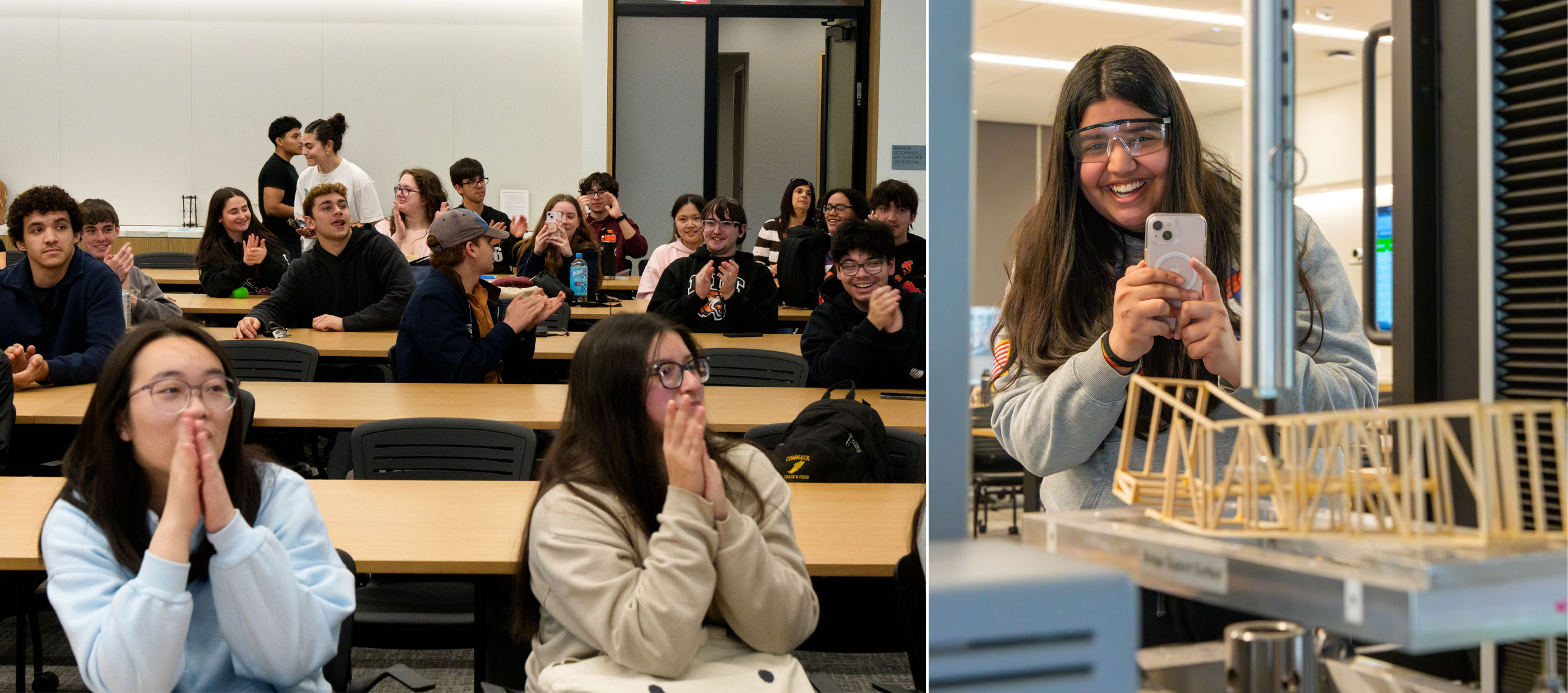
Students watched with anticipation as the competition's testing machine crushed bridges. (Timothy Kuhn/Brookhaven National Laboratory)
Competitors must craft bridges that meet a set of specifications that consider weight, span, and more. Out of 254 bridges submitted prior to Brookhaven’s competition day, 112 qualified for testing. Judges place each bridge under a machine that slowly applies more and more pressure to a structure until it meets its breaking point. Every year, the testing room fills with excitement as bridges either hold up for a while under pressure or snap and crack under the machine.
 enlarge
Third place winner Chloe Lin of Patchogue-Medford High School. (Timothy Kuhn/Brookhaven National Laboratory)
The structures are ranked based on efficiency scores that are calculated from the load the bridge supports divided by the mass of the bridge — all in grams. Bridges could not have a mass greater than 25 grams.
Liang’s design earned first place with an efficiency score of 2839.72. Liang, who earned the top spot in the competition in 2024, said she looked to past competitions for inspiration then simulated her bridge using design software for engineers.
“I am excited about this area of science because it allows me to apply my knowledge of physics to a real-world application,” Liang wrote in an email following the contest. “Furthermore, it’s fun to build a miniature version of the real bridges we see in everyday life.”
 enlarge
Giovanni Ottenwalder, a freshman from John Glenn High school, received the competition's aesthetic award. (Timothy Kuhn/Brookhaven National Laboratory)
It was surprising, she wrote, that such a seemingly delicate structure could hold thousands of times its own weight.
Second place winner Emigholz, who said he’s interested in engineering and aerospace, took a different approach to craft a bridge that earned an efficiency score of 2092.07. He used a Warren truss design that uses triangles in its framework to spread out the load of the bridge.
“I’m very excited to go to the next level, and I’m still very shocked that I did this well,” Emigholz said of qualifying for the International Bridge Contest.
Chloe Lin, a senior from Patchogue-Medford High School, took the third-place spot with a structure that achieved an efficiency score of 1793.32.
The competition also awarded unique bridge designs. Giovanni Ottenwalder, a freshman from John Glenn High school, took home the aesthetic award. Judges noted the bridge’s curved design and careful attention to the symmetric detail on its triangular patterns.
Brookhaven National Laboratory is supported by the Office of Science of the U.S. Department of Energy. The Office of Science is the single largest supporter of basic research in the physical sciences in the United States and is working to address some of the most pressing challenges of our time. For more information, visit science.energy.gov.
Follow @BrookhavenLab on social media. Find us on Instagram, LinkedIn, X, and Facebook.
2026-22890 | INT/EXT | Newsroom