Bringing Cooling System Designs to Life with Jennifer Maceiko
December 3, 2025
Editor’s note: This story is a part of a series of profiles highlighting the scientists, engineers, and other professionals who are helping to design the Electron-Ion Collider, a next-generation nuclear physics research facility being built at the U.S. Department of Energy’s (DOE) Brookhaven National Laboratory in partnership with DOE’s Thomas Jefferson National Accelerator Facility (Jefferson Lab) and collaborators around the world.
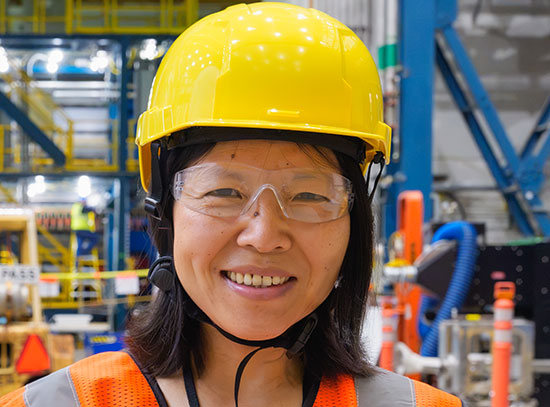
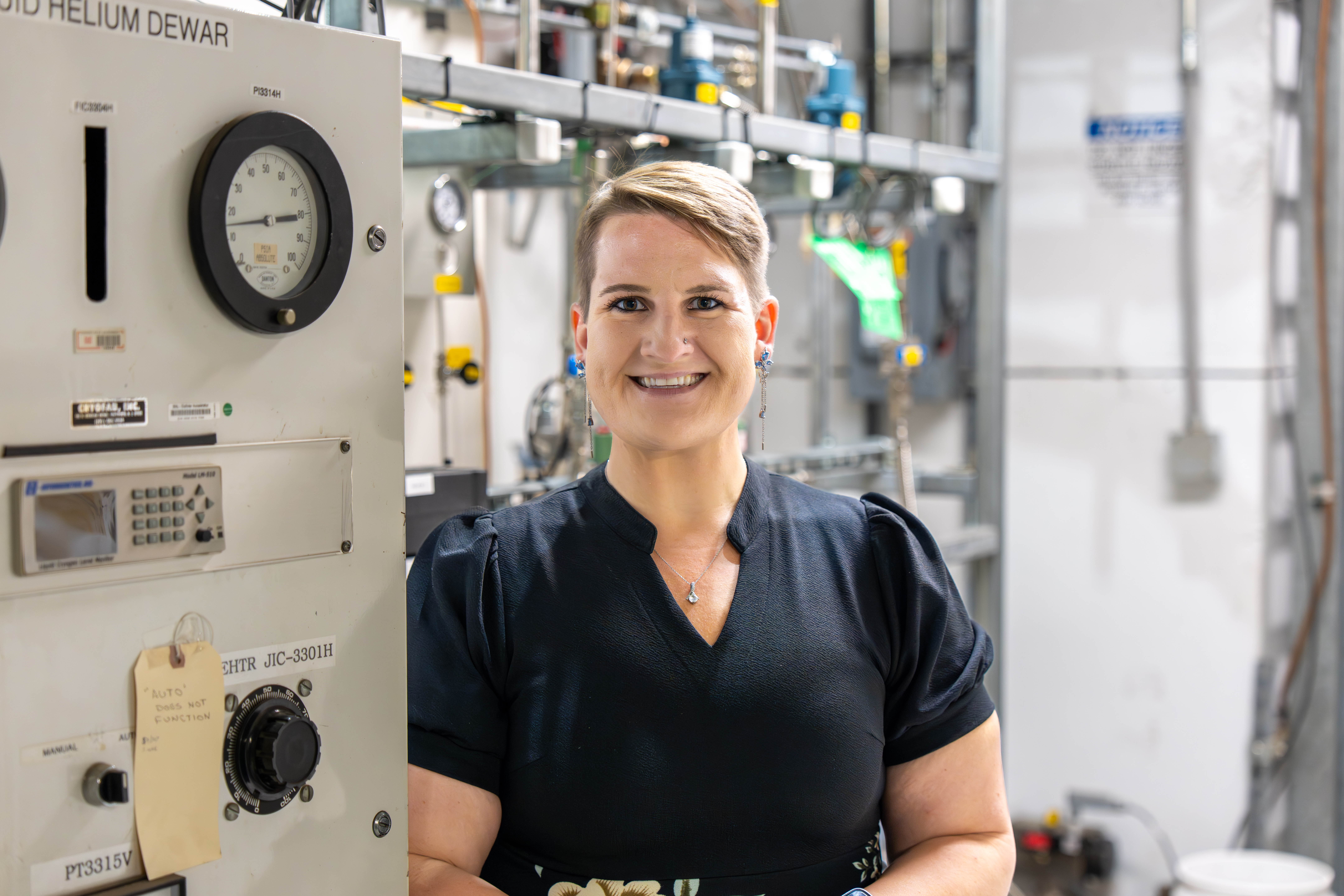
Jennifer Maceiko is a mechanical engineer who works as a senior piping designer in the Design & Documentation group in the Electron-Ion Collider (EIC) Directorate at Brookhaven National Laboratory. Maceiko uses specialized software to create detailed designs of the piping systems that will deliver coolants, such as liquid helium and liquid nitrogen, to key components throughout the EIC accelerator. These coolants, and the “cryogenic” systems of pipes that transport them, are necessary to keep magnets and other accelerator components at the temperatures required for optimal operations. That includes the extremely low temperatures that allow superconducting radiofrequency cavities and magnets to carry the very high currents needed to accelerate and steer particle beams.
What do you do in this role?
I serve as the link between the EIC’s cryogenic engineers and technicians, translating their designs into reality by modeling and laying out piping routes and cryogenic equipment using specialized software. Cryogenics involves producing and using materials at extremely low temperatures, below -238 degrees Fahrenheit, where unique properties like superconductivity emerge. I create 2D and 3D layouts for the Alternating Gradient Synchrotron (AGS) experiment hall and the upcoming EIC. The cryogenic team provides 2D piping and instrumentation diagrams showing new and existing equipment. I translate these into a 2D floor plan to visualize equipment placement and potential piping routes. Once the design is finalized, I develop 3D models and collaborate with technicians on fabrication and installation, producing the final construction drawings.
Why is this important to the EIC?
In recent years, my work has focused on the Superconducting Radio Frequency (SRF) testing facility at AGS, and more recently on the EIC cryogenic piping systems. Since SRF cavities must be tested before installation, a dedicated testing facility is essential. Cryogenics play a critical role in the EIC, as superconducting magnets and radiofrequency cavities must be cooled below -452 degrees Fahrenheit (4.5 Kelvin) to achieve superconductivity.
What is the most exciting part of your job?
Everything about my job excites me. I get to design, model, and problem-solve every day. Having the construction site on campus is a huge advantage, as I can walk to the testing facility to collaborate directly with other engineers and technicians. I never had that kind of access in previous roles, and it’s one of the most rewarding aspects of this job.
What is most challenging?
The biggest challenge I face is resisting the urge to get involved in everything Brookhaven Lab offers. With so many clubs, lectures, volunteer opportunities, and training programs, I’ve had to learn to pace myself and set limits.
Did you always know what you wanted to do? Why did you pick your field of study??
Not at all — I originally wanted to be an FBI agent. That changed in 11th grade when I fell in love with physics and decided to pursue engineering. As an undergrad, I triple-majored in mathematics, physics, and pre-engineering before transferring to Stony Brook University to focus on mechanical engineering with the goal of designing roller coasters. I graduated with my Bachelor of Engineering in mechanical engineering in 2012.
What did you do before joining Brookhaven Lab?
Before joining Brookhaven Lab in 2023, I worked as a heating, ventilation, and air conditioning mechanical designer on major New York City projects, including Moynihan Station, One Vanderbilt and its observation deck, One Madison Avenue, and Columbia Business School. Earlier in my career, while finding my niche, I explored different industries — designing testing equipment for the Air Force and Navy, trade show exhibits, and high-end jewelry stores.
What is some advice you would give to those starting in your field? What do you wish you had known earlier?
Don’t be afraid to move between jobs and industries. Exploring different paths was one of the best decisions I made. It ultimately led me to piping design and to my role here at Brookhaven Lab. Each step added valuable experience I wouldn’t have gained otherwise.
What do you do when you’re not at work? How do you unwind??
Outside of work, I run a small cookie and brownie business in memory of my dad, who always loved my baking. On weekends, I’m busy creating new recipes, packaging, and delivering orders. I also stay active by pitching for the Upton Isotopes — my softball team in the Lab’s softball league — and doing body combat, boxing, hiking, and cycling. Recently, I’ve become a regular moviegoer, and I also enjoy gaming with friends and family. When it’s time to truly unwind, I watch sitcom reruns, build Legos, and relax with my two dachshunds, Noodles and Daisy.
Finally, what excites you about the EIC?
What excites me most about the EIC is being part of something truly groundbreaking — the first of its kind. It’s history in the making. I’m especially excited to watch it come to life, step by step, and to see how the project evolves from the initial design to the final build.
Brookhaven National Laboratory is supported by the Office of Science of the U.S. Department of Energy. The Office of Science is the single largest supporter of basic research in the physical sciences in the United States and is working to address some of the most pressing challenges of our time. For more information, visit science.energy.gov.
Follow @BrookhavenLab on social media. Find us on Instagram, LinkedIn, X, and Facebook.
2025-22619 | INT/EXT | Newsroom