How Molecule Length Shapes Self-Assembling Materials
December 22, 2025
 enlarge
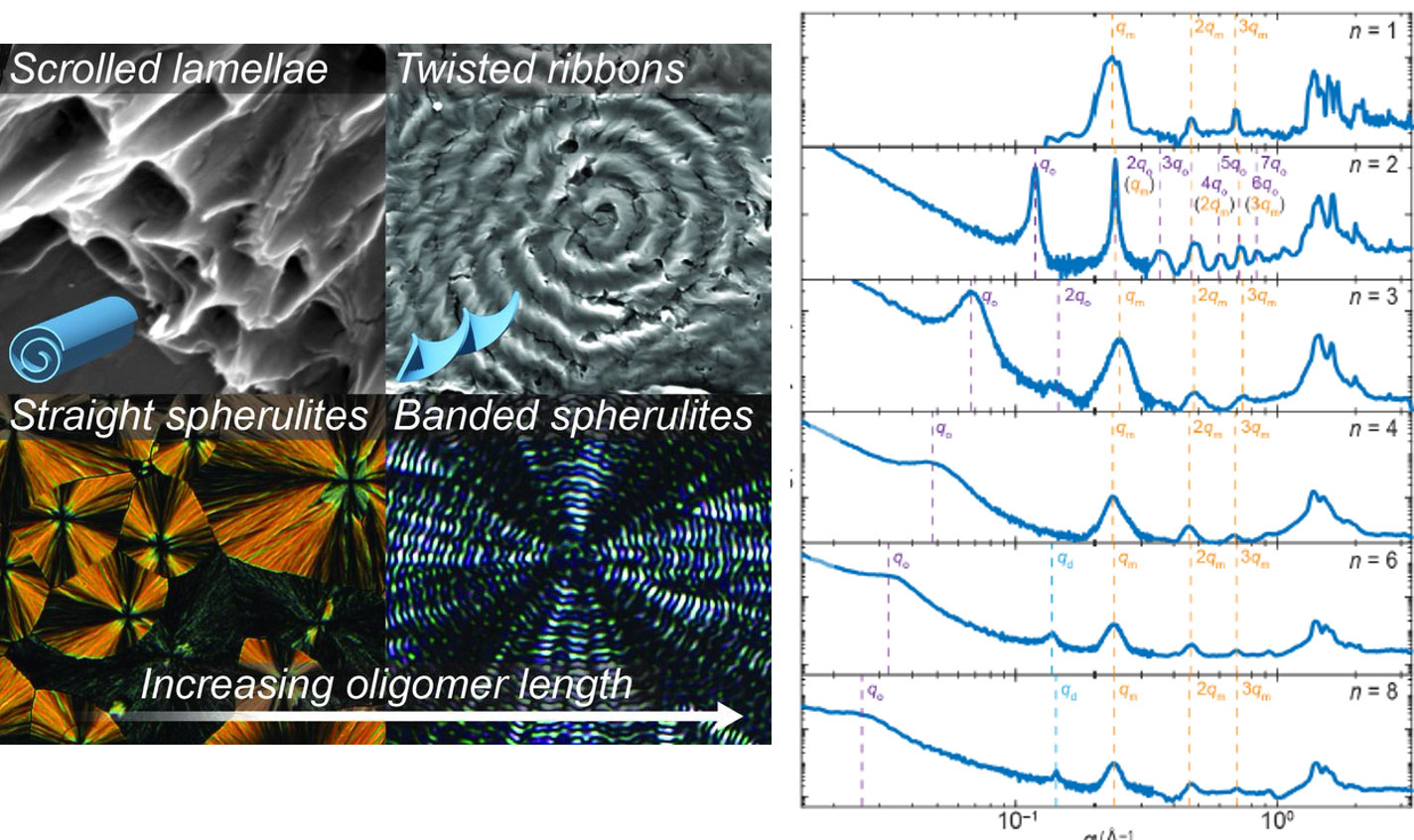
(Left) Polarized optical and scanning electron micrographs showing changes in microstructure and spherulite type driven by increased oligomer length. (Right) X-ray scattering profiles of increasing oligomer length. P1 and P2 display a high degree of crystalline order, indicated by a large number of sharp peaks in the high-q regime. Beyond P2, the peaks broaden with fewer higher-order reflections, indicating that the degree of order decreases with increasing oligomer length.
The Science
The length of mesogenic oligomers, liquid-crystal-like molecules, can tune the curvature of the self-assembled structures without changing their core chemistry.
The Impact
Controlling microstructure through molecular design can enable tailoring of self-assembling polymers for applications like optoelectronics and lenses with tunable refractivity.
Summary
Researchers from Princeton University and the U.S. Department of Energy’s Brookhaven National Laboratory have discovered a simple yet effective way to control the shape of self-assembled liquid crystal polymers. By precisely adjusting the number of repeating units in mesogenic oligomers, molecules made of repeating, rod-shaped “mesogens” linked by flexible connectors, the team was able to determine what type of curved microstructure would form.
To create these molecules, the researchers used an approach called iterative exponential growth synthesis which allowed them to build uniform oligomer chains ranging from two to eight mesogenic units in length. They found that when many chains pack and crystallize, their crystalline order competes with the built-in bends between units of the chain, which pushes the assembly to curve. Short chains stack into clear, separate layers (non-intercalated). Those layers can slip past each other, making it easier to bend into scrolled sheets. Long chains stack more intermixed (intercalated) with less order. That kind of packing resists simple bending, so the structure relieves stress by adopting ribbon shapes with twisted, saddle-like features.
The team characterized these transformations using differential scanning calorimetry to measure heat flow and phase transitions, polarized microscopy to observe textures, rheology to examine flow and viscosity, and X-ray scattering, including micromapping, to analyze the alignment of the mesogens at the Soft Matter Interfaces beamline at the National Synchrotron Light Source-II, a user facility at the Department of Energy’s Brookhaven National Laboratory. When the oligomers formed spherulites, which are spherical, radiating crystalline structures, the kind of crystallite formed changed systematically with increasing oligomer length. Samples with chains of three units or fewer produced straight crystals, while those with four or more units began to develop banded spherulites.
When a self-assembled material bends or twists it can affect properties like optics, mechanics, and transport. Tuning those shapes through oligomer chain length allows these polymers to undergo drastic changes without redesigning their core chemistry. This work could have implications for next-generation electro-optical devices, tunable lenses, or other functional soft materials.
Download the research summary slide (PDF)
Related Links
DOI: https://www.science.org/doi/10.1126/sciadv.adw5327
Contact
Emily Davidson
Princeton University
edavidson@princeton.edu
Publications
Chun Lam Clement Chan, Emily C. Ostermann, Shawn M. Maguire, Zachary Schmidt, Jacob S. Votava, Patryk Wasik, Michael A. Webb, Emily C. Davidson, Supramolecular bending and twisting in the hierarchical self-assembly of monodisperse mesogenic oligomers.Sci. Adv.11,eadw5327(2025).DOI:10.1126/sciadv.adw5327
Funding
This work was funded by the Department of Energy grant DE-SC0023023 (E.C.D.), the National Science Foundation GRFP (E.C.O.), and the US Department of Energy DE-SC0012704 (P.W.).
2025-22760 | INT/EXT | Newsroom