DOE Approves Next Phase of Funding for Electron-Ion Collider
February 6, 2026
 enlarge
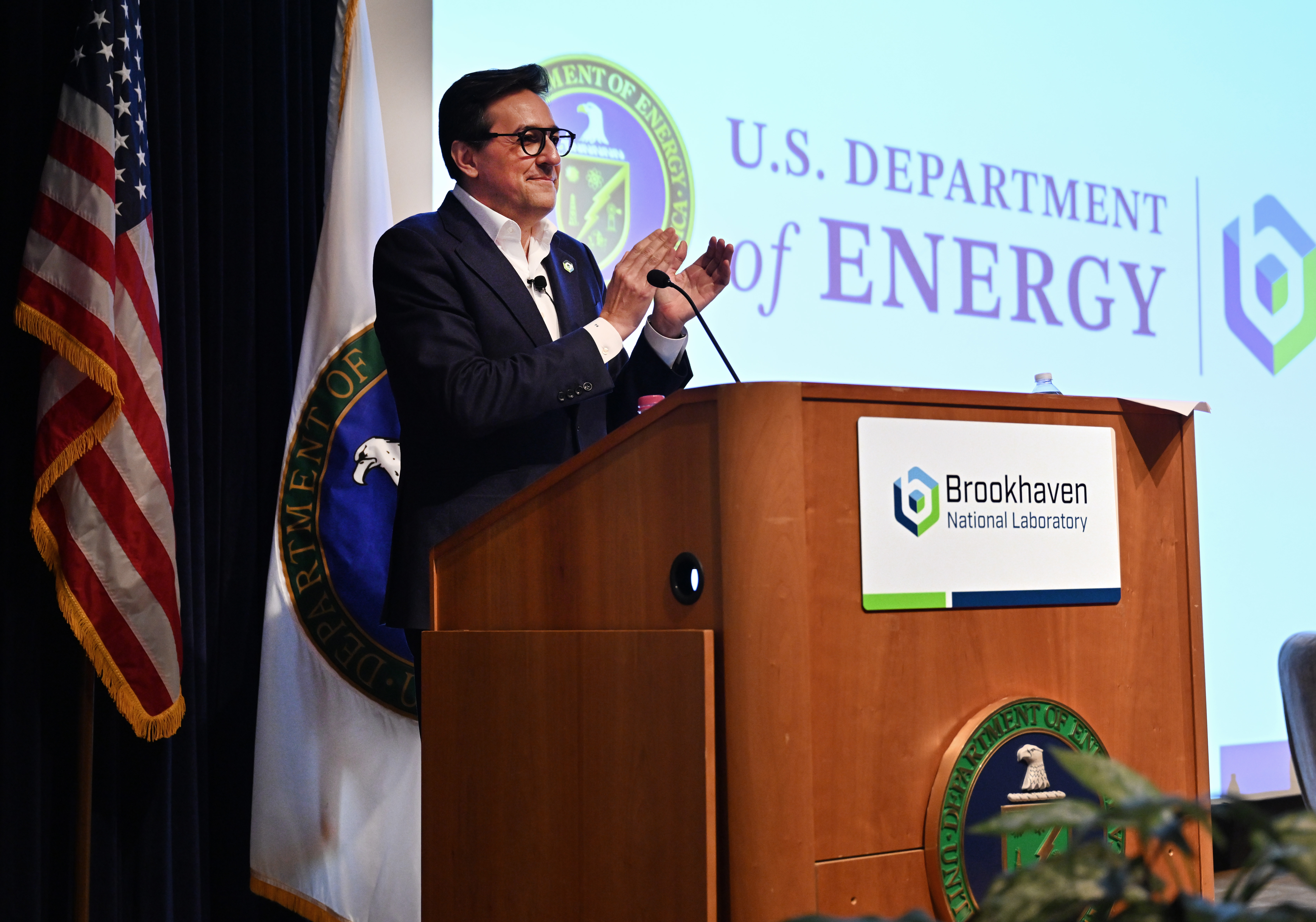
U.S. Department of Energy (DOE) Under Secretary for Science Darío Gil announces the next major milestone for the Electron-Ion Collider during his first visit to DOE's Brookhaven National Laboratory on Feb. 6, 2026. (Kevin Coughlin/Brookhaven National Laboratory)
UPTON, N.Y. — The U.S. Department of Energy (DOE) has approved Critical Decision 3B (CD-3B) for the Electron-Ion Collider (EIC), authorizing the second phase of federally funded long-lead procurements for this major new nuclear physics facility to be built at DOE’s Brookhaven National Laboratory in partnership with DOE’s Thomas Jefferson National Accelerator Facility (Jefferson Lab). CD-3B approval allows the project to purchase equipment, materials, and services that require long manufacturing lead times, ensuring key accelerator and detector components are available as the EIC transitions into construction.
"It’s exciting to see this groundbreaking project continue to move from design toward construction,” said DOE Under Secretary for Science Darío Gil. "The EIC will be a flagship facility for nuclear physics research that will maintain U.S. leadership in this critical field and in the development of technologies that are key to the DOE's mission of pursuing transformational science to help maintain national and economic security."
EIC Project Director Jim Yeck said, “Approval of these additional procurements gives the project exactly what it needs to secure the accelerator and detector systems required to build the EIC and to prepare for the formal transition into the construction phase. The Brookhaven-Jefferson Lab project team is ready to execute contracts with qualified suppliers, turning our designs into a state-of-the-art collider and detector.”
A one-of-a-kind collider with broad national impact
The EIC will be a one-of-a-kind collider facility worldwide and the only collider in the United States. By bringing electrons into collisions with protons and the nuclei of atoms, the EIC will give scientists a new understanding of the particles and “glue” that build up the structure and properties of the visible matter of our universe. Thousands of physicists, engineers, and technicians will collaborate to build this unique machine to extend the frontiers of discovery in nuclear physics and push the evolution of accelerator and particle detector technologies, artificial intelligence, and data management tools — all with broad applications beyond nuclear physics.
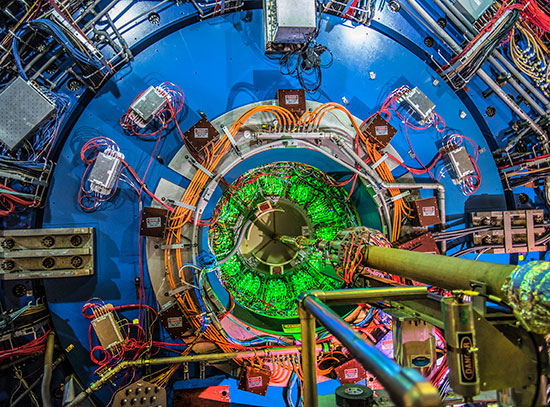
Within its 2.4-mile-circumference accelerator rings, polarized electron and proton or ion beams will circulate in opposite directions at nearly the speed of light until they collide. A house-sized, state-of-the-art detector will capture these collisions, producing 3D images that reveal quarks and gluons — the indivisible particles that make up the protons and neutrons of atomic nuclei. EIC experiments will probe how quarks and gluons generate mass, spin, and other fundamental properties of visible matter, and it will reveal new insights into the strongest force in nature.
 enlarge
Members of the EIC's leadership team pose with U.S. Department of Energy Under Secretary for Science Darío Gil at Brookhaven National Laboratory, Feb. 6, 2026, when Gil announced approval of CD-3B, a major EIC milestone. Left to right: EIC Project Manager Luisella Lari, Under Secretary Gil, EIC Project Director Jim Yeck, and EIC Technical Director Sergei Nagaitsev. (Kevin Coughlin/Brookhaven National Laboratory)
Building smart: early purchases, reuse, and workforce continuity
During the first phase of federally approved long-lead procurements, announced in April 2024, the EIC project awarded more than $24 million in contracts to U.S. companies for highly specialized components, including superconducting wire, beam screens to protect accelerator magnets, and early models of specialized accelerator hardware. Those CD-3A procurements also included approximately $8.3 million in goods from overseas vendors who are among the only suppliers worldwide for specialty items such as silicon photomultipliers required for the EIC detector.
This latest approval of CD-3B procurements will enable the purchase of approximately $67 million in critical long-lead items. These include a power supply for the detector’s solenoid magnet, which bends the trajectories of charged particles for momentum measurement; crystals, to measure the energy of particles with very high precision, needed to get the most detailed information about the momentum of the quarks and gluons inside the proton; light-detecting fibers; and electronics to enable data transmission.
"The EIC teams at both Brookhaven Lab and Jefferson Lab collaborated extensively on the detailed proposals for this next round of procurements,” said EIC Project Manager Luisella Lari. “The technical and business offices are committed to executing this CD-3B plan. Their dedication to the EIC is an essential ingredient to the success of the project.”
The EIC will reuse major components of Brookhaven Lab's Relativistic Heavy Ion Collider (RHIC), a DOE Office of Science user facility, as well as components repurposed from other DOE facilities — cost-saving measures that build on proven technologies. CD-3B funding will support the testing, refurbishment, and assembly of these repurposed components, which include hundreds of magnets from the Advanced Photon Source (APS) at DOE’s Argonne National Laboratory and optical components known as DIRC bars from DOE’s SLAC National Accelerator Laboratory.
Jefferson Lab EIC Deputy Project Director Katherine Wilson said, "Jefferson Lab and Brookhaven Lab are proud to be partners on this exciting project to build the EIC. The approval of CD-3B will let us take the next step in building a facility that will give us new insight into the universe around us and help drive discoveries and technologies that will impact us all. It will allow us to proceed with the refurbishment of the APS magnets and the DIRC bars, as well as move forward with contracts for other specialized materials needed for the facility."
Early procurement also supports workforce continuity. As operations of RHIC conclude, the EIC project plans a seamless transition that allows RHIC’s highly skilled accelerator workforce to pivot directly to EIC assembly.
Funded primarily by the DOE Office of Science, the EIC draws on expertise from national laboratories, universities, and industry partners worldwide. Beyond advancing fundamental science, technologies developed for the EIC — ranging from advanced accelerators and particle detectors to AI-driven data tools — are expected to benefit medicine, energy research, national security, and U.S. industry.
Brookhaven National Laboratory is supported by the Office of Science of the U.S. Department of Energy. The Office of Science is the single largest supporter of basic research in the physical sciences in the United States and is working to address some of the most pressing challenges of our time. For more information, visit science.energy.gov.
Follow @BrookhavenLab on social media. Find us on Instagram, LinkedIn, X, and Facebook.
2026-22807 | INT/EXT | Newsroom