Yutao Li Advances Automation Research Through DOE's Energy I-Corps Program
January 29, 2026
 enlarge
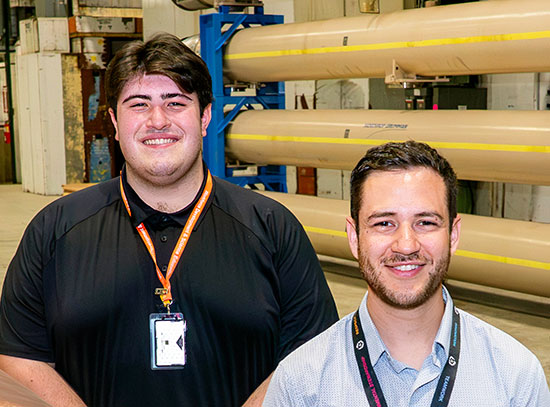
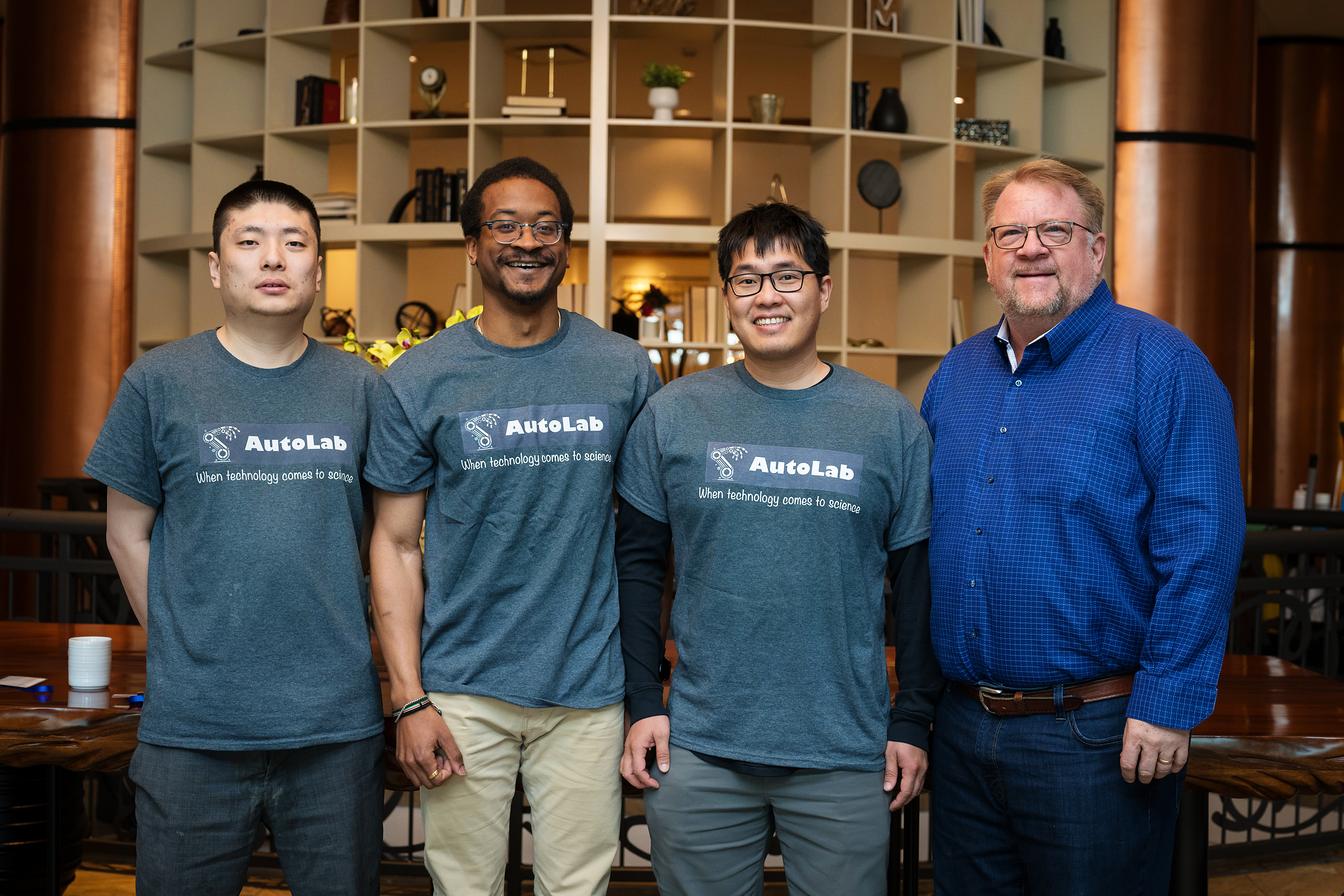
Scientists Yutao Li (left), Raymond Blackwell, and Huandong Chen, and their industry mentor Michael Clarkin at a recent Energy I-Corps event.
Yutao Li, a scientist at the U.S. Department of Energy's (DOE) Brookhaven National Laboratory, recently completed DOE's Energy I-Corps program, gaining valuable experience in bringing innovative technologies from the laboratory into the marketplace. Li and his colleagues Huandong Chen and Raymond Blackwell are the first Brookhaven researchers to take part in the program, which is designed to help scientists explore real-world applications of their research and sharpen entrepreneurial skills.
“The program forces you to ask hard questions," Li said. "What is your target market? How big is it? What funding opportunities exist? Listening to the market changed my perspective. It made me focus on where the technology can have the most immediate impact.”
Over the course of two months, participants learn to evaluate market opportunities, conduct stakeholder interviews, and develop strategies for commercialization. Since its launch in 2015, the program has trained hundreds of researchers across the national lab system.
From idea to market opportunity
Li entered the program with an idea: automating scientific experiments. At first, he thought his technology might serve as an educational exhibit in museums or high schools. But as the program unfolded, Li, Chen, and Blackwell, after conducting more than 75 stakeholder interviews and working with their industry mentor Mike Clarkin, saw a new opportunity. They discovered that significant impact was more likely to come from developing AI-powered tools for quantum science and materials research, where automation could accelerate discoveries.
Clarkin recalled that this pivot was a defining moment. “Yutao was skeptical in the beginning. But after dozens of stakeholder interviews, he began to see the power of talking to people you don’t know. By the end of the interviews, he understood exactly who he needed to meet with,” Clarkin said.
Clarkin is a Colorado-based consultant with an engineering background who now works in business and technology management. He also serves as an industry mentor in Energy I-Corps.
“I’m not a scientist,” Clarkin said. “I’d never seen Yutao, Huandong, and Raymond's world, and they’d never seen mine. But watching scientists learn the framework, gain clarity, and become more sophisticated in the span of a few weeks — it’s proof of what you can do in this program.”
What is AutoLab?
At the center of Li’s work is AutoLab, a laboratory automation platform that uses machine vision, motion control, and precision robotics to handle delicate experimental tasks. It was first developed for research on two-dimensional materials, where scientists often spend hours manually aligning and stacking microscopic flakes under a microscope. AutoLab makes this process faster and more reliable by using computer vision to identify materials, set alignment, and carry out stacking with micron-level accuracy.
“Stakeholder interviews revealed that researchers were spending weeks or even months trying to build testable 2D devices,” Li said. “In our lab, we’ve shown that automation can cut that timeline down to overnight. Imagine the impact if scientists could spend less time building experiments and more time gaining new knowledge.”
This speed and reliability, he added, can create a flywheel effect for science: one breakthrough leads to another, and discoveries in one area can unlock progress elsewhere. If building and running experiments is the bottleneck, automation removes that barrier and accelerates the pace of discovery.
The larger goal is to create a universal framework for automating experiments, reducing human error, and speeding discovery in fields such as quantum materials, nanoscience, and energy research.
The value of mentorship
Clarkin began his career as an engineer, but eventually moved into the business and consulting side of technology, where he specialized in helping organizations bridge the gap between technical innovation and market application. As a mentor for Energy I-Corps, he said he thrives on connecting with scientists and guiding them through the challenges of commercialization.
For him, the value of the program is mutual: “I get to see some of the amazing science happening inside the labs, and at the same time, I get to watch researchers gain the skills and confidence to take their work out into the world."
Li credited much of his team’s progress to Clarkin, who pushed them to think critically about whether their solution should focus purely on software or integrate hardware as well.
“He made me consider questions I had never thought of before,” Li said. “It wasn’t easy, but it was exactly what we needed."
Learning through industry engagement
The program pushed Li and his team well beyond the walls of the laboratory. They showcased their work at Automate 2025, North America’s largest automation conference, where Li even designed and managed his own booth. At the conference, he spoke with more than 25 industry leaders, learning directly what customers expected: instruments that are simple, reliable, and ready “out of the box."
Clarkin emphasized how transformative these experiences were. “The hardest thing they ask you to do is make the 75 calls. The first ten are easy — you know people. But after that, it’s cold outreach. That’s where the learning really happens. There’s something powerful about talking to people you don’t already know,” he said.
A stepping stone at Brookhaven
Before joining DOE’s Energy I-Corps, Li first explored entrepreneurship through Brookhaven Lab’s internal entrepreneurial training program, run by Brookhaven’s Office of Technology Transfer. Developed in partnership with FedTech, a deep tech accelerator, the program has introduced Brookhaven Lab researchers to the fundamentals of customer discovery, value propositions, and market analysis. The program is now working with its seventh cohort.
“This initiative aims to arm participants with the necessary tools and skills to assess the market potential of their research and technological innovations,” said Poorni Upadhya, Brookhaven’s manager for technology transfer. “We are beginning to see a real appetite for entrepreneurship at Brookhaven. Programs like this give scientists the chance to break out of their traditional roles and see how much an idea can be developed.”
For Li, the experience in the Brookhaven program was an important first step in learning how to move beyond the lab and consider broader applications for his research. It helped prepare him for the deeper dive into commercialization he would later undertake in Energy I-Corps.
Building connections across the national labs
Energy I-Corps is more than training; it’s a cross-lab community. Li’s cohort included 16 other teams tackling diverse challenges, from advanced materials to AI-based image recognition. Weekly workshops provided a crash course in market discovery and business fundamentals — a “mini MBA” for scientists.
Clarkin noted that what set Li’s project apart was its broad potential impact: “Most teams come interested in commercializing a specific technology. But Yutao asked, ‘What’s a clever way of automating the scientific discovery process itself?’ That’s a powerful idea — something that could unlock discoveries for scientists everywhere."
Looking ahead
For Brookhaven and DOE, "Programs like Energy I-Corps help federally funded research results that have the potential to address market needs reach the market through collaborations with industries and entrepreneurs," Upadhya said.
Reflecting on the journey, Li said, “I’m very happy to have been the first participant from Brookhaven. This program doesn’t just help us think about technology — it helps us think about the people and industries that can benefit from it.”
Li also credited the encouragement of his supervisor, Abhay Pasupathy, for making his participation possible. Pasupathy serves as a professor of physics at Columbia University and a group leader in the Condensed Matter Physics and Materials Science Department at Brookhaven.
“This wouldn’t have happened without the support he gave me,” Li said. “Having a supervisor who values exploration beyond the lab made all the difference.”
And according to Upadhya, the experience has been transformative for Li. “He’s brought back so much business know-how," she said. "It’s very heartening to see what has come out of this experience.”
Brookhaven National Laboratory is supported by the Office of Science of the U.S. Department of Energy. The Office of Science is the single largest supporter of basic research in the physical sciences in the United States and is working to address some of the most pressing challenges of our time. For more information, visit science.energy.gov.
Follow @BrookhavenLab on social media. Find us on Instagram, LinkedIn, X, and Facebook
2026-22804 | INT/EXT | Newsroom