New Quantum Imaging Method Uses Correlated X-Ray Photons
February 11, 2026
 enlarge
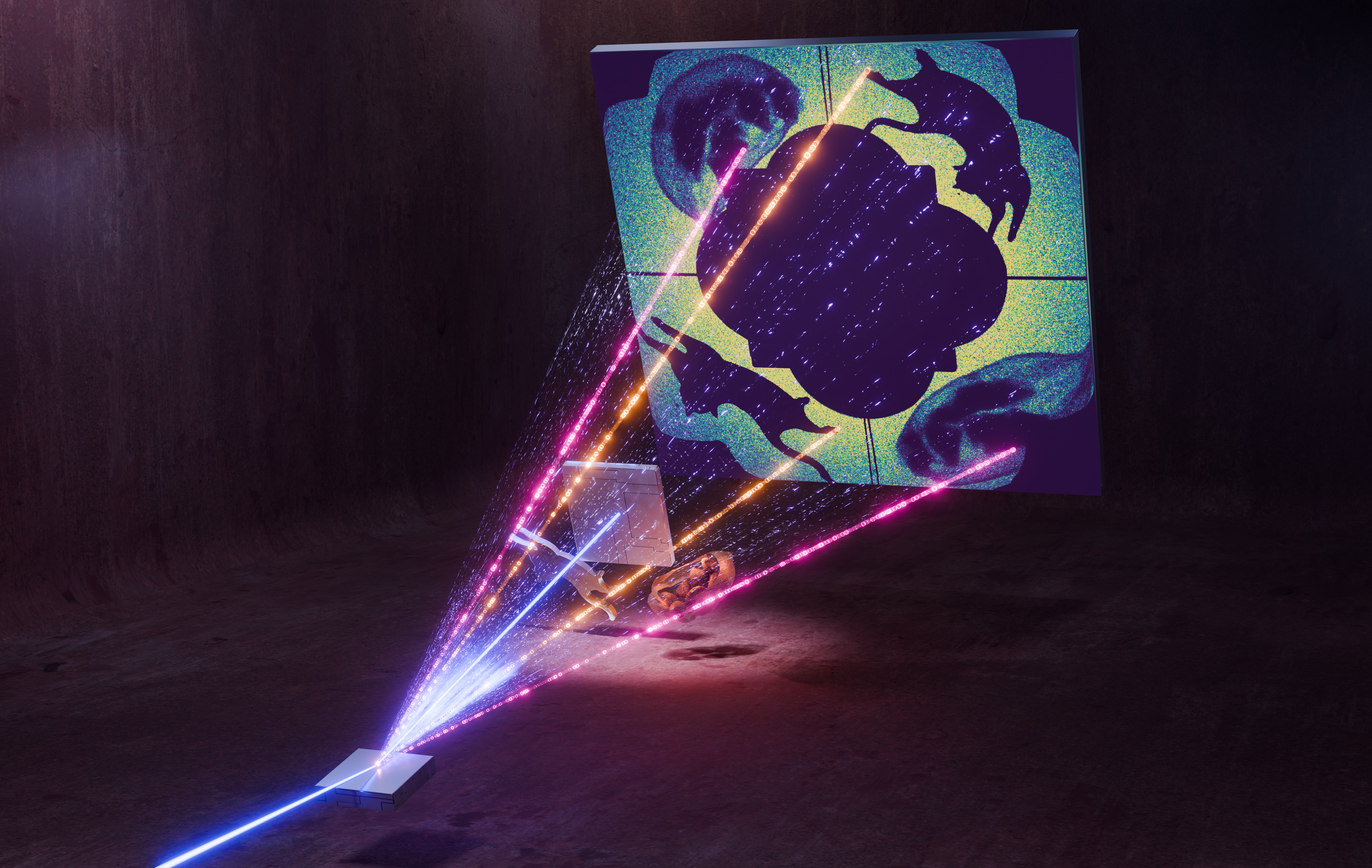
Conceptual schematic of "ghost imaging" depicts samples being imaged, including a cat-shaped tungsten test pattern and an E. cardamomum seed. The objects are placed inside a ring on the lower two detector chips, while the upper chips are left open. By measuring paired X-ray signals at the same time, the system produces two matching images.
The Science
Scientists demonstrate a new imaging method using entangled X-ray photons and an advanced detector that measures the correlation of their position, timing, and energy.
The Impact
This proof of concept could enable lower-dose studies of delicate biological materials, such as plant tissues, and may one day inform lower-dose medical imaging.
Summary
A research team led by scientists at the U.S. Department of Energy’s Brookhaven National Laboratory have demonstrated a quantum-inspired X-ray imaging approach that could enable high-resolution measurements with significantly reduced radiation dose. The proof-of-concept study uses pairs of quantum-entangled X-ray photons to extract imaging information even when one photon never interacts with the sample. The method is based on X-ray “ghost” imaging which uses entangled photon pairs that share linked properties. In each pair, one photon passes through a sample while its partner does not. By measuring correlations between the two photons, researchers are able to use information carried by the untouched photon to help reconstruct an image, complementing data from the photon that interacts with the sample.
The team configured a specialized detector system capable of capturing individual photons and identifying coincident photon pairs with nanosecond precision at the Coherent Hard X-ray Scattering (CHX) beamline at the National Synchrotron Light Source II (NSLS-II). Separate detector regions recorded the “signal” photons that passed through the sample and the “idler” photons that did not. Generating correlated X-ray photon pairs is challenging because the process is inherently probabilistic and X-rays don’t interact with matter as strongly as visible light. The process begins by sending photons through a nonlinear material. Unlike ordinary materials, which allow photons to reflect and refract proportionally to a light source’s intensity, nonlinear materials interact with photons in complex, disproportionate ways. This interaction can alter the photons and, under the right conditions, give rise to unusual quantum effects, like the splitting of a single photon into a correlated pair. Despite these challenges, the team measured a photon-pair production rate of about 7,800 pairs per hour and were able to characterize the spatial correlations between them.
To demonstrate the technique, the researchers imaged a tungsten sample shaped like a cat (a nod to Schrödinger) and a cardamom seed over several hours. By isolating coincident photon events and applying corrections for image blurring, the team successfully reconstructed “ghost” images that closely matched pre-experiment simulations. Using correlated photons helps us get more information from fewer interactions. Because small, delicate biological samples are highly sensitive to X-ray damage, the ability to extract information from photons that never touch the sample could enable longer imaging times and higher-quality data at lower doses.
Future efforts will focus on improving imaging speed, resolution, and scalability to larger and more complex samples. Techniques like this may even pave the way towards lower-dose medical imaging.
Download the research summary slide (PDF)
Related Links
Paper: https://opg.optica.org/optica/fulltext.cfm?uri=optica-13-1-135
Contact
Justin C. Goodrich
Brookhaven National Laboratory
jgoodrich@bnl.gov
Publications
Justin C. Goodrich, Ryan Mahon, Joseph Hanrahan, Dennis Bollweg, Monika Dziubelski, Raphael A. Abrahao, Sanjit Karmakar, Kazimierz J. Gofron, Thomas A. Caswell, Daniel Allan, Lonny Berman, Andrei Nomerotski, Andrei Fluerasu, Cinzia DaVià, and Sean McSweeney, "Quantum correlation imaging via X-ray parametric down-conversion," Optica 13, 135-142 (2026). https://doi.org/10.1364/OPTICA.574747
Funding
U.S. Department of Energy Office of Science (DE-SC0012704); U.S. Department of Energy–Biological and Environmental Research (BER) (KP1607020); Workforce Development for Teachers and Scientists; Brookhaven National Laboratory (LDRD 19-30, LDRD 22-22). This research is supported by the BER Quantum Information Science Program.
2026-22832 | INT/EXT | Newsroom