MEDIA ADVISORY: Featured Talks on Legacy of RHIC and Transition to EIC at APS Global Physics Summit
March 9, 2026
 enlarge
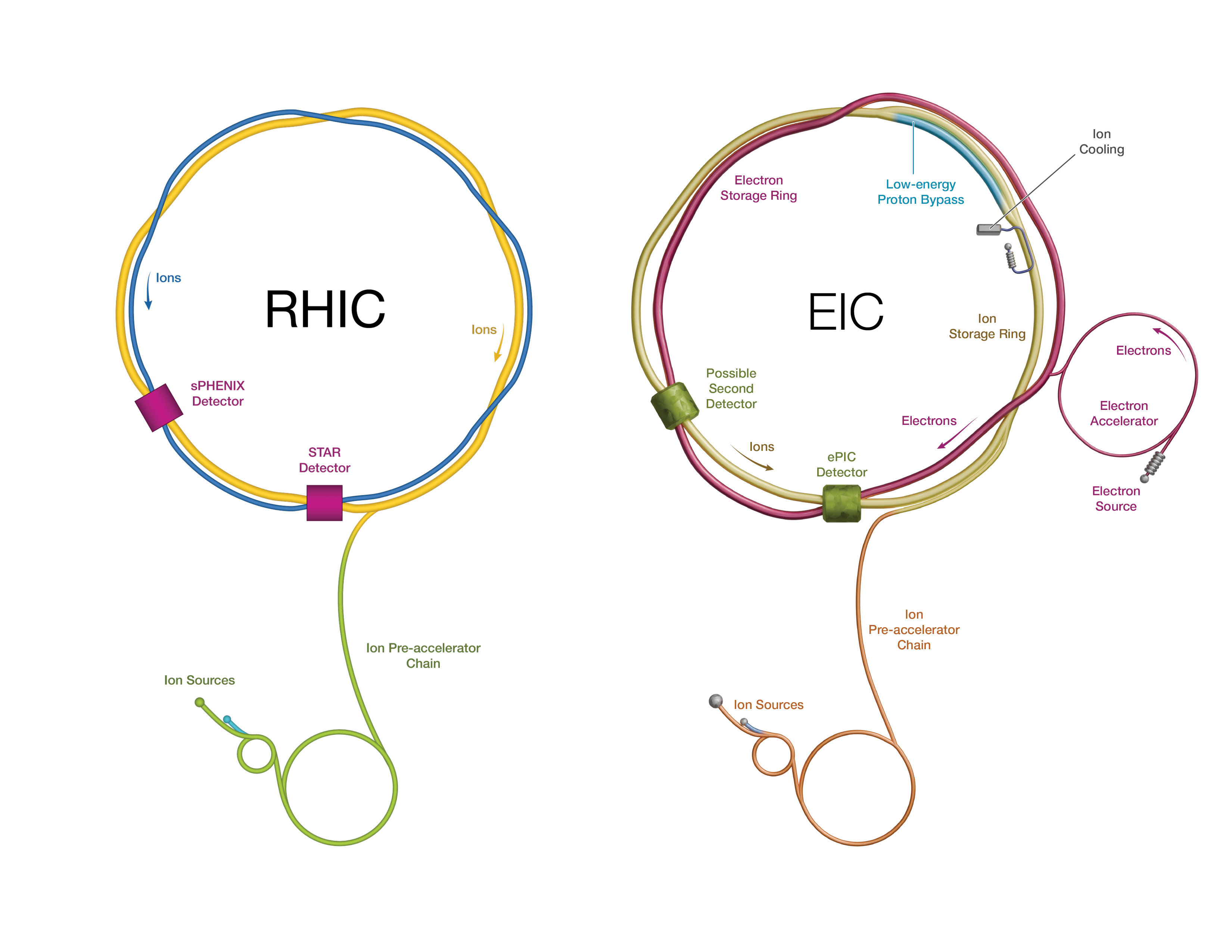
This image shows a schematic of the Relativistic Heavy Ion Collider (RHIC), left, which will be transformed into the Electron-Ion Collider (EIC), right. (Valerie A. Lentz/Brookhaven National Laboratory)
WHAT: The Relativistic Heavy Ion Collider (RHIC) — a flagship facility for nuclear physics research at the U.S. Department of Energy’s (DOE) Brookhaven National Laboratory —produced its final subatomic smashups on Feb. 6. Those final collisions capped a quarter century of remarkable experiments, groundbreaking discoveries, and technological advances. Now, as nuclear physicists continue to mine RHIC’s vast datasets to make new discoveries, much of RHIC’s unique infrastructure will be transformed into an Electron-Ion Collider (EIC). This new machine will have unprecedented capabilities for exploring the building blocks of matter. Several sessions and talks at the American Physical Society’s (APS) Global Physics Summit will delve into the details of RHIC’s legacy and the future of nuclear physics at the EIC.
WHERE: The APS Global Physics Summit in Denver, Colorado
WHEN: March 15-20, 2026
BACKGROUND: RHIC has been producing subatomic smashups at Brookhaven Lab since 2000. It’s collided atomic species from single protons up to heavy atoms such as gold stripped of their electrons. The energetic collisions recreate the conditions of the early universe so scientists can study quarks and gluons, the building blocks of visible matter. In addition, RHIC has collided protons with their spins aligned. This research has given scientists new insight into the origins of proton spin, an essential quantum property. Now scientists want to learn more, including how quarks and gluons interact within the matter that makes up our world today.
The EIC, which will be built by reusing key components of RHIC, will open up this new frontier in nuclear physics. It will enable studies of the arrangements and interactions of quarks and gluons within protons and nuclei. Scientists will use the EIC to study how quarks and gluons generate mass, spin, and other key properties of nuclear matter.
The EIC will be built by scientists, engineers, and technicians from Brookhaven National Laboratory, DOE’s Thomas Jefferson National Accelerator Facility (Jefferson Lab or JLab), and collaborating institutions around the world. They’ll remove one of RHIC’s ion rings and add new electron accelerator components and a state-of-the-art detector for analyzing precision interactions between electrons and protons or nuclei. Rather than smashing and melting nuclear matter, this new machine will act more like a precision microscope. It will produce 3D snapshots of quarks and gluons and give scientists fresh insight into the strongest force in nature.
FEATURED APS SESSIONS AND TALKS ON RHIC AND THE EIC
Plenary: The Legacy of RHIC and the Path to the EIC
Monday, March 16, 8:00-9:51 a.m., Convention Center, Bellco Theatre 3-5
This session will explore the history and legacy of the physics program at RHIC, how the science and infrastructure of RHIC provide a foundation for the EIC, and connections between the smallest building blocks of matter and the early universe shortly after the Big Bang.
Accelerator Design Progress for the Future Electron-Ion Collider at Brookhaven National Laboratory
Wednesday, March 18, 10:42-10:54 a.m., Hayatt Regency, Mineral A
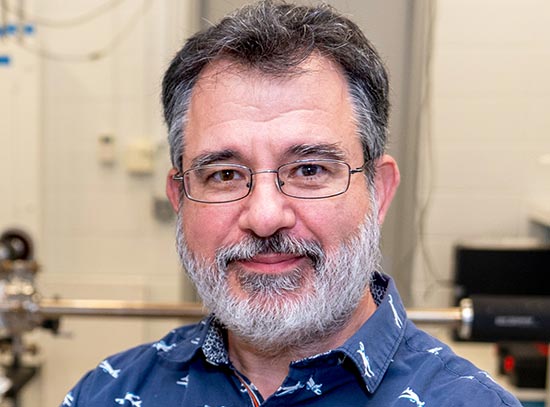
Brookhaven Lab accelerator physicist Daniel Marx will present an overview of accelerator design progress for the EIC. This talk is part of a session on Future Colliders I, chaired by Brookhaven Lab’s Sergei Nagaitsev, technical director for the EIC.
EIC: Breakthroughs and Challenges for the Flagship Nuclear Program
Wednesday, March 18, 1:51-2:27 p.m., Hayatt Regency, Centennial A
Sergei Nagaitsev, technical director for the EIC, will describe the design and construction of the facility being built at Brookhaven Lab in partnership with Jefferson Lab. The talk will include the challenges and breakthroughs in accelerator technologies essential to the success of the machine. This talk is included in a session on Progress in Accelerator Physics.
Unlocking the Secrets of the Nucleus at the Electron-Ion Collider (EIC)
Thursday, March 19, 11:06-11:42 a.m., Hayatt Regency, Centennial A
Brookhaven Lab physicist Alex Jentsch will describe the fundamental physics to be explored at the future EIC, the experimental technology being developed to achieve the EIC’s science goals, and connections with existing data from RHIC. The talks is part of a session highlighting Three Megaprojects Defining the 2030s, chaired by Brookhaven Lab accelerator physicist Daniel Marx.
PRESS REGISTRATION
Members of the media — staff journalists, freelancers, public information officers, and students/postdocs enrolled in science writing programs — can register for the APS Global Physics Summit at no cost to attend this event. Sign up for APS press credentials to verify eligibility. For questions, please contact the APS media team.
Brookhaven National Laboratory, Thomas Jefferson National Accelerator Facility, RHIC, and the EIC project are supported primarily by the DOE Office of Science. The Office of Science is the single largest supporter of basic research in the physical sciences in the United States and is working to address some of the most pressing challenges of our time. For more information, visit science.energy.gov.
RELATED LINKS
- A Smashing Success: Relativistic Heavy Ion Collider Wraps up Final Collisions
- DOE Approves Next Phase of Funding for Electron-Ion Collider
- Fact sheets: EIC Science Overview, EIC Project Update, EIC Partners
- Brookhaven Lab’s Flickr albums: RHIC, EIC
- Interactive EIC website: Explore the Electron-Ion Collider
- Social media: Follow and tag #RHIC, #ElectronIonCollider, and @BrookhavenLab on social media. Find us on Instagram, LinkedIn, X, and Facebook.
MEDIA CONTACTS
Karen McNulty Walsh, Brookhaven National Laboratory
kmcnulty@bnl.gov
631-344-8350
Kandice Carter, Thomas Jefferson National Accelerator Facility
kcarter@jlab.org
2026-22856 | INT/EXT | Newsroom