Atomic-Scale Control Drives Electrocatalyst Performance
April 8, 2026
 enlarge
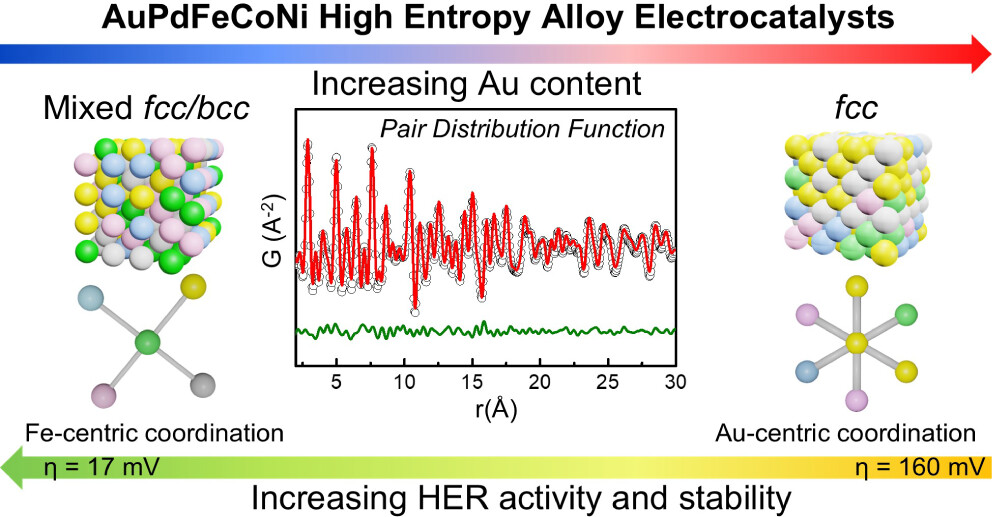
The local structural environment of gold, palladium, iron, cobalt, and nickel high entropy alloys (HEA) electrocatalysts transformed from a mixed Face-Centered Cubic (FCC) and Body-Centered Cubic (BCC) iron- (Fe) centric pattern (left) to a purely FCC Gold- (Au) centric pattern (right) with increased Au content. This is a lot more ordered, which enables the material to have increased hydrogen evolution reaction activity and remain stable for a longer period of time. The data in the center shows a Pair Distribution Function plot of the local structure.
The Science
Scientists demonstrated that tuning gold content can control high entropy alloy (HEA) structures to create durable, efficient catalysts that use fewer precious metals.
The Impact
This work could pave the way for cheaper, more robust alternatives to platinum catalysts for energy applications.
Summary
High-entropy alloys (HEAs) are novel materials made by combining five or more elements in near-equal concentrations. This complex composition can often create a highly disordered but stable structure with tunable electronic and chemical properties, making HEAs promising candidates for catalysis. Scientists can already control which elements are included in these alloys, however, it remains difficult to precisely control their crystal structure and morphology at the atomic scale. Improving this control would allow researchers to fine-tune where and how reactions occur, enhancing catalytic performance.
In this study, researchers from the University of Massachusetts Lowell and the National Synchrotron Light Source II (NSLS-II), a U.S. Department of Energy (DOE) Office of Science user facility at DOE’s Brookhaven National Laboratory, demonstrated that adjusting the gold content in an HEA electrocatalyst can control its crystalline structure. This structural control enabled them to identify the atomic configurations responsible for enhanced hydrogen production through catalysis.
Using an HEA comprised of gold, palladium, iron, cobalt, and nickel, the team found that adding more gold pushes the alloy from a mixed crystal form to a more uniform face-centered cubic form. The best catalysts had low gold content, where the mixed structure created more favorable electronic properties at the material’s surface, enhancing catalytic performance.
To understand why the structure affected performance, researchers used advanced X-ray techniques at NSLS-II to map these atomic-scale features. They were able to confirm the crystal structure changes as gold content varied and, through pair distribution function analysis at the Pair Distribution Function (PDF) beamline, map out the precise distances between specific pairs of atoms throughout the nanoparticles, revealing subtle structural details. These findings were supported by simulation results based on theoretical models.
The best-performing HEA catalysts were exceptionally good at driving the hydrogen evolution reaction, the process that splits water to make hydrogen fuel. One version needed only 17 mV to drive hydrogen evolution at a useful rate, stayed stable for 240 hours, and outperformed not only commercial platinum on carbon (Pt/C) but were also superior when normalized by precious metal content. For comparison, the Pt/C catalyst needed 27.3 mV and remained stable for about 100 hours. This could lead to significant cost savings, as current commercial Pt/C catalysts cost about $59.30/g and these HEA catalysts could drop the cost to $18.36/g.
Download the research summary slide (PDF)
Related Links
Contact
Michael B. Ross
University of Massachusetts Lowell
michael_ross@uml.edu
Publication
Jeong, S., Branco, A. J., Nagarajan, P., Sullivan, C. S., Cha, J. H., Bollen, S. W., Mason, N. L., Abeykoon, M., Olds, D., & Ross, M. B. (2026). Compositional Phase Control in High-Entropy Alloy Electrocatalysts. Journal of the American Chemical Society, 148(5), 5146–5154. https://doi.org/10.1021/jacs.5c16422
Funding
This work relates to the Department of Navy awards N00014-22-1-2654 and N00014-25-1-2038, issued by the Office of Naval Research. This research used beamline 28-ID-1 of the National Synchrotron Light Source II, a U.S. Department of Energy (DOE) Office of Science User Facility operated for the DOE Office of Science by Brookhaven National Laboratory under contract no. DE-SC0012704. We are grateful to the UMass Lowell Core Research Facilities and the MIT.Nano facility for the use of the JEM-2100Plus and PHI VersaProbe II.
2026-22931 | INT/EXT | Newsroom