EIC Featured in CERN Colloquium
CERN colloquium highlights EIC science and international exchange
August 12, 2026
 enlarge
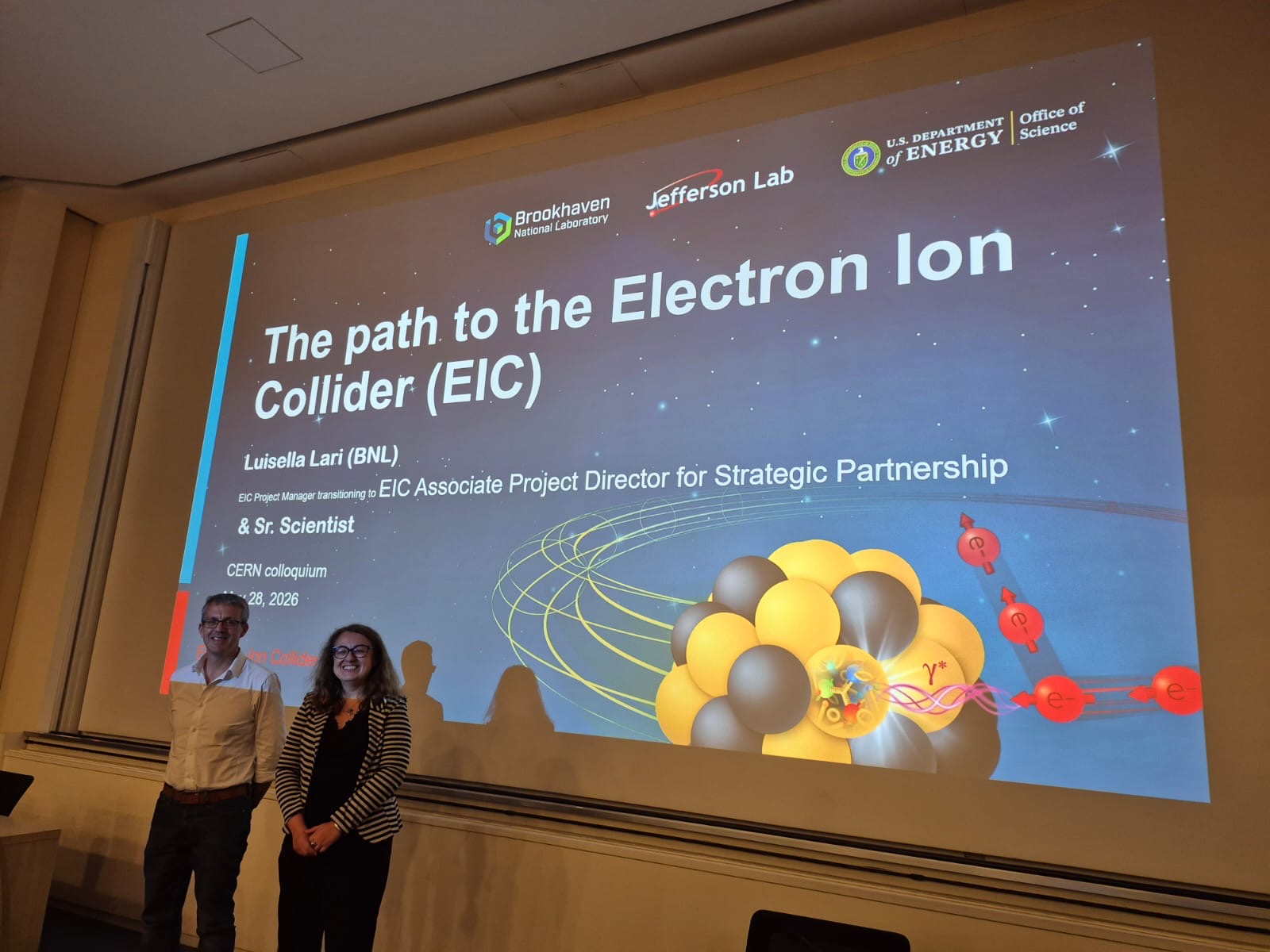
Luisella Lari (right), associate director for strategic partnerships for the Electron-Ion Collider (EIC) project, stands with Matthew Chalmers, organizer of the CERN colloquium series, following her presentation, "The Path to the Electron-Ion Collider," at CERN, the European Organization for Nuclear Research. (Photo courtesy of Luisella Lari)
Growing international interest in the Electron-Ion Collider (EIC) was visible at CERN, the European Laboratory for Particle Physics, where the future facility was the focus of a CERN Colloquium on May 28. The event brought the EIC's scientific mission and future opportunities to an international scientific community at CERN.
Luisella Lari, a senior scientist who led the EIC project as project manager since 2022 and is transitioning to associate director for strategic partnerships, presented "The Path to the Electron-Ion Collider," offering an overview of the project's status, scientific goals, and future impact.
Hosted by CERN, the colloquium series is a longstanding lecture platform, regularly featuring Nobel laureates, pioneering researchers, and internationally recognized leaders whose work is shaping the future of discovery. Designed for a broad scientific audience, the series challenges speakers to communicate complex scientific ideas in ways that resonate across disciplines.
The EIC, to be built at the U.S. Department of Energy’s (DOE) Brookhaven National Laboratory in partnership with DOE’s Thomas Jefferson National Accelerator Facility (Jefferson Lab), will be the world's first polarized electron-ion collider. The facility will provide unprecedented insights into the structure of protons, neutrons, and atomic nuclei, helping scientists answer fundamental questions about the building blocks of visible matter.
 enlarge
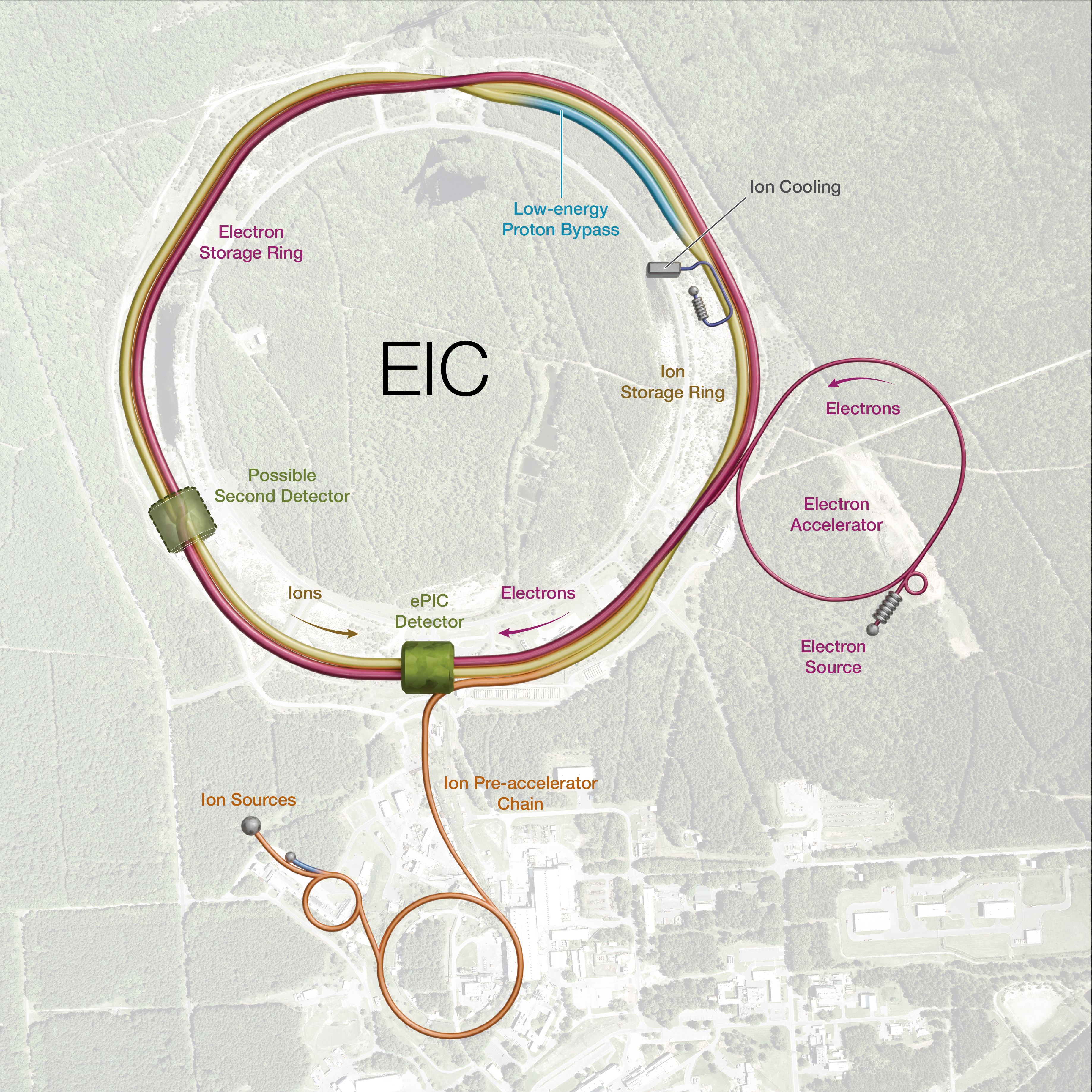
This rendering depicts the Electron-Ion Collider (EIC), whose scientific vision and technical progress have recently been highlighted through collaborations and presentations at CERN and other international accelerator conferences. (Valerie A. Lentz/Brookhaven National Laboratory)
The talk provided an opportunity to showcase the EIC's progress to one of the world's most influential scientific audiences while strengthening relationships across the global physics community. Lari's invitation to speak reflects growing international interest in the facility and its scientific potential.
"The CERN community is extremely interested in the EIC's scientific program," Lari said. "Physicists look forward to having new and different data to play with. They want the EIC."
The colloquium highlights the longstanding partnership between CERN and the U.S. The collaboration includes technical expertise, resource contributions, and shared research and development efforts that are helping advance technologies critical to particle colliders, including the future EIC.
Scientists and engineers from institutions around the world continue to contribute to the project's development, reinforcing the EIC's role as an international scientific endeavor.
The event also reflects a broader series of recent international engagements where the EIC’s scientific vision and technical progress have been shared with the global accelerator community. Earlier this year, Lari hosted the EIC Accelerator Collaboration satellite meeting at the 17th International Particle Accelerator Conference, bringing together accelerator experts from around the world to discuss the project's technical progress, accelerator design, and opportunities for international collaboration.
The EIC's groundbreaking accelerator design was also featured at CERN's Future Circular Collider (FCC) Week 2026, where presentations highlighted technical synergies between the EIC and FCC. Researchers explored shared accelerator challenges and research and development opportunities that could benefit both next-generation collider programs.
As the project advances toward construction and operations, Lari noted that continued engagement with researchers worldwide will help build the collaborations needed to maximize the collider's scientific impact and prepare future users to take advantage of its unprecedented capabilities.
Brookhaven National Laboratory is supported by the Office of Science of the U.S. Department of Energy. The Office of Science is the single largest supporter of basic research in the physical sciences in the United States and is working to address some of the most pressing challenges of our time. For more information, visit science.energy.gov.
Follow @BrookhavenLab on social media. Find us on Instagram, LinkedIn, X, and Facebook.
2026-23092 | INT/EXT | Newsroom