Gluons May Play Central Role in Baryon Number Conservation
Quark-connecting 'gluon junction' could be primary carrier of baryon number, essential to stability of protons, atoms, and all visible matter
August 13, 2026
 enlarge
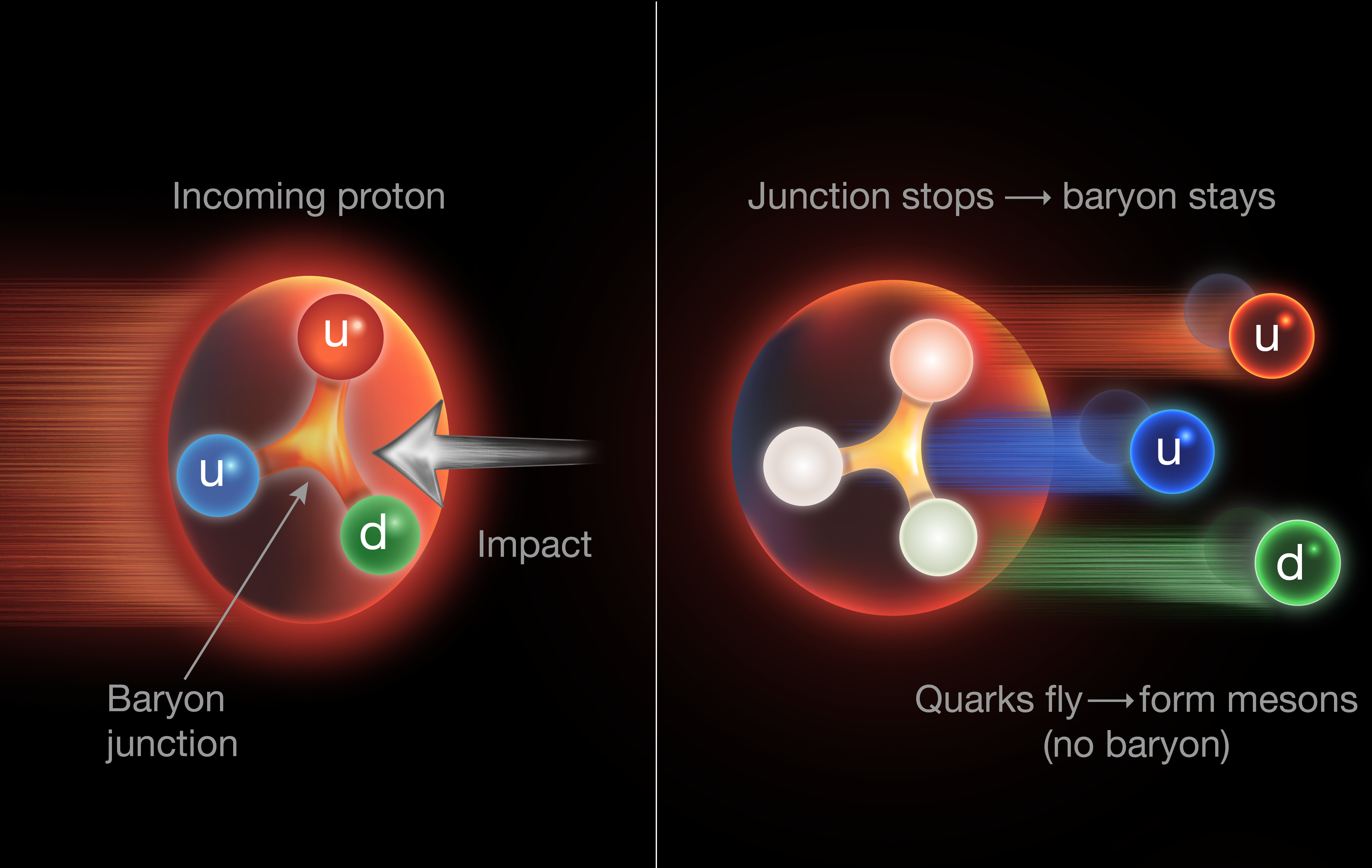
This image shows how, upon impact in a collision (left), a proton's three valence quarks (u, u, d) will continue to fly down the beampipe while the baryon junction, the Y-shaped configuration of gluons, is more easily stopped (right). The baryon junction will pull three new quarks out of the vacuum to become a new baryon, thus retaining the baryon number, while the "freed" quarks will each pair up with a new partner to form mesons. (Valerie A. Lentz/Brookhaven National Laboratory)
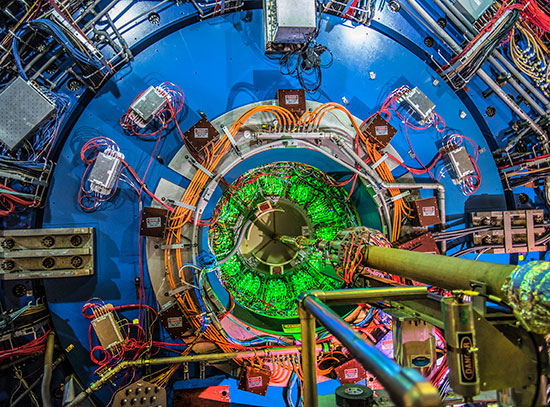
UPTON, N.Y. — New results from the STAR detector at the Relativistic Heavy Ion Collider (RHIC) suggest that gluons, the gluelike particles that hold quarks together inside protons, play a central role in the conservation of baryon number — an essential part of a particle’s quantum identity. The findings from energetic particle collisions at RHIC — a U.S. Department of Energy (DOE) Office of Science user facility for nuclear physics research that operated at DOE’s Brookhaven National Laboratory from 2000 to early 2026 — suggest that baryon number is carried by a Y-shaped “junction” of gluons connecting the proton’s three main quarks. The study, published in the journal Science, challenges a long-held view that baryon number is solely carried by those three quarks.
“Traditionally, scientists have assumed that each of the three main ‘valence’ quarks inside a proton or neutron carries one-third of the baryon number,” said Zhangbu Xu, a professor at Kent State University with a joint appointment at Brookhaven Lab.
The baryon junction, or gluon junction, was predicted by physicists in the 1970s to explain how gluons hold those valence quarks together within protons. Then, in 1996, four years before RHIC turned on, Dmitri Kharzeev, a theoretical physicist at Stony Brook University and Brookhaven Lab, proposed that the baryon junction could be the true carrier of baryon number, instead of the valence quarks. In the current paper, the STAR team describes their innovative strategy to test this idea.
“Using data collected from different types of particle collisions at RHIC, our results suggest that the baryon number is not simply carried by individual quarks,” Xu added “Our findings strongly support the idea that baryon number is more favorably carried and transported by gluons, the particles that hold quarks together, when arranged in this special configuration.”
 enlarge
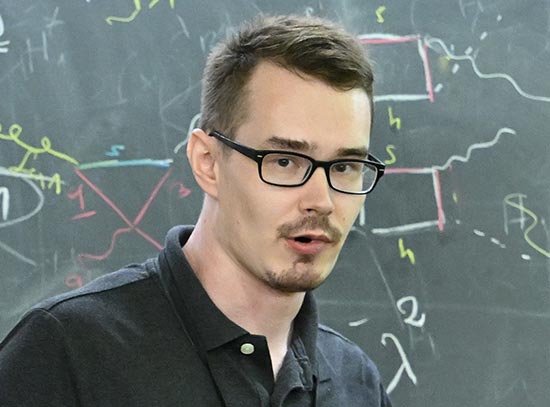
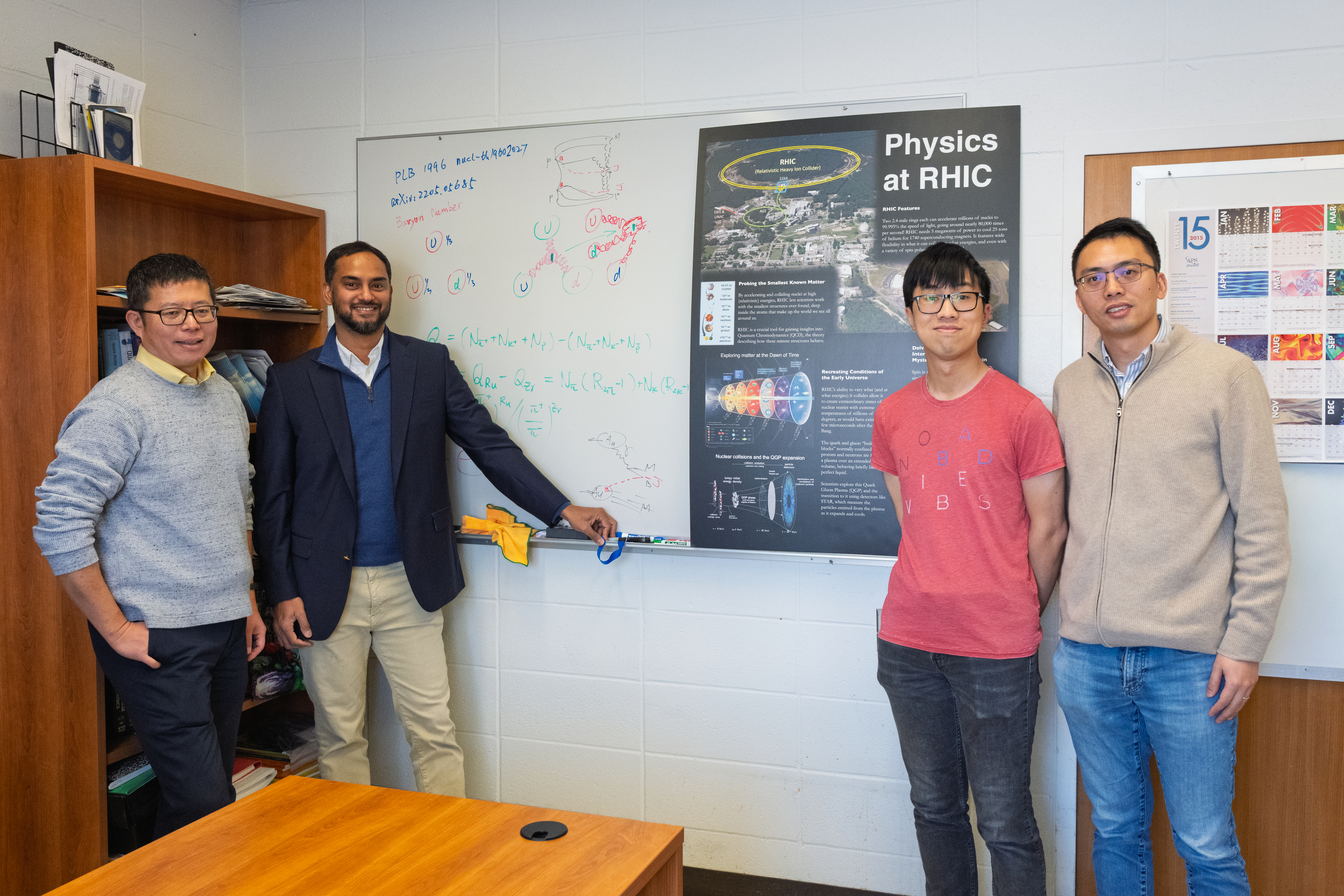
Four of the lead authors on this study at a celebration of 25 years of research using the STAR detector at Brookhaven Lab's Relativistic Heavy Ion Collider (RHIC), left to right: Zhangbu Xu (Kent State University and Brookhaven National Laboratory), Prithwish Tribedy (Brookhaven Lab), Chun Yuen (Tommy) Tsang (a former Kent State postdoctoral fellow, now at Argonne National Laboratory), and Rongrong Ma (Brookhaven Lab). (Timothy Kuhn/Brookhaven National Laboratory)
Baryon number conservation
Identifying the carrier of baryon number has important implications. At the level of RHIC collisions, baryon number conservation ensures that the total number of baryons — three-quark particles such as protons and neutrons — remains the same before and after a collision. But the idea of baryon number conservation extends to the entire universe.
“Since the Big Bang, the number of protons and neutrons all together never changes as a function of time,” said Nicole Lewis, a STAR physicist at Rice University who started this project as a postdoc at Brookhaven Lab in 2020. “The reasons for this conservation are not well understood. It’s one of the mysteries of the universe, related to why we have more matter than antimatter,” she said.
On an everyday practical level, baryon number conservation explains why protons, central building blocks of atomic nuclei, are so stable and don’t decay.
“It’s believed that the lifetime of a proton is longer than the lifespan of the universe,” Lewis said. “This allows atomic nuclei to form and be stable — which means matter, as we interact with it in the universe, can exist.”
Excess baryons
 enlarge
Nicole Lewis, now a STAR Collaboration physicist at Rice University, began the analysis that led to the discovery that baryon number is carried by the baryon junction when she was a postdoctoral fellow at Brookhaven National Laboratory in 2020. (Rice University)
The idea that gluons carry baryon number challenges the conventional picture of how this quantum property is conserved. Most textbooks state that a proton’s baryon number of plus one is divided equally among its three primary valence quarks, with each of these quarks carrying a plus one-third baryon number. This is similar to the way electric charge is distributed among the three valence quarks of a proton.
“In the naïve quark model, there are three quarks inside a proton, but nothing else,” said Tommy Tsang, formerly a postdoc at Kent State University, now at DOE's Argonne National Laboratory. “But if we look at details inside, there are not only three quarks but also a lot of gluons interacting, connecting between those quarks, and there are also quarks and antiquarks that pop up from the vacuum, so it’s actually a really complex object.”
The theory developed to describe this complex structure, known as quantum chromodynamics (QCD), has been very successful at describing the “strong force” mediated interactions among quarks and gluons. However, models inspired by QCD often require additional assumptions to account for observations of particles streaming from RHIC’s collisions of nuclei accelerated close to the speed of light.
“In the STAR detector, we consistently see an excess of baryons coming out of the collisions perpendicular to the direction of the colliding beams,” Tsang said. “The fact that we end up with more baryons than antibaryons — or more matter than antimatter — is not surprising since our collisions start with matter,” he said. The high energy collisions release an enormous amount of energy that is transformed into the creation of thousands of new particles.
But seeing a baryon excess, or net baryon number, in particles emerging away from the beamline caused the STAR team to question the assumption that valence quarks are solely responsible for carrying the baryon number. To produce the observed excess, it would require all three quarks of a single colliding proton to “stop” and undergo a transformation from matter to energy and then back to matter in the center of the detector, with all those newly created baryons spraying out away from the beamline.
Comparison with charges
Fortunately, the STAR physicists could use the fact that valence quarks carry electric charge to test what was going on. They compared the net baryon numbers observed from different kinds of nuclear smashups at RHIC with the redistribution of electric charges in the same collisions.
“Measuring the electric charge coming out perpendicular to the collision gives you a definitive way of measuring how many quarks are stopped and transformed into new particles,” said Zebo Tang, a professor at the University of Science and Technology of China who led a group of students performing data analyses and model simulations.
The scientists found twice as many baryons as would be expected from the measured electric charges coming from stopped quarks. This means, according to the models based on QCD, that not enough quarks are being stopped to create the observed baryons.
So where are all the excess baryons coming from? The answer, according to the STAR physicists, could be the gluons — and specifically the three-pronged junction of gluons that normally holds the valence quarks together.
Baryon junction transformation and transportation
According to the STAR team, when the protons that make up nuclei collide at RHIC, the quark-connecting “gluon junction” or “baryon junction” can be stopped much more easily than the three quarks; all its energy is transformed into new baryons that spray out in perpendicular directions while the quarks it usually connects continue to fly down the beampipe.
To understand this sleight-of-hand decoupling, it might help to picture what happens inside protons accelerated close to the speed of light.
“The baryon junction is always there even as protons are accelerated to higher and higher energy,” Prithwish Tribedy, a STAR physicist at Brookhaven Lab. “But at high energy, gluons within the proton split and multiply.”
With more and more gluons, each individual gluon, including those that make up the junction, carries less and less of the proton’s overall momentum, while the valence quarks, also still present, continue to carry the bulk of the proton’s forward oomph. That means, at the instant of the collision, the slower-moving three-pronged gluon structure should be easier to stop and transform into new particles than the speeding quarks.
The simplicity of stopping a single object — the junction — rather than three individual quarks also makes such an interaction more likely, Tribedy said. “In the collision, the baryon junction gets held behind and the quarks continue on,” he noted.
Then, since quarks and gluons can’t exist on their own, these entities immediately partner up with new particles. In an oversimplified case, each quark flying down the beampipe might partner up with an antiquark to form two-quark particles called mesons, while the three-pronged gluon junction, like a Y shaped magnet, pulls in three new quarks from the vacuum to become a new baryon.
In reality, the transformation tends to be much more dramatic.
“Even though we start with nuclei that contain roughly 100 protons and 100 neutrons, these collisions create thousands of new particles; 99% of the energy is transformed into new particles,” said Rongrong Ma, a Brookhaven Lab physicist. The higher the number of particles produced in a collision, the greater the observed excess of “midrapidity” baryons is, compared with what would be expected from the naïve picture of quarks as the sole carriers of baryon number.
The observation that so many of the baryons produced emerge perpendicular to the beamline provides compelling support for the existence of the baryon junction.
“Our research challenges the long-held idea that baryon number is simply divided among and carried by the three quarks,” said Ma. “This new understanding reshapes how we think about the structure of matter and deepens our knowledge of the most fundamental element that is responsible for the universe in its current form.”
This work was supported by the DOE Office of Science, the U.S. National Science Foundation (NSF), and a range of international agencies and organizations listed in the scientific paper. In addition to using the Open Science Grid, supported directly by NSF, the researchers made use of computing resources in the Scientific Data and Computing Facilities at Brookhaven Lab and the National Energy Research Scientific Computing Center (NERSC), which is another DOE Office of Science user facility at DOE’s Lawrence Berkeley National Laboratory.
Brookhaven National Laboratory is supported by the Office of Science of the U.S. Department of Energy. The Office of Science is the single largest supporter of basic research in the physical sciences in the United States and is working to address some of the most pressing challenges of our time. For more information, visit science.energy.gov.
Follow @BrookhavenLab on social media. Find us on Instagram, LinkedIn, X, and Facebook.
2026-22692 | INT/EXT | Newsroom