Protein Assemblies Shape Membranes to Control Cell Death
April 8, 2026
 enlarge
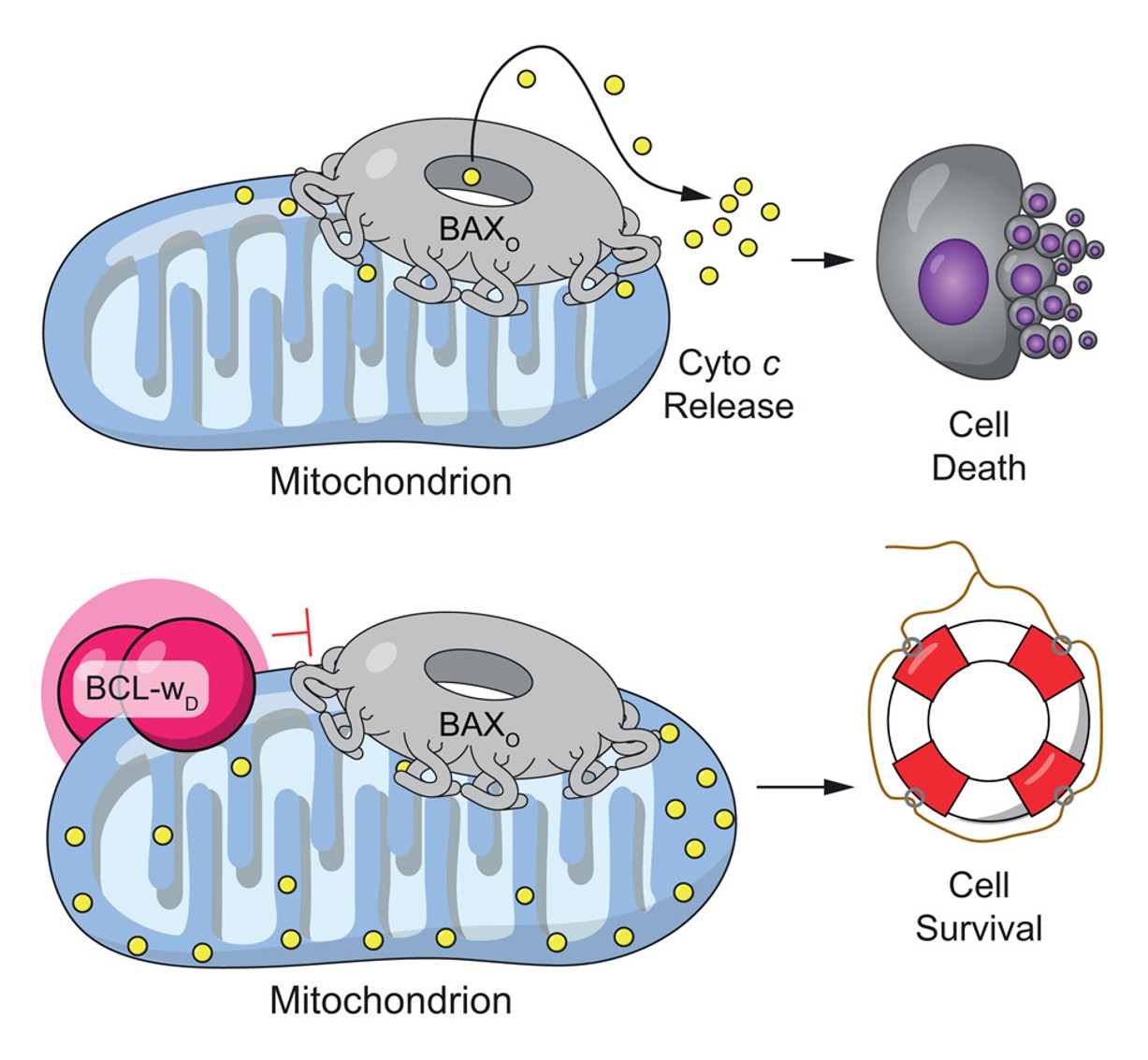
Top row: BAX oligomers deform membranes promoting rupture (negative Gaussian curvature) and cell death. Bottom row: BCL-w dimers induce the opposite curvature, stabilizing the membrane and counteracting BAX.
The Science
BAX oligomers can deform membranes to promote their rupture while BCL-w dimers can counteract BAX by unbending the membrane and stabilizing its structure.
The Impact
This study reveals a previously unknown apoptosis mechanism in which anti-apoptotic dimers dismantle BAX oligomers and remodel membrane curvature, redefining mitochondrial cell death control.
Summary
BAX is a protein that promotes programmed cell death (apoptosis). Normally inactive in the cytosol as a monomer, it becomes activated under cellular stress, assembling into oligomers that damage mitochondrial membranes and trigger cell death. Apoptosis has traditionally been thought to be regulated by simple one-to-one interactions between pro-death proteins like BAX and pro-survival BCL-2 family proteins. This study reveals a more complex layer of control.
The pro-survival protein BCL-w can form a symmetric dimer. This dimer can counteract BAX by breaking apart its clusters, preventing its movement to mitochondria, pulling it back into the cytosol, and blocking its ability to form membrane pores. Using small-angle X-ray scattering (SAXS) —a technique that probes the overall shape and structural effects of molecules in solution—at NSLS-II Beamline 16-ID (LiX), the researchers determined the first low resolution structures of dimeric BCL-w and multimeric BAX. They further used SAXS to study how these protein assemblies influence membrane curvature. SAXS revealed that BAX clusters deform membranes in a way that promotes rupture (negative Gaussian curvature), while BCL-w dimers induce the opposite curvature, stabilizing the membrane and counteracting BAX.
Overall, the study shows that apoptosis regulation involves not just simple protein pairs, but larger protein assemblies and their physical effects on membrane structure.
Download the research summary slide (PDF)
Related Links
Contact
Loren D. Walensky
Dana-Farber Cancer Institute
loren_walensky@dfci.harvard.edu
Publication
C. E. Newman, M. A. Gygi, H. Alimohamadi, T. M. DeAngelo, C. M. Camara, J. Mintseris, E. Yu, E. P. Harvey, Z. J. Hauseman, L. Fan, Y.-X. Wang, E. W.-C. Luo, M. Godes, J. Gehtman, A. M. Cathcart, S. P. Gygi, J. R. Engen, G. H. Bird, G. C. L. Wong, T. E. Wales, L. D. Walensky. “Inhibition of oligomeric BAX by an anti-apoptotic dimer.” Cell 188 (26), 7397-7412.e21 (2025). https://doi.org/10.1016/j.cell.2025.10.037.
Funding
This work was funded by NIH grants R35CA197583 to L.D.W., T32GM144273 and F30CA264846 to C.E.N., F31CA210592 to E.P.H., F31CA210590 to Z.J.H., F30CA275293 to E.Y., R50CA211399 to G.H.B., R01GM67945 to S.P.G., T32HL069766 to H.A., and S10OD012331 to L.F. Additional support was provided by NSF grant DMR-2325840 and AHA grant 966662 to G.C.L.W. and a William Lawrence and Blanche Hughes Foundation grant to L.D.W. SAXS experiments performed at the NCI SAXS Facility are supported by the Frederick National Laboratory (75N91019D00024) and the NIH Intramural Research Program. Data were collected at the LiX beamline of CBMS, supported by NIH/NIGMS (P30GM133893) and DOE (KP1605010 and DE-SC0012704).
2026-22932 | INT/EXT | Newsroom