Improved Quantum Interference Imaging of Atomic Nuclei
New data from near-miss collisions at RHIC will help physicists map the "glue" that holds visible matter together
June 17, 2026
 enlarge
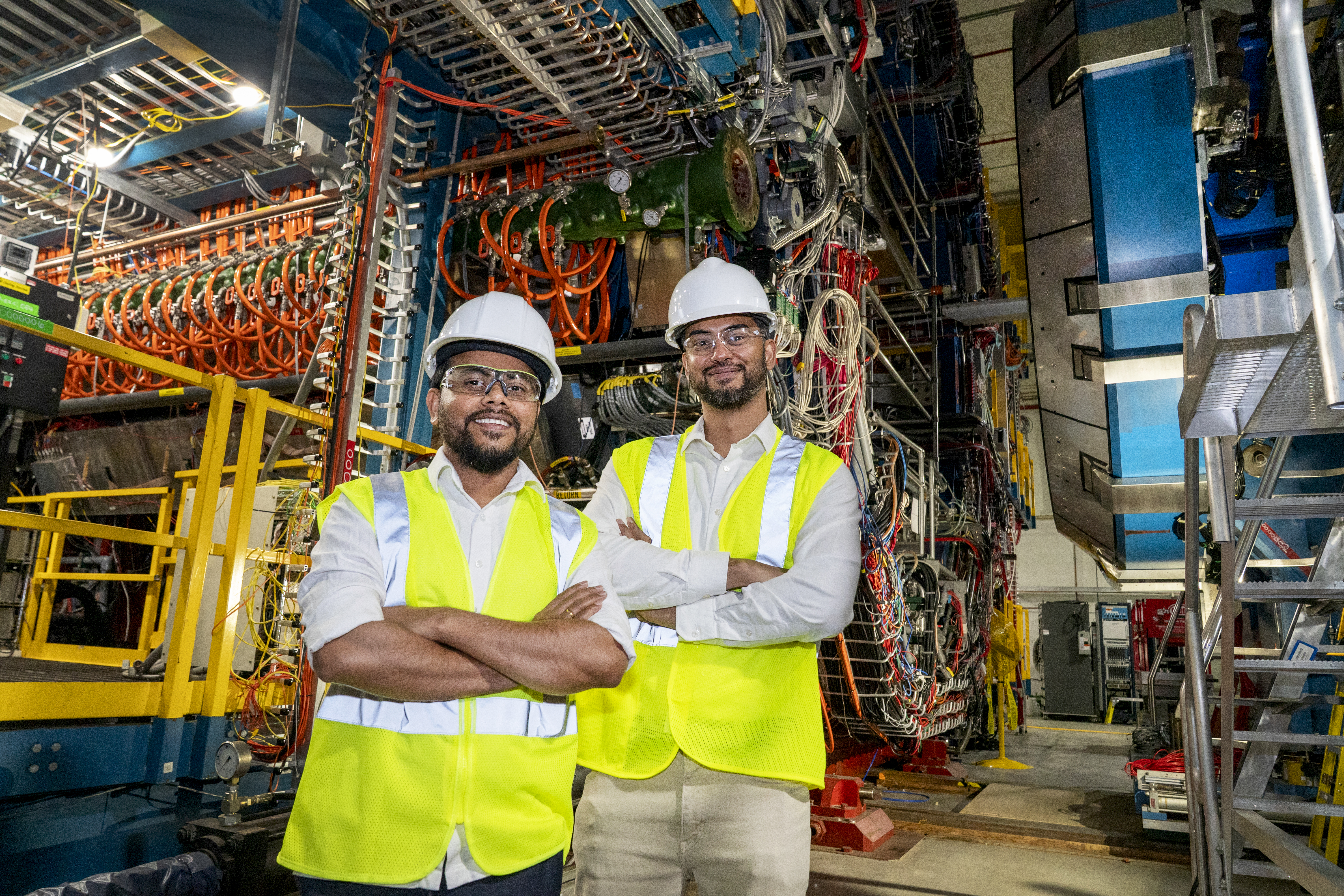
Kent State University postdoctoral research scientist Ashik Ikbal and Brookhaven Lab physicist Prithwish Tribedy stand in front of the STAR detector at the Relativistic Heavy Ion Collider (RHIC) at Brookhaven National Laboratory. The two were on a team that tracked the decay "daughters" of J/psi particles created in not-quite-colliding interactions of gold ions at RHIC. Their goal: Establish the foundation for using J/psi particles and their spin to map out the distribution of gluons within the ions. (David Rahner/Brookhaven National Laboratory)
UPTON, N.Y. — Scientists studying particle collisions at the Relativistic Heavy Ion Collider (RHIC) usually capture what happens when atomic nuclei smash into one another at nearly the speed of light. But even when the nuclei don’t collide, interesting things can happen. In a new paper just published in Physical Review Letters, members of RHIC’s STAR collaboration describe a new way to use near-miss collisions at RHIC to study what’s going on inside the nucleus. The approach advances the reach of RHIC, a U.S. Department of Energy (DOE) Office of Science user facility at DOE’s Brookhaven National Laboratory, into the next frontier in nuclear physics — a journey into the inner workings of the building blocks of matter.
The technique relies on particles of light, known as photons, that surround the nuclei as they speed around the 2.4-mile RHIC racetrack. Acting something like the beam of a giant X-ray machine, the photons around one nucleus can interact with particles called gluons inside a nucleus whizzing by in the opposite direction. By tracking the signals produced by those interactions, scientists can map out the distribution of the gluons — the gluelike particles that hold the nucleus together.
“This as an extension of the many ways people have used light to probe hidden structures in our world — from using X-rays to see broken bones and reveal the 3D atomic structures of proteins, to capturing signals from the cosmic microwave background to study the evolution of the universe,” said Ashik Ikbal, a STAR collaborator from Kent State University who carried out this work as a major component of his postdoctoral research. “In this case, we’re using light to map out features at a scale much smaller than atoms to study the gluons that hold quarks together inside the protons and neutrons of atomic nuclei.”
Nuclear physicists are particularly interested in gluons because they appear to play an outsized role in establishing the fundamental properties of protons and neutrons — the building blocks of nearly all the visible matter in our universe. Mapping out gluons is one of the central goals of the Electron-Ion Collider (EIC), a new nuclear physics research machine under construction at Brookhaven Lab that will build on RHIC’s infrastructure and science.
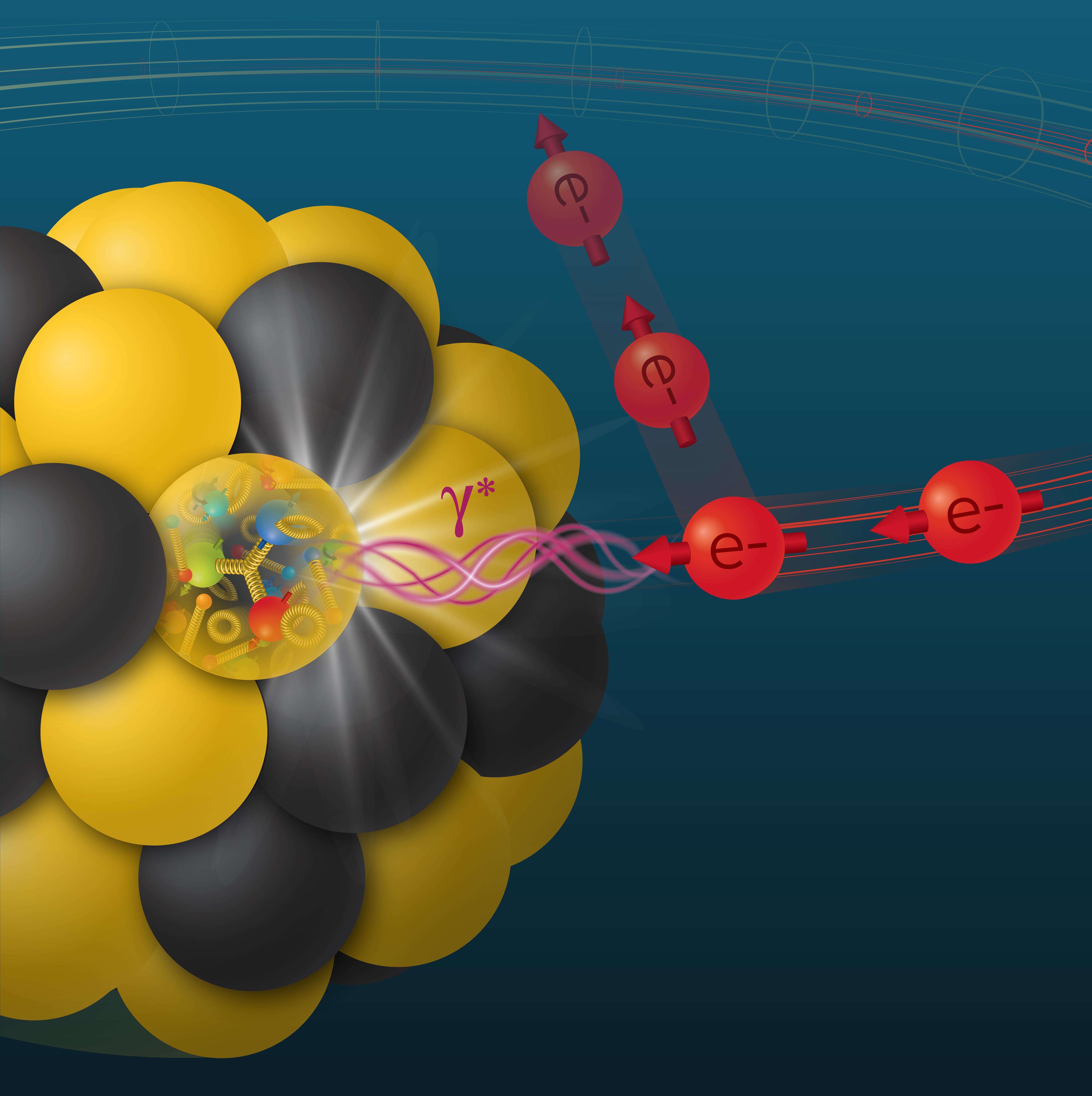
At the EIC, virtual photons emitted by electrons will provide the “beams” that scientists use to reveal gluons’ arrangements and interactions within protons and nuclei. These new results from RHIC provide a preview of this imaging technique and a way to test its assumptions.
Using light to create particles and map structures
The particles of light used in this imaging technique at RHIC are something of an artifact. They emerge as a cloud of electromagnetic energy that surrounds the positively charged ions traveling around the circular accelerator at close to the speed of light. When two ions traveling in opposite directions pass very close by one another without colliding, these “shockwaves” of energy can sometimes interact with one another to create new particles of matter and antimatter out of pure energy.
At other times, the photons create new particles by interacting with gluons inside the nuclei. For example, an earlier STAR paper traced photon-gluon interactions that generated particles known as rho mesons. STAR scientists detected those particles by looking for pairs of oppositely charged pions — the “daughters” into which the rhos decay. By tracking the pions’ speed and the angles at which they struck the detector, the scientists suggested they could use ripples of interference generated by these quantum-entangled particles to map out gluon distributions within the nuclei.
But because the rho particles decay so quickly, there was uncertainty about the origin of the interference — specifically whether it was coming from the decay “daughter” pions or the rho “parents.” In addition, the somewhat lightweight rho particles lack the “focus” to map detailed gluon features.
 enlarge
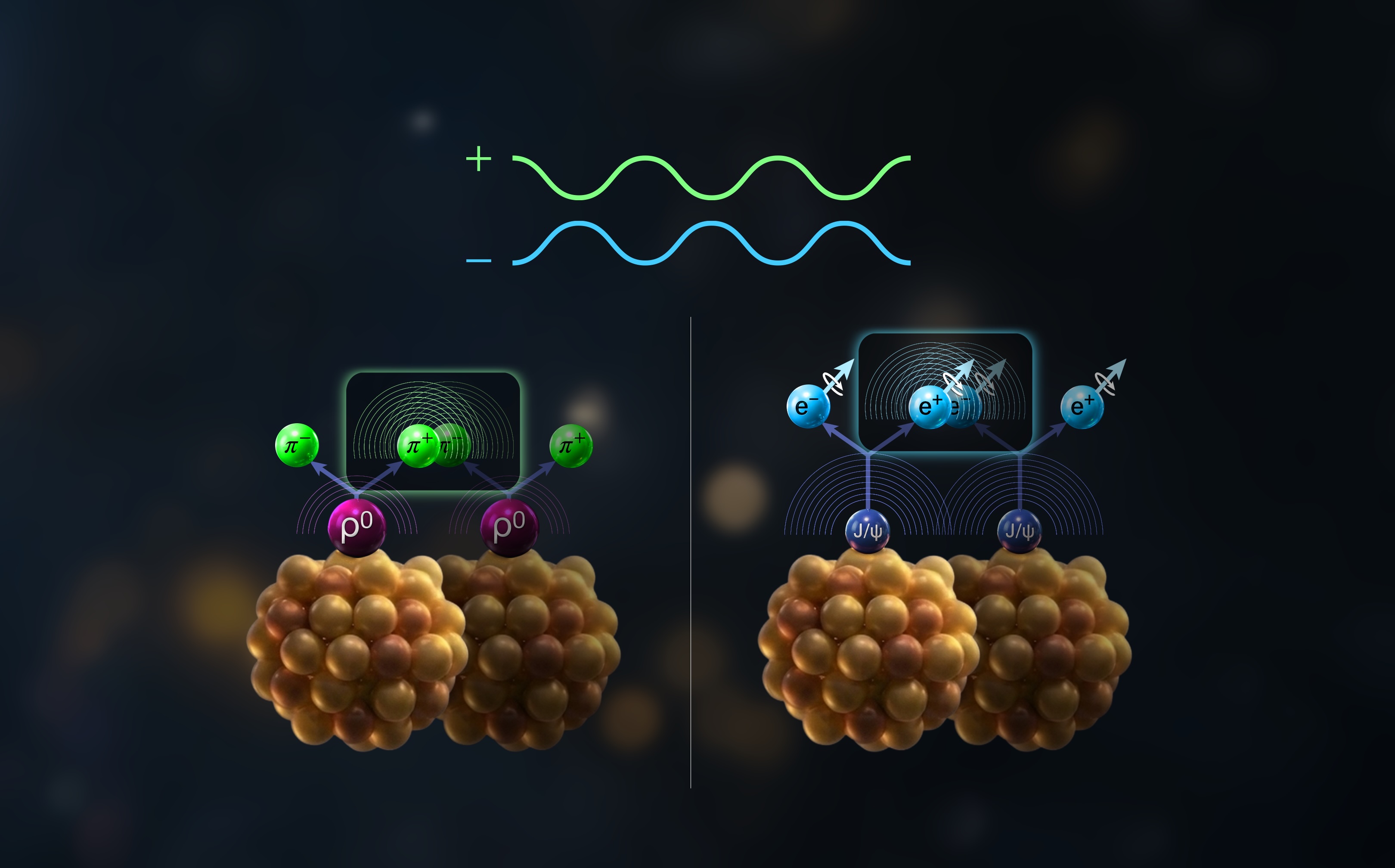
Spin reveals a sharper way to image nuclei: In near-miss gold-ion collisions at RHIC, photons from one nucleus can briefly transform into particles that probe the gluons inside the other nucleus. This image compares two such probes. On the left, short-lived rho (ρ0) particles decay into pion pairs (π-/π+), producing one interference pattern (green wave). On the right, compact J/psi (J/ψ) particles decay into electron-positron (e-/e+) pairs, which have spin. That spin flips the sign of the observed interference pattern (blue wave), revealing that spin is shaping the interference signal. The combination of spin and the higher resolution enabled by the smaller J/psi particles and add dimension and detail to the process of mapping gluons within nuclei. (Joanna Pendzick/Brookhaven National Laboratory)
Flipping the interference pattern
This new paper builds on that previous work by tracking the daughters of heavier mesons known as J/psi particles, which are also created in photon-gluon interactions.
“The heavier yet more compact structure of J/psi particles should boost their imaging resolution,” said Zebo Tang, a professor from the University of Science and Technology of China (USTC) who is one of the newly appointed deputy spokespersons for the STAR Collaboration. “J/psi particles also live longer than rhos before decaying, giving more time for separation between their own interference patterns and that of the particles into which they decay — in this case, electrons and positrons.”
Most importantly, these electron and positron daughters have a quantum property called spin, unlike the daughters of rhos. That spin completely “flips” the particles’ interference pattern compared to what the scientists saw when studying the rhos.
“If you think of a repeating wave with alternating peaks and dips, the rhos and their daughter pions produced interference waves with essentially the exact same pattern — peaks lined up with peaks, dips lined up with dips. But when we tracked the electron and positron daughters of J/psi decays, they produced the opposite pattern — opposite from the rhos, their pion daughters, and even their own J/psi parents. Wherever there were low points became high points, and the high points became low points,” said Prithwish Tribedy, a Brookhaven Lab/STAR collaboration physicist.
The scientists saw the same flipped pattern in data from near-miss collisions using three different types of ions at RHIC — gold, zirconium, and ruthenium. In fact, the interference pattern became stronger with the smaller nuclei, which is exactly what theorists had predicted would happen if the interference was being driven by the decay daughters.
“Seeing this flipped pattern and alignment with predictions in data from collisions using three different types of nuclei gives us confidence that the daughters are the true source of the interference,” said Kaiyang Wang, a student at USTC, who worked on this project as part of his PhD thesis.
What is particularly exciting is that this measurement does more than just confirm a quantum interference effect. It allows scientists to use this information and a bit of backtracking to learn how gluons are distributed within atomic nuclei.
Mapping out gluons
In the case of either the rho or J/psi decay, scientists can use the momentum distribution and angles at which the daughter particles strike the detector to infer spin information about their parent particles. This is easier for J/psi than rho, but the method works for both particles. The parent spin, in turn, gives them information about the spin alignment of the photon that triggered the initial photon-gluon interaction, the orientation of the nucleus with which it collided, and the exact location of the gluon that created the parent particle. You can think of it as a super high-tech way of “geolocating” gluons at the subatomic scale.
“The parent particles are ultimately what we are using to ‘see’ inside the nucleus, because they are the ones that are closest to the gluon-triggered action, but knowing that the daughters give us direct access to those interactions is what makes this imaging possible,” said Wangmei Zha, a professor at USTC who is a member of the STAR collaboration.
The future of gluon imaging
“This will be exactly the technique used at the EIC,” said Farid Salazar, a nuclear theorist at Temple University who helped develop the theoretical predictions used for comparison with the RHIC measurements and for the future science program at the EIC.
 enlarge
This study strengthens the case for using the spin of particles produced by light to make sharper images of gluons inside gold nuclei. This method will be used at the future Electron-Ion Collider (EIC), where virtual photons (γ*) emitted by electrons (e-) during electron-ion collisions will provide the imaging beam. (Tiffany Bowman/Brookhaven National Laboratory)
At the EIC, the photons will be emitted by electrons interacting with ions and the measurements will rely mainly on J/psi decays.
For one thing, the spins of the J/psi decay daughters make it easy to infer the parents’ spin orientation. In addition, their compact size gives them the ability to see details at a finer scale. They are also easier to describe through mathematical calculations. This makes it much easier to derive the theoretical predictions scientists use when evaluating experimental measurements — to see if the data match theorists’ predictions of how gluons are expected to behave.
One of the major mysteries physicists hope to explore at the EIC is whether gluons — which can split and recombine — reach a state of “saturation” where these splitting and recombination processes balance one another out within atomic nuclei. Other STAR findings have already shown hints of gluon recombination, a necessary step to achieving the steady state of gluon saturation. With J/psi imaging using virtual photons, the EIC may be the first to reveal definitive evidence of this new state of matter, known as a “color glass condensate.”
“RHIC operations have wrapped up, and work is beginning to transform the accelerator infrastructure at Brookhaven Lab into the EIC, but we’ll be conducting deep analyses of RHIC data for many years to come,” Brookhaven’s Tribedy said. “These analyses will undoubtedly produce many more discoveries — and help us develop the theoretical and experimental approaches for the EIC.”
Additional collaborators on this analysis include Declan Keane and Zhangbu Xu from Kent State University, Daniel Brandenburg from Ohio State University, and Shuai Yang from South China Normal University.
This research was supported by the DOE Office of Science, the U.S. National Science Foundation (NSF), and a range of international agencies and organizations listed in the scientific paper. In addition to using the Open Science Grid, supported directly by NSF, the researchers made use of computing resources in the Scientific Data and Computing Facilities at Brookhaven Lab and the National Energy Research Scientific Computing Center (NERSC), which is another DOE Office of Science user facility at DOE’s Lawrence Berkeley National Laboratory.
Brookhaven National Laboratory is supported by the Office of Science of the U.S. Department of Energy. The Office of Science is the single largest supporter of basic research in the physical sciences in the United States and is working to address some of the most pressing challenges of our time. For more information, visit science.energy.gov.
Follow @BrookhavenLab on social media. Find us on Instagram, LinkedIn, X, and Facebook.
2026-22878 | INT/EXT | Newsroom