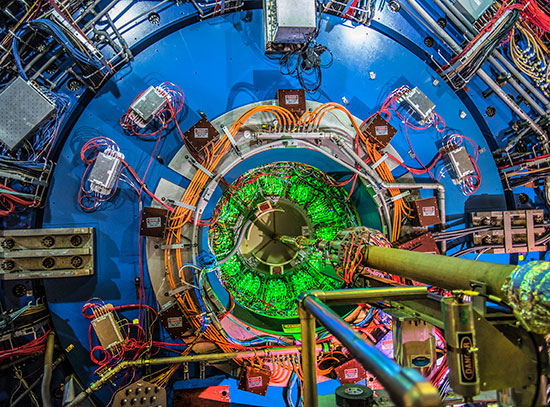
EIC Radiofrequency Controls System Passes First Real-World Test
Milestone demonstrates new approach to operating critical systems for future collider
June 22, 2026
 enlarge
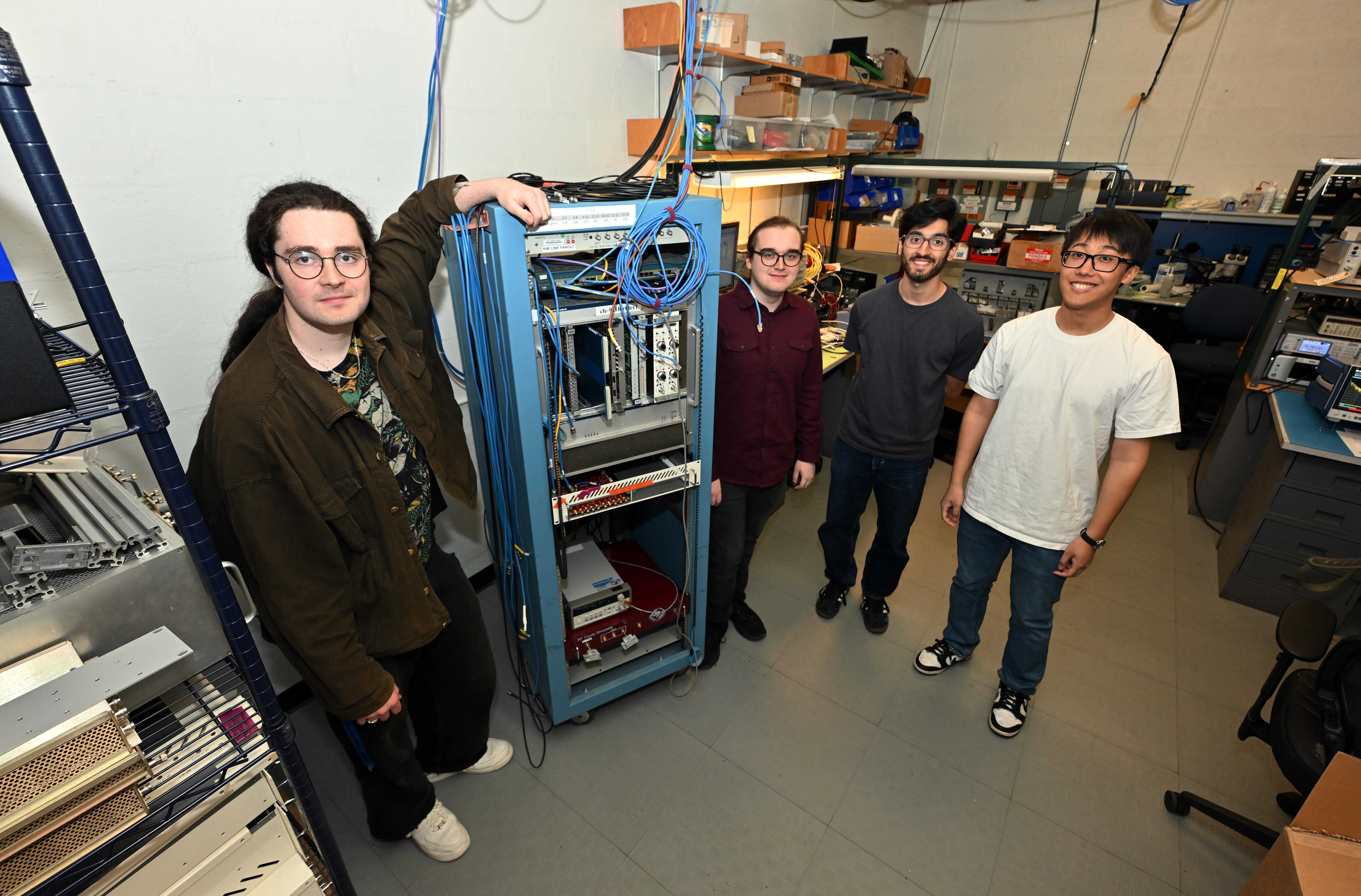
Early-career engineers (left to right) Michael McCooey, Alex Fahey, Arshdeep Singh, and Samson Mai played a central role in the first successful real-world test of the Electron-Ion Collider's (EIC) Common Platform-based low-level radiofrequency controls system — a key milestone toward future EIC operations. (Kevin Coughlin/Brookhaven National Laboratory)
UPTON, N.Y. — The U.S. Department of Energy’s (DOE) Brookhaven National Laboratory has reached a key early milestone in developing radiofrequency control systems for the Electron-Ion Collider (EIC) — a next-generation research facility that will collide electrons with ions to reveal how the building blocks of matter are held together.
At the heart of any particle accelerator are radiofrequency (RF) systems, which use electromagnetic waves to accelerate particle beams to near light speed and keep them tightly controlled. The system tested here — known as low-level radiofrequency (LLRF) — acts as the “brain,” precisely controlling those RF fields to ensure stable and accurate operation.
This milestone marks the first successful test of the newly built EIC common platform-based LLRF electronics on a real accelerator cavity. The common platform is a shared hardware and controls system for accelerator operations, allowing teams to use the same technology rather than create separate electronics for each system.
For the first time, the system moved beyond simulations and controlled lab environments to operate as a fully integrated setup. The test demonstrated that the system can reliably maintain stable operating conditions under real-world constraints, confirming the design is on track for future EIC operations.
“This was the first time we used our new hardware on a real RF cavity, with the full system — amplifiers, cavity, and controls — all working together,” said Kevin Mernick, an engineer at Brookhaven Lab and a technical lead for the common platform effort.
From fragmented systems to a unified approach
The milestone reflects a broader shift in how accelerator systems are designed.
In earlier facilities such as the Relativistic Heavy Ion Collider (RHIC) — a DOE Office of Science user facility at Brookhaven Lab that completed operations in February 2026 — subsystems often relied on custom-built electronics. While effective, that approach led to duplicated effort and limited interoperability. The common platform was developed to unify those efforts into a shared architecture that multiple groups can use and build upon.
“This platform has been in the works for more than three to four years,” said Geetha Narayan, an engineer at Brookhaven Lab and project manager for the EIC LLRF controls subsystem. “It was an effort to coordinate different groups using different hardware platforms to access the control systems.”
The platform supports a wide range of EIC systems — including RF controls, beam instrumentation, and monitoring — while reducing costs and accelerating deployment.
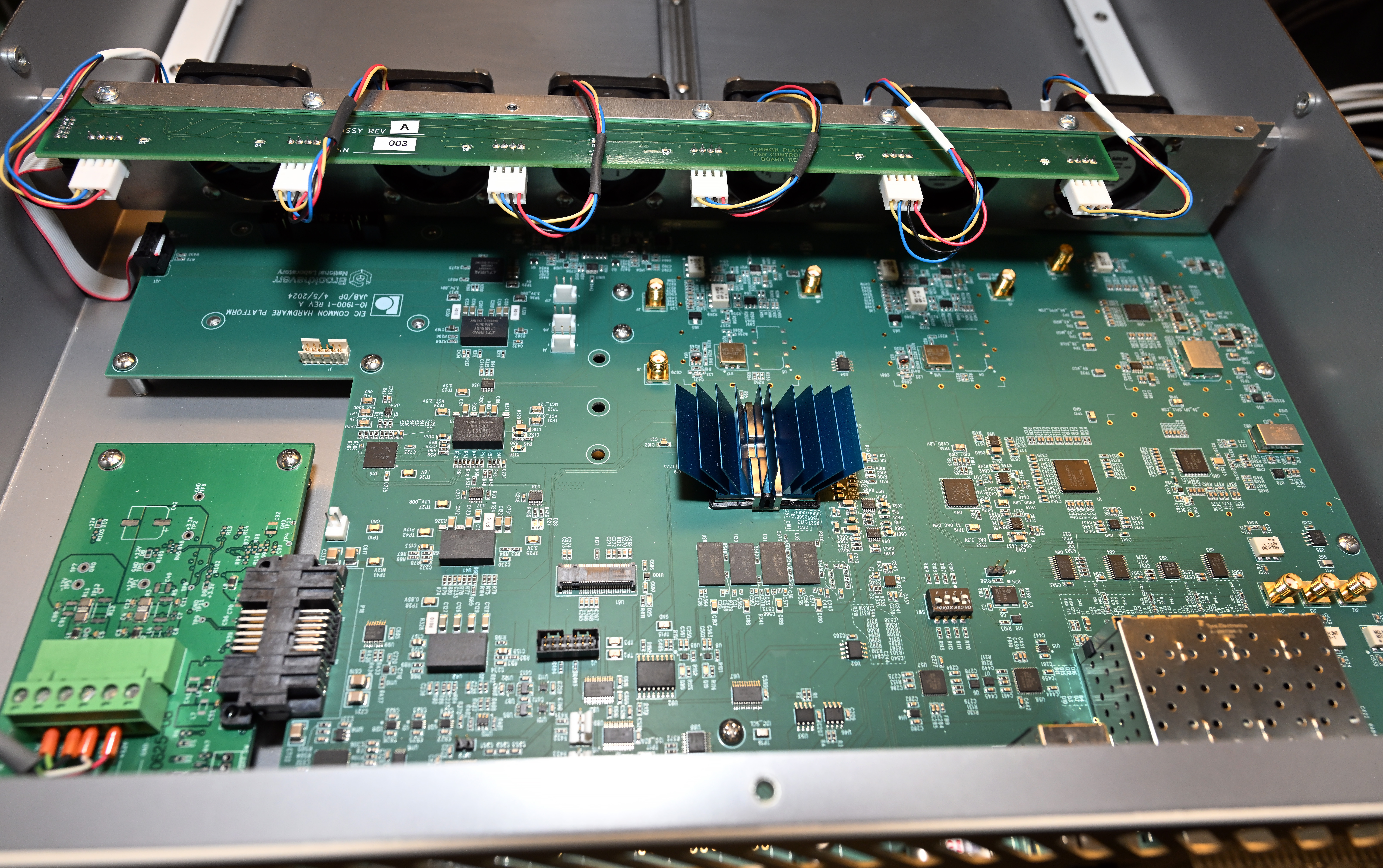
At its core is a modular design. A central carrier board connects to the network, distributes timing signals, and coordinates data flow. Plug-in daughter cards provide specialized functionality, allowing groups to customize components while maintaining compatibility.
“Each group can customize based on what they need,” Narayan said. “But what is standard is the timing, data link, system clock, and network capability that the carrier provides.”
 enlarge
The Common Platform, developed by engineers at Brookhaven National Laboratory and Thomas Jefferson National Accelerator Facility, is more compact, more powerful, and capable of faster data transfer. It supports a wide range of systems — including radiofrequency controls, beam instrumentation, and monitoring — while reducing costs and accelerating deployment. This milestone reflects a broader shift in how accelerator systems are designed. (Kevin Coughlin/Brookhaven National Laboratory)
Advancing beyond legacy systems
The LLRF system plays a critical role by controlling RF cavities, which transfer energy to particle beams. It must continuously monitor conditions and make rapid adjustments to maintain precise voltage and phase.
Operators send setpoints through the network to the carrier board, which relays them to daughter cards. There, field-programmable gate arrays process incoming signals and run feedback algorithms at high speed, comparing real-time conditions to desired values and making constant corrections.
“They’re running continuously, updating at a very fast rate to make these little corrections,” Mernick said. “It corrects for fast fluctuations and long-term drift and keeps the cavity voltage at the set point.”
This represents a significant advancement over legacy RHIC systems, which relied on larger, less integrated electronics. The common platform is more compact, more powerful, and capable of faster data transfer, with planned rates up to 8 gigabits per second.
Overcoming challenges, proving the design
During the test, the system ran continuously for several days, maintaining stable control of the RF cavity and accurately tracking setpoints. Results showed that performance observed in laboratory testing translated successfully to real-world operation, including improved noise performance.
“It was maintaining the voltage on the cavity at the correct set point that we had requested,” Mernick said. “The controller performance that we measured in the lab carries through to running the full RF system with the controller, power amplifier, and cavity all together.”
The team worked under a compressed timeline, with about two weeks to complete testing before RHIC systems were shut down and repurposed for the EIC.
“It didn’t work perfectly on day one,” Mernick said. “We made a lot of progress in those two weeks, fixing bugs.”
That rapid iteration helped identify issues not apparent in simulations, strengthening both hardware and control algorithms.
Early career engineers take the lead
The project brought together experts from multiple groups at Brookhaven Lab, along with collaborators from other institutions, including DOE’s Thomas Jefferson National Accelerator Facility.
Early career engineers played a central role in implementation and testing.
“I was involved with some of the firmware development, but mainly with verifying our integrated system,” said Arshdeep Singh, an associate staff electrical engineer at Brookhaven Lab. “I developed test benches and simulation tools to evaluate our designs in the lab and ensure we were ready for testing with a real cavity.”
“It was very encouraging for the early career engineers to see a reward for their efforts.”
— Geetha Narayan, project manager for the EIC LLRF controls subsystem
Singh said the transition to real-world testing revealed important lessons.
“While we have strong simulation tools that verify major components of our design, this testing taught me about some of the smaller — but critical — details that we need to examine more thoroughly in the lab,” he said. “My main takeaway is the knowledge and experience of what can go wrong.”
He also emphasized the team environment. “It was also fun working with other early career engineers,” Singh said. “It was a learning experience for all of us as we worked through and solved various problems leading up to the test.”
“It’s a big collaboration,” Mernick said. “It’s pulling together people from different departments of the Lab to use the expertise that we have spread through lots of different people.”
He added, “The new guys were leading this whole process. I was just there to help out.”
For Narayan, that collaboration — and the opportunity for early career staff to take ownership — was a key success. “The key thing was getting the team to work together,” she said. “It was very encouraging for the early career engineers to see a reward for their efforts.”
Looking ahead, the common platform is expected to serve as a foundation for many EIC subsystems, enabling coordinated system development and efficient data sharing. Its flexible architecture also opens the door to future innovations, including advanced data analysis and potential integration of artificial intelligence tools.
With RHIC now shut down, opportunities for full-system testing will be limited in the near term. The team will continue refining the system in laboratory environments while preparing for future integration.
“The next chance to do this work may be a year or more away, when Brookhaven and Jefferson Labs test critical EIC components before they are installed in the accelerator tunnel,” said Narayan. “That’s why this is important for us — a proof of concept to know we are on the right track.”
Brookhaven National Laboratory is supported by the Office of Science of the U.S. Department of Energy. The Office of Science is the single largest supporter of basic research in the physical sciences in the United States and is working to address some of the most pressing challenges of our time. For more information, visit science.energy.gov.
Follow @BrookhavenLab on social media. Find us on Instagram, LinkedIn, X, and Facebook.
2026-22988 | INT/EXT | Newsroom