Next-Generation Collider Programs Strengthen Global Collaboration
Electron-Ion Collider and CERN expand technical partnerships
July 20, 2026
 enlarge
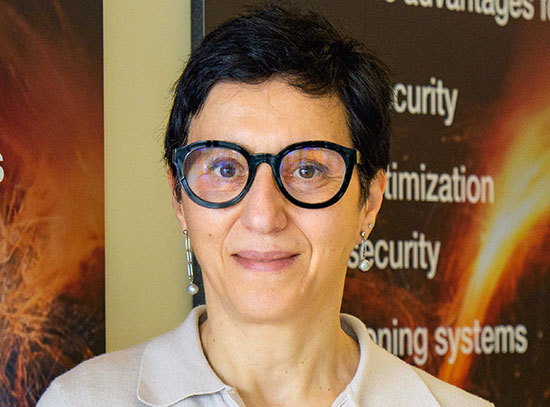
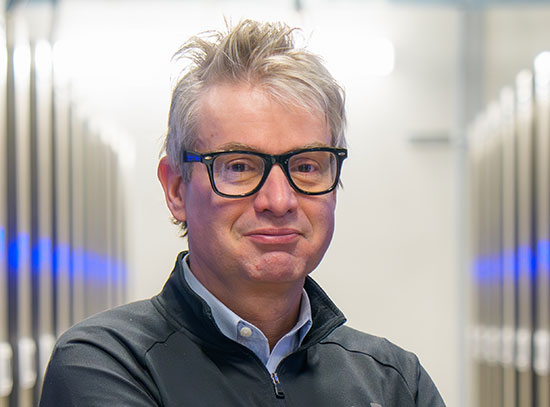
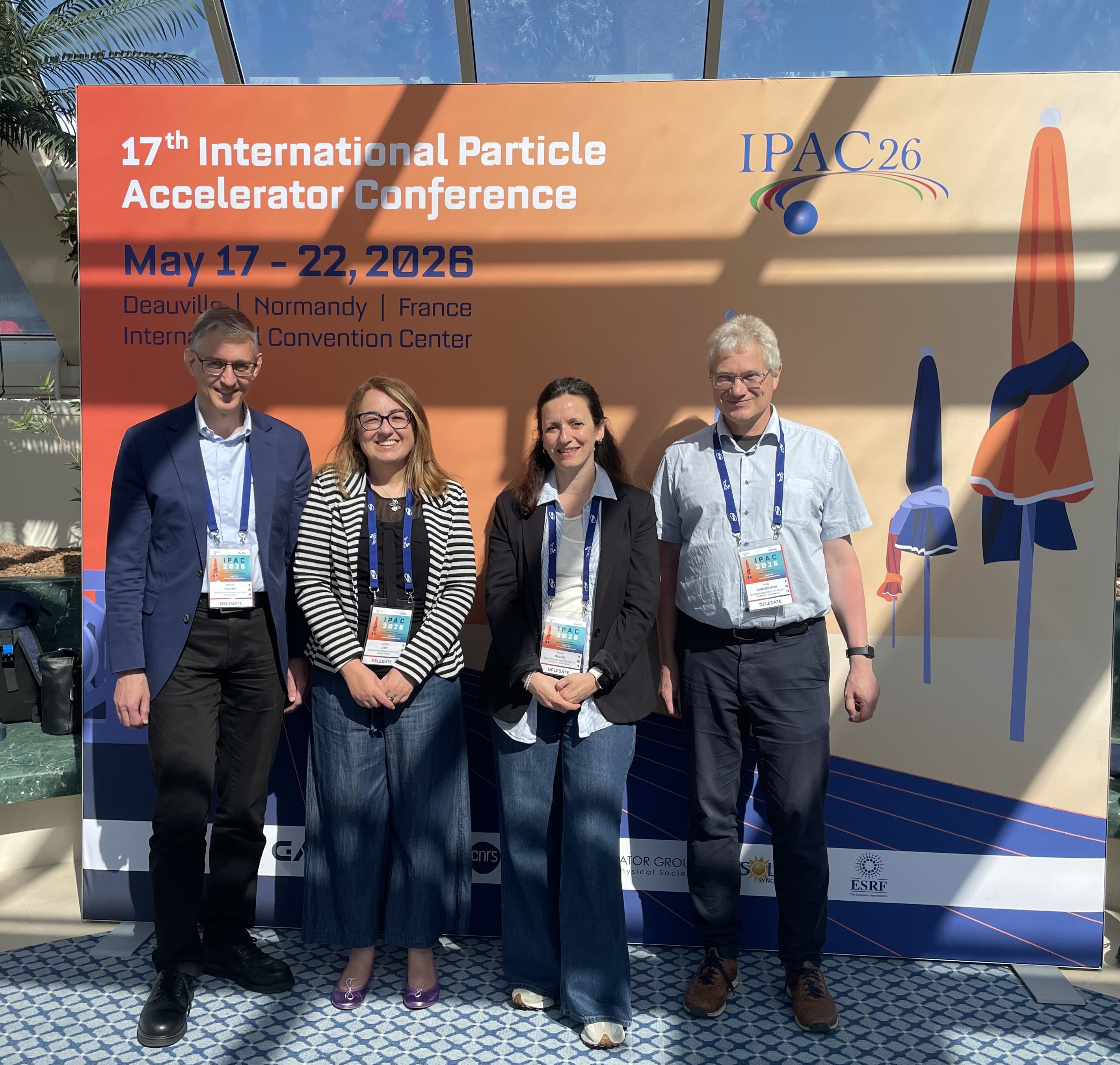
From left: Wolfram Fischer, chair of Brookhaven National Laboratory's Collider-Accelerator Department and co-chair of the Electron-Ion Collider Accelerator Collaboration (EICAC); Luisella Lari, associate director for strategic partnerships for the Electron-Ion Collider (EIC) Project; Tatiana Pieloni, co-chair of the EICAC and scientist at École Polytechnique Fédérale de Lausanne; and Frank Zimmermann, deputy leader of Future Circular Collider Studies at CERN, the European Organization for Nuclear Research, led an international satellite meeting dedicated to the EICAC during the 17th International Particle Accelerator Conference (IPAC'26), the accelerator community's premier annual conference, in Deauville, France. The meeting brought together researchers from around the world to strengthen technical collaboration supporting the EIC and future collider programs. (Luisella Lari)
The U.S. Department of Energy's (DOE) Brookhaven National Laboratory and its international partners are expanding technical collaboration supporting the Electron-Ion Collider (EIC), with recent engagements at the 17th International Particle Accelerator Conference (IPAC'26) and Future Circular Collider (FCC) Week 2026 strengthening partnerships between the EIC and FCC program at CERN, the European Organization for Nuclear Research.
In May and June, EIC leaders and collaborators met with accelerator experts in Europe to advance the EIC Accelerator Collaboration (EICAC), address shared technical challenges, and identify joint research opportunities that will benefit both the EIC and future collider projects.
“The EIC is a global endeavor. Its design and construction depend on the expertise of partners from around the world, and we actively promote technical collaborations to deliver a facility that is international in both character and capability,” said Jim Yeck, EIC project director.
The EIC, to be built at Brookhaven Lab in partnership with DOE’s Thomas Jefferson National Accelerator Facility (Jefferson Lab), will be the world's first polarized electron-ion collider, using beams whose particles have aligned spins to reveal the internal structure and dynamics of protons and nuclei with unprecedented precision.
Delivering unprecedented scientific capabilities requires advances in accelerator technologies and expertise from institutions around the world, making international partnerships a key component of the project's success.
 enlarge
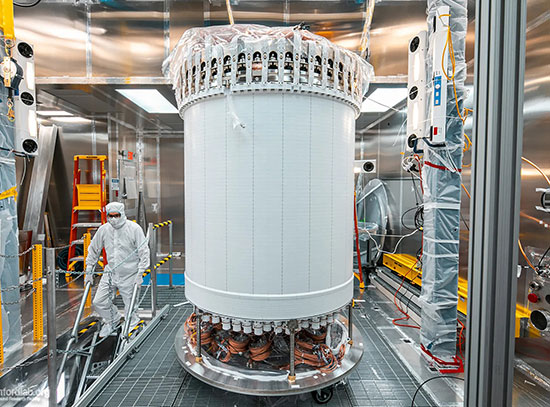
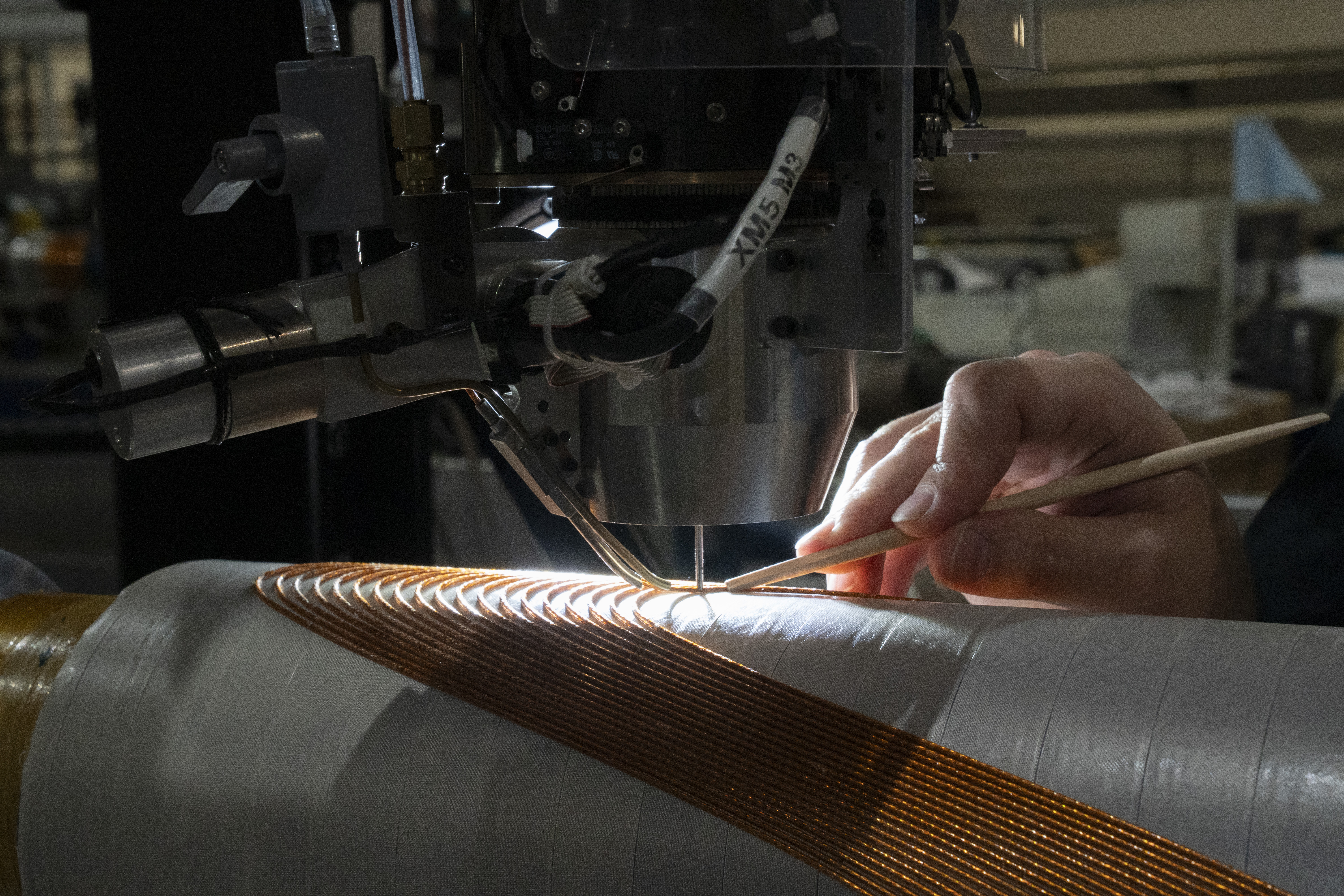
Direct-wind magnet technology developed at Brookhaven National Laboratory enables engineers to precisely wind superconducting wire into accelerator magnets with complex magnetic field patterns. During recent meetings of the Electron-Ion Collider Accelerator Collaboration, researchers highlighted the technology as one example of how expertise developed for the EIC can benefit future collider projects, including studies at CERN, the European Organization for Nuclear Research. (Jessica Rotkiewicz/Brookhaven National Laboratory)
Accelerator collaboration explores future opportunities
 enlarge
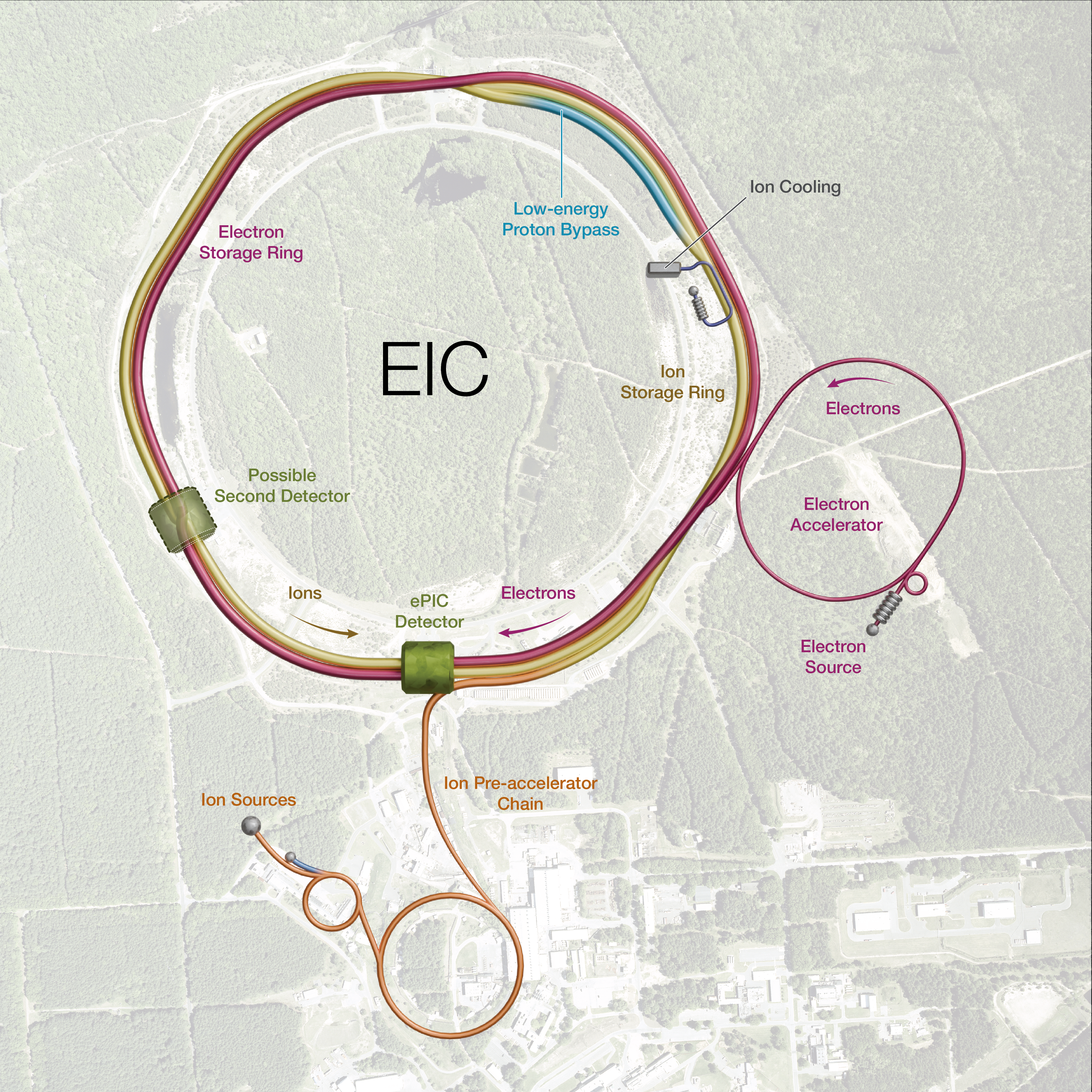
An aerial rendering of the Electron-Ion Collider (EIC), the world's first polarized electron-ion collider, shows the 2.4-mile-circumference facility that will be built at Brookhaven National Laboratory using existing infrastructure from the Relativistic Heavy Ion Collider and advanced accelerator technologies to enable precision studies of the fundamental building blocks of visible matter. International collaborators are working together to develop accelerator technologies that will support the EIC and future collider facilities. (Valerie Lentz/Brookhaven National Laboratory)
EIC leaders and collaborators gathered during IPAC'26 in Deauville, France, for a satellite meeting focused on the EICAC and its connections to studies for CERN's proposed FCC, the next-generation particle collider at CERN.
Widely regarded as the field's most important annual gathering, IPAC brings together the global accelerator community to share breakthroughs, develop collaborations, and advance plans for future scientific facilities.
The EICAC meeting was led by Wolfram Fischer, co-chair of the EICAC and chair of the Collider-Accelerator Department at Brookhaven Lab; Tatiana Pieloni, co-chair of the EICAC and a scientist at École Polytechnique Fédérale de Lausanne; Frank Zimmermann, deputy leader of FCC Studies at CERN; and Luisella Lari, a senior scientist who led the EIC project as project manager for four years and is transitioning to associate director for strategic partnerships.
"The EIC and FCC are the next generation colliders, and collaboration is essential for the success of these machines,” Fischer said.
Participants discussed project updates, progress across EICAC working groups, technical challenges, and opportunities to expand collaboration beyond the immediate scope of the EIC.
“By sharing expertise and pursuing common technical challenges, these partnerships strengthen the EIC while advancing accelerator science more broadly,” said EIC Technical Director Sergei Nagaitsev.
Participants also identified specific opportunities for joint studies and technology development, including a potential second interaction region for the EIC and accelerator technologies relevant to both the EIC and FCC research programs.
"The EIC and FCC are the next generation colliders, and collaboration is essential for the success of these machines.”
— Wolfram Fischer, co-chair of the EICAC and chair of the Collider-Accelerator Department at Brookhaven Lab
"Brookhaven Lab and CERN each bring unique strengths to this collaboration. Our goal is to establish a framework for sharing knowledge across two different machines," Lari said. "That collaboration will help us identify technologies that can be scaled."
Participants highlighted examples of complementary strengths between the two communities. CERN has expressed interest in direct-wind magnet technology pioneered at Brookhaven Lab for the Relativistic Heavy Ion Collider, a DOE Office of Science user facility, while CERN's extensive experience operating large proton-proton colliders offers valuable insights that could inform future EIC studies and technical developments.
The meeting also marked the establishment of an EICAC board, providing additional structure for the growing collaboration and helping coordinate future technical exchanges among participating institutions. Attendees agreed to continue discussions through follow-up meetings and joint studies.
EIC accelerator design featured at FCC Week 2026
 enlarge
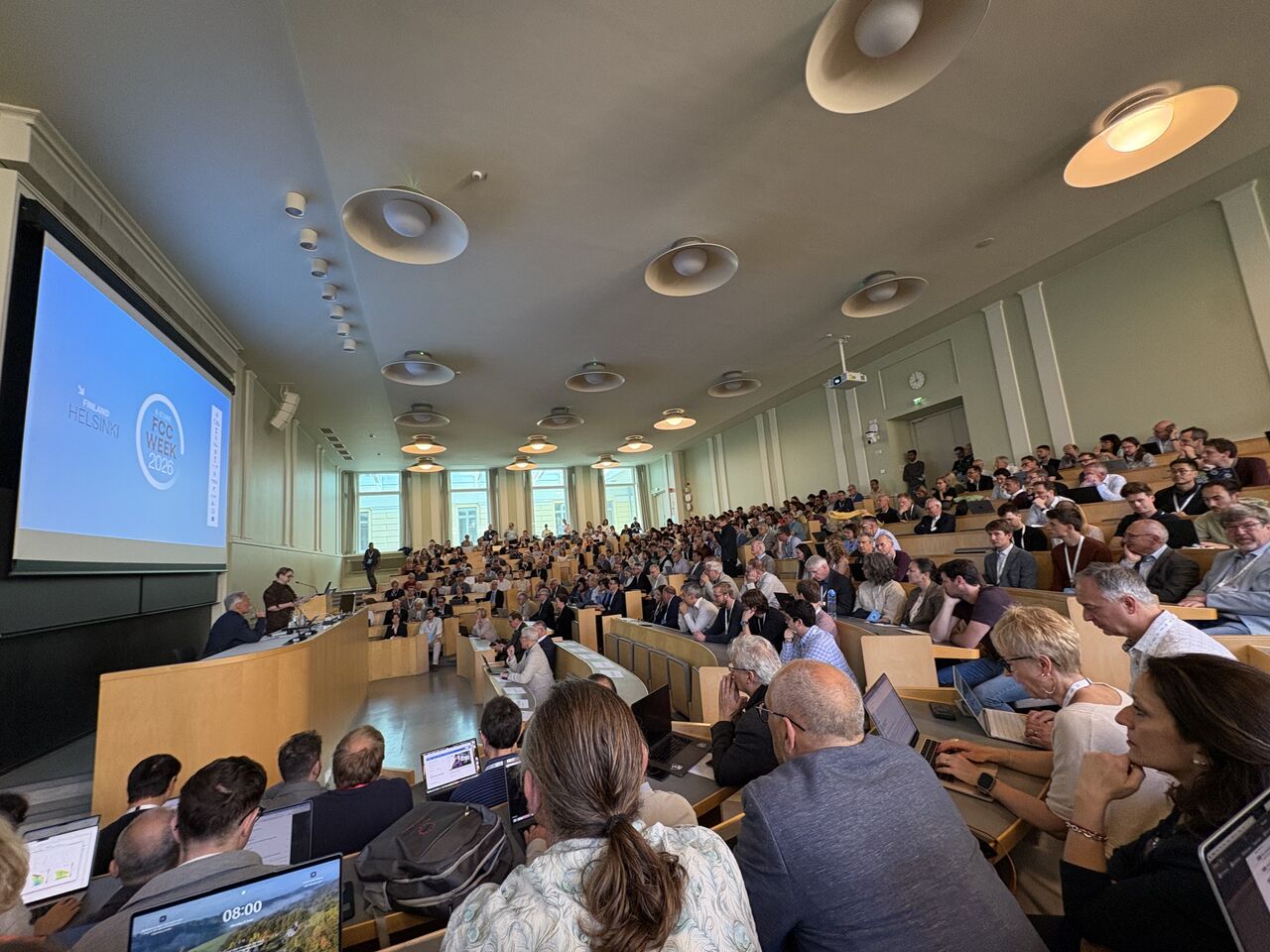
More than 700 scientists, engineers, and students from around the world attended FCC Week 2026 in Helsinki, Finland, in June 2026. The annual conference brings together the international accelerator community to advance research and technical collaborations supporting future collider facilities, including Future Circular Collider studies at CERN, the European Organization for Nuclear Research, and the Electron-Ion Collider at Brookhaven Lab. (Rebeca Gonzalez Suarez)
The EIC built on the momentum of IPAC'26 by showcasing its innovative accelerator design at FCC Week 2026 in Helsinki, Finland. The annual flagship meeting of CERN's FCC study community brought together hundreds of accelerator scientists, engineers, and researchers to discuss technologies and concepts that will shape the next generation of particle colliders.
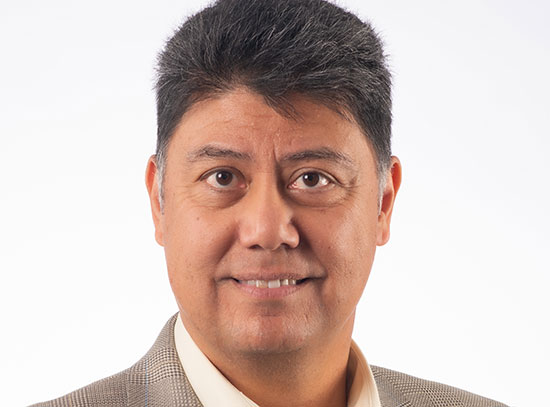
At the conference, Christoph Montag, an EIC accelerator systems manager, presented the EIC's innovative accelerator design and its technical synergies with CERN's proposed FCC-electron-positron (FCC-ee) collider.
"We're tackling many of the same accelerator challenges. When we compare design approaches and share what we've learned, both projects benefit. Those exchanges help us refine our ideas,” Montag said.
Discussions underscored opportunities for the EIC and CERN to address shared accelerator challenges, including achieving high luminosity — the rate at which particles collide — across a broad range of collision energies, while advancing technologies that could benefit future collider projects.
Brookhaven National Laboratory is supported by the Office of Science of the U.S. Department of Energy. The Office of Science is the single largest supporter of basic research in the physical sciences in the United States and is working to address some of the most pressing challenges of our time. For more information, visit science.energy.gov.
Follow @BrookhavenLab on social media. Find us on Instagram, LinkedIn, X, and Facebook.
2026-23020 | INT/EXT | Newsroom