Built for Discovery: LBMS at Five Years
Launched during a global pandemic, the Laboratory for BioMolecular Structure has grown into a world-class cryo-EM user facility
August 26, 2026
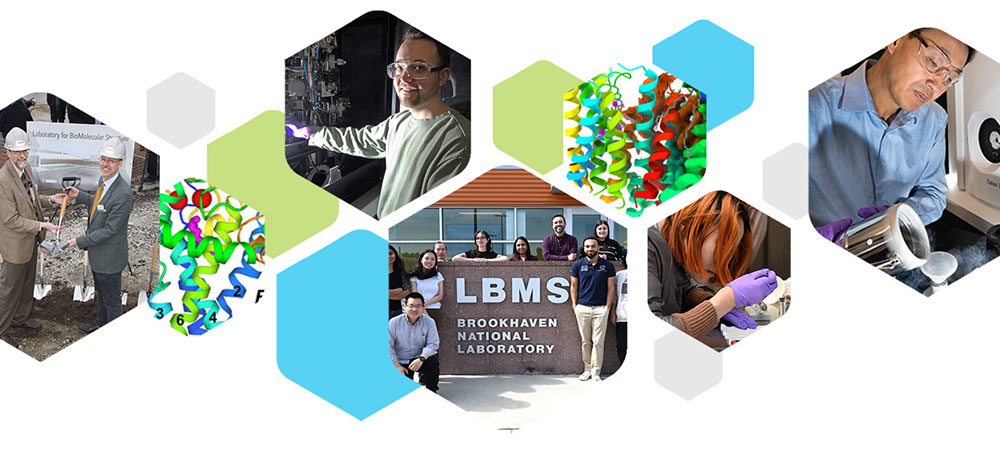
In late 2018, construction started on a new cryo-electron microscopy (cryo-EM) center at the U.S. Department of Energy’s (DOE) Brookhaven National Laboratory: the Laboratory for BioMolecular Structure (LBMS). Just three years later, the facility welcomed its first group of users, marking the beginning of a new chapter for structural biology research at the Lab. Five years after opening its doors, LBMS has established itself as a world-class center for life science imaging, enabling high-impact discoveries across a wide range of biological research.
Integrated within the National Synchrotron Light Source II (NSLS-II), a DOE Office of Science user facility, LBMS offers researchers state-of-the-art electron microscopy instruments and laboratory resources to investigate the building blocks of all living organisms and their behavior. The facility supports high-resolution data collection for single-particle cryo-EM work, and cryo-Electron Tomography (cryo-ET) work, enabling scientists to investigate biological structures and processes with unprecedented detail.
In just five years, LBMS has become a premier national cryo-EM user facility, collecting more than 1 million biological images annually, supporting publications in leading scientific journals, and enabling researchers to deposit nearly 100 new structures into the Electron Microscopy Data Bank each year.
“Cryo-EM is a bit like crystallography was 30 years ago,” said Liguo Wang, director of scientific operations at LBMS. “There was a point where crystallography experienced exponential growth, and now cryo-EM has reached a similar phase. The technique is rapidly expanding, and we want to help the research community better understand it so that they can take advantage of its capabilities.”
A collaborative foundation
 enlarge
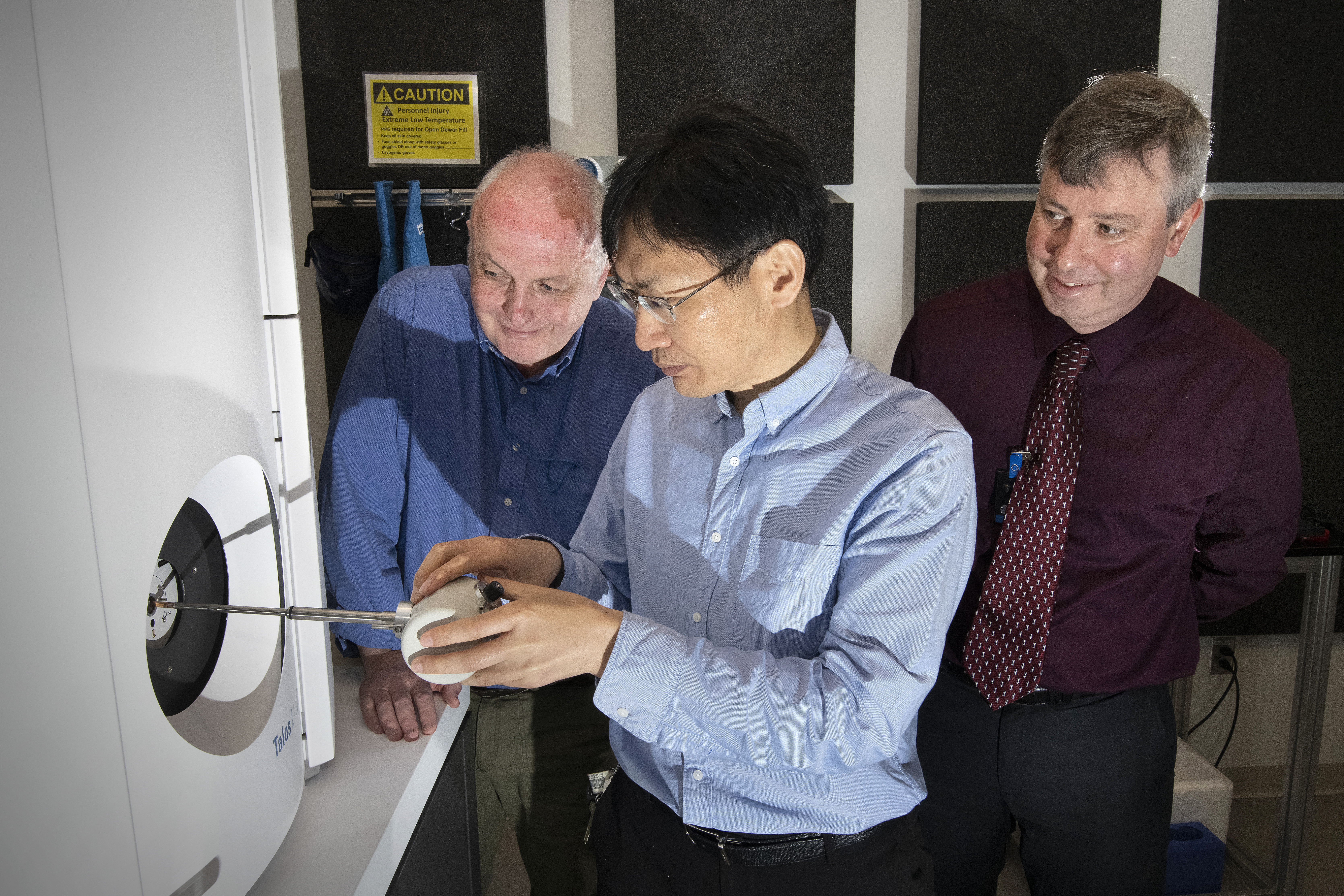
Interim Deputy for Strategy at NSLS-II Sean McSweeney (left), structural biologist Qun Liu, and Project Manager Julian Adams place a sample into the 'Powell' Screening Electron Microscope at LBMS for one of the instrument's first science commissioning experiments. (Roger Stoutenburgh/Brookhaven National Laboratory)
The center’s origins reflect a strong partnership between federal and state investments in scientific infrastructure. In recognition of New York State’s generous support for the facility’s construction and instrumentation, each laboratory and its associated microscope was named after a notable New York landmark, including the flagship high-end Krios electron microscope, Empire.
“We wanted to do something different with this space,” said Senior Advisor to NSLS-II Director Erik Johnson, who was then the NSLS-II deputy director for construction. “The design team brought ideas to life that visually represented our New York identity and highlighted the role that the state played in getting us up and running.”
Today, LBMS continues to build on a collaborative foundation through strong partnerships with institutions whose complementary expertise and shared research goals help advance scientific discovery. That spirit of partnership, collaboration, and support shows up in many ways. Facility operations are supported by DOE’s Biological and Environmental Research (BER) program, ensuring that LBMS remains a vital resource for the scientific community. By providing researchers from across the country with access to cutting-edge cryo-EM capabilities, LBMS also advances the missions of federal agencies and programs, including DOE BER and the National Institutes of Health, to deepen scientists’ understanding of life, health, and the natural world.
“It took a lot of work and a lot of investment to get to this point, but we’re able to do some amazing things at this facility,” said Sean McSweeney, director of the Biological, Environmental, and Planetary Sciences Division at NSLS-II and LBMS and interim deputy for strategy at NSLS-II. “LBMS has proven itself to be a valuable resource, not only to these key agencies and the work that they’re doing but to the broader research community.”
Trial by virus
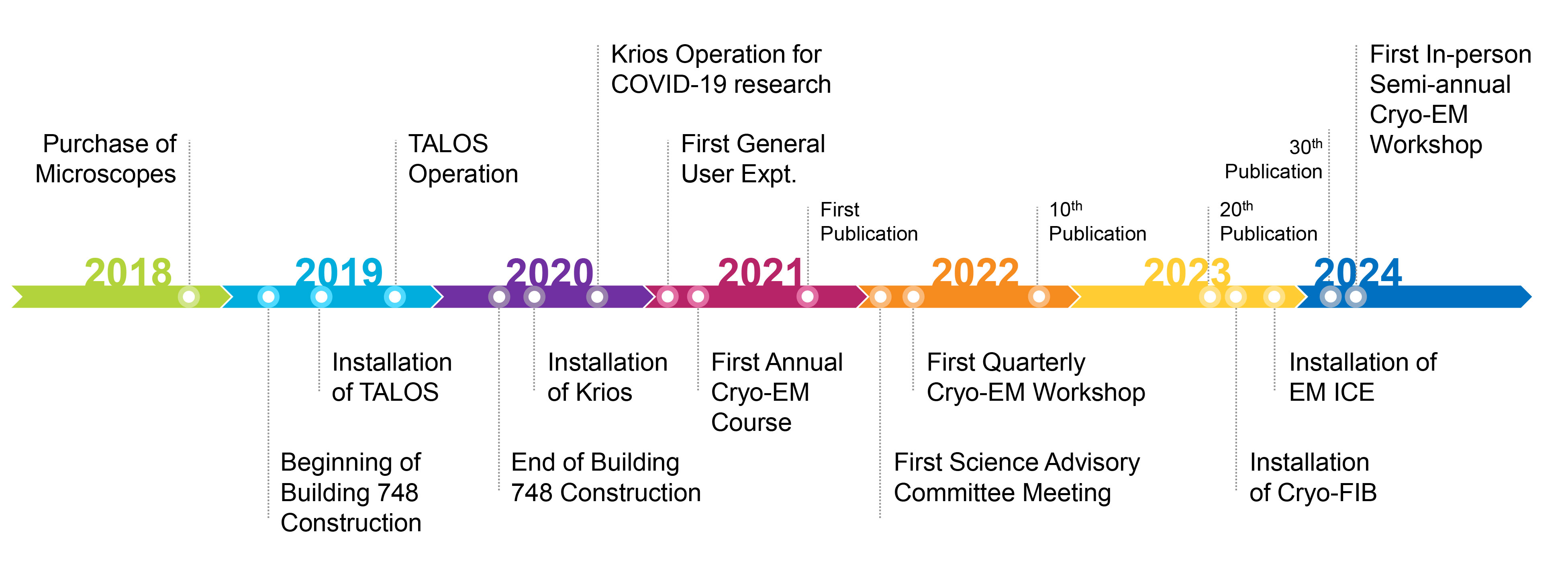
Research at LBMS initiated quickly during the COVID-19 pandemic, starting in 2020. While so much of the world was shut down, LBMS started operations earlier than scheduled to enable urgent biological studies. Despite some of the challenging limitations that were put in place to ensure safety, essential COVID-related structural biology research pressed on to uncover major breakthroughs when they were needed most. This time period remains a testament to the hard work and dedication of the LBMS team.
One great example of this work is captured in a paper published in Nature Communications from 2021 that describes insights on how complex protein interactions influence the virulence and severity of the virus. Scientists used cryo-EM to determine the structures of the virus envelope and its relationship to the human junction protein PALS1, including a pocket where the envelope is able to insert itself. This shed light on targets for therapeutics that could block those interactions and reduce envelope mediated virulence.
“Having to execute this project during COVID actually sped it up,” Johnson said. “After the microscope vendor asked whether we would be working on COVID-related problems, and we told them we were, they moved up the delivery of our high-end microscope faster than originally promised. We revised the entire project schedule and even moved the microscope into the building before construction was fully completed.”
This was just the start of LBMS’s story, though. With each passing year, the facility continues to expand its capabilities and scientific impact. In 2025, the facility collected more than 1,076,086 biological images over its 242 days of active user operations. Research conducted at LBMS also achieved significant visibility, with 62.5% of papers published in 2025 appearing in high-impact journals with an impact factor greater than seven. In addition, users deposited 94 electron microscopy maps into the Electron Microscopy Data Bank, further contributing valuable resources to the broader scientific community.
Major impacts
Moving beyond the immediate demands of the pandemic, the LBMS team was eager to apply its expertise to the many complex life science questions and challenges ahead. One such challenge was gaining a better understanding of CRISPR and the CRISPR-associated protein 9 (Cas9) enzyme. This groundbreaking gene-editing technology enables scientists to modify mutated or disease-causing genes in living organisms. Although researchers have made remarkable progress in the relatively short time since CRISPR technologies have emerged, important questions still remain. Exploring these mysteries and testing new theories could help unlock an even deeper understanding of how this powerful tool works and new ways that it can be applied to improve health and well-being.
One of these high-impact publications, research led by Cornell University and published in a 2022 Science paper, revealed that Cas9 likely evolved from a smaller ancestral enzyme, IscB, with key functions shifting from RNA molecules to protein components while preserving the fundamental mechanism of DNA recognition and cleavage. These evolutionary insights were made possible through high-resolution cryo-EM reconstructions that revealed structural similarities between the two systems. CRISPR remains one of the most transformative biotechnologies in modern science and the team at LBMS is excited to see what comes next.
More recently at LBMS, a group led by Ohio State University studied an enzyme called methylthio-alkane reductase (MAR) and how bacteria use it to break down sulfur compounds releasing ethylene, a widely used petrochemical that has a range of applications spanning from plastic manufacture to ripening fruit. Their results were published in Nature Catalysis last year. This work can help researchers engineer enhanced versions of the MAR enzyme to make ethylene production cost-competitive with current industrial methods. It was a strong example of multidisciplinary collaboration, combining expertise in X-ray crystallography, cryo-EM, and biochemistry.
 enlarge
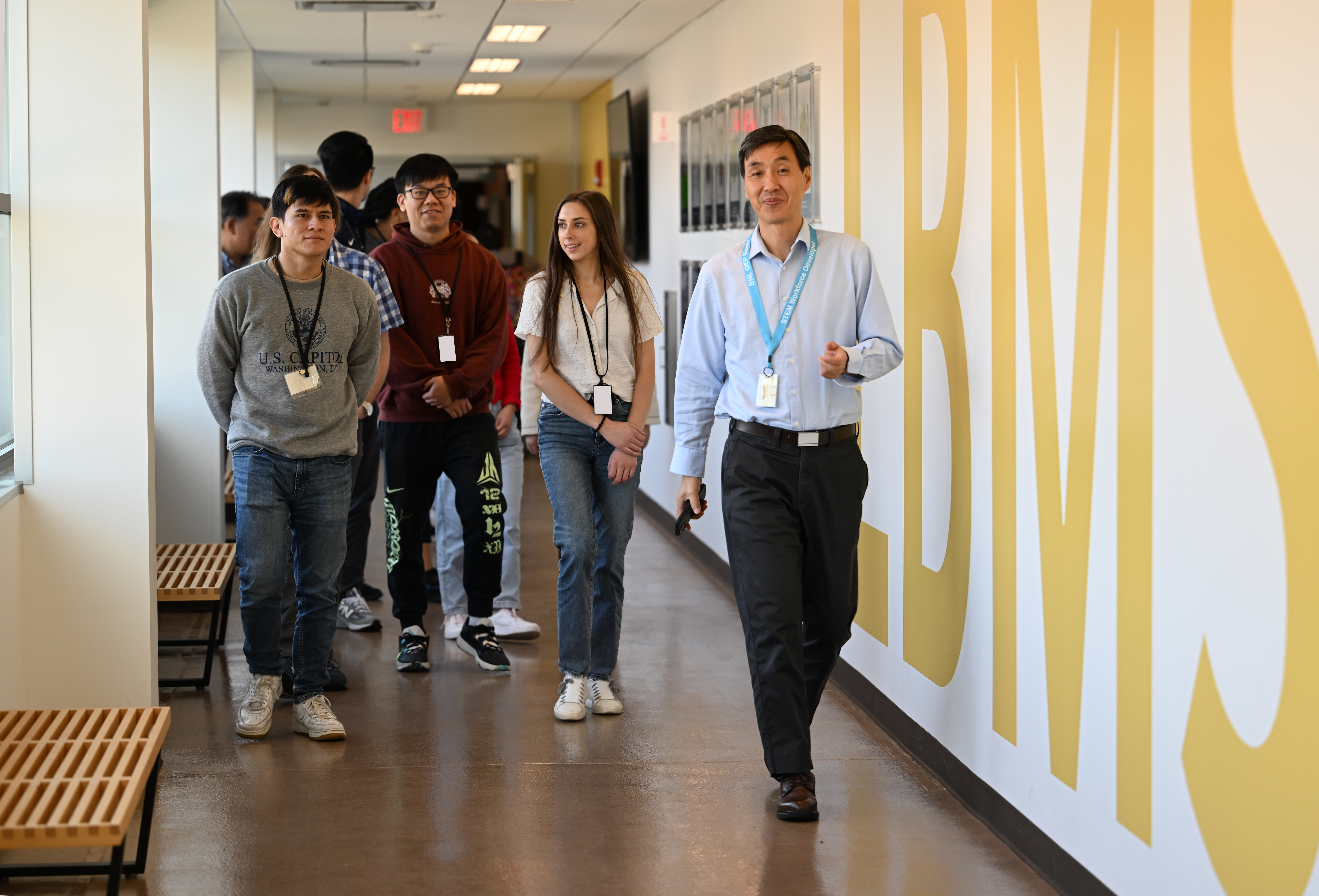
Liguo Wang walks a group of workshop attendees through LBMS. (Kevin Coughlin/Brookhaven National Laboratory)
Visions for the future
Artificial intelligence (AI) and machine learning (ML) are becoming an integral part of so many scientific facilities and programs, and LBMS is no exception. The team is focused on building AI/ML infrastructure and identifying where these tools can have the greatest impact. These technologies are already improving data collection, image analysis, and experiment automation, with future efforts focused on more integrated workflows and increasingly autonomous operation. While these projects are estimated to increase efficiency, the LBMS team acknowledges that AI/ML is a tool that amplifies scientific capability and not a replacement for experienced scientists.
The facility is also working on a major expansion into cryo-ET. While current cryo-EM work largely studies purified molecules, cryo-ET will enable researchers to study cells and tissues directly, observing biological processes in their natural environments. By bridging the gap between light microscopy, which provides cellular context, and high-resolution structural methods such as cryo-EM and X-ray crystallography, cryo-ET will help researchers understand how molecular structures give rise to biological function in living systems. New tools being developed at NSLS-II are also poised to complement upcoming research at LBMS.
“Imaging at NSLS-II is also evolving,” McSweeney said. “The Quantitative Cellular Tomography beamline, which is currently in development, will enable us to look at the cells directly without needing to cut into them. It will give us an unprecedented view of cellular machinery in action.”
Tools and capabilities aren’t the only areas that need to evolve and grow. To establish the LBMS of tomorrow, the team realizes that they need to build and develop the researchers and workforce of tomorrow. A key part of this is making training and education surrounding Cryo-EM techniques accessible and available. Starting in 2021, LBMS began hosting a series of virtual Cryo-EM courses that are open to all researchers. Each class attracts hundreds of participants who are eager to learn more about sample preparation, data analysis, and practical cryo-EM workflows. In 2022, LBMS expanded its educational offerings by introducing virtual workshops focused on the practical aspects of both single-particle cryo-EM and cryo-ET workflows. These later developed into in-person workshops, due to popular demand and the desire for a more hands-on experience.
“Despite receiving over 100 applications for each in-person cryo-EM workshop, we maintain a class size of 16 people to ensure each student has a deep level of involvement,” Wang said. “We also host student interns in the summer, which has been really rewarding. The research they do is always very impressive.”
That commitment to innovation, collaboration, and workforce development has helped define LBMS during its first five years and will continue to guide the facility as it looks toward the future.
“As LBMS enters its next chapter, we remain dedicated to its mission: to provide researchers with the tools, expertise, and collaborative environment needed to tackle some of the most important questions in biology and life sciences,” said Brookhaven Lab Director and former NSLS-II Director John Hill.
Five years after opening, LBMS has established itself as a national leader in cryo-EM. With expanding cryo-ET capabilities, AI-enabled workflows, and growing partnerships, the facility is well positioned to drive the next generation of biological discovery.
Brookhaven National Laboratory is supported by the Office of Science of the U.S. Department of Energy. The Office of Science is the single largest supporter of basic research in the physical sciences in the United States and is working to address some of the most pressing challenges of our time. For more information, visit science.energy.gov.
Follow @BrookhavenLab on social media. Find us on Instagram, LinkedIn, X, and Facebook.
2026-23088 | INT/EXT | Newsroom