Hydrothermal Vent Twins Offer New Insights to Ocean Chemistry
June 17, 2026
 enlarge
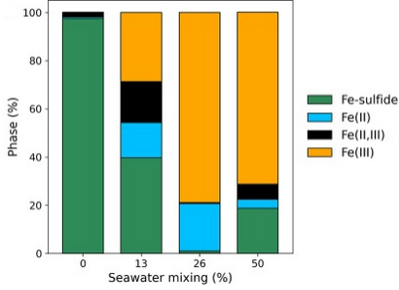
Linear combination fitting results for Fe K-edge X-ray Absorption Near Edge Structure (m-XANES) Spectroscopy measurements as a function of seawater mixing: Iron (Fe) sulfides (green), non-sulfide Fe(II) (blue), mixed-valence Fe(II, (oxy)hydroxides III) (oxy)hydroxides (orange), and Fe(III) (black).
The Science
Researchers recreated hydrothermal vent conditions to explore how iron (Fe) and other trace metals in vent fluids react with cold seawater to form metal-rich nanoparticles.
The Impact
Insights on how hydrothermal vents influence global ocean chemistry provide important clues about the chemical environments that supported early life on Earth.
Summary
Hydrothermal vents on the seafloor release hot, metal-rich fluids into the ocean. When these fluids mix with cold seawater, they quickly form tiny particles (colloids) that transport vital nutrients such as iron, copper, zinc, manganese, and molybdenum throughout the ocean. Understanding how these particles form is important because these nutrients influence marine ecosystems, global biogeochemical cycles, and may have even played a role in early life on Earth.
In this study, researchers recreated deep-sea hydrothermal vent conditions in the laboratory by injecting 400°C hydrothermal fluids into artificial seawater at pressures similar to those found on the seafloor (~250 – 500 bar). The experiments allowed the team to observe the earliest stages of particle formation. These processes naturally occur within seconds and are extremely difficult to study directly in the ocean.
The scientists found that the resulting particles were made up of complex aggregates of nanoparticles containing iron, copper, zinc, sulfur, and other elements. As the amount of seawater mixing increased, however, the chemistry of the particles changed. Iron initially formed sulfide minerals, but progressively transformed into iron (oxy)hydroxides such as ferrihydrite as oxidation increased. The experiments also revealed that different metals preferentially partition into specific mineral phases. Copper and molybdenum tended to partition into iron sulfide minerals, while zinc preferentially formed zinc sulfides. Manganese became increasingly associated with iron-rich hydroxide particles as seawater mixing increased.
One of the study's most surprising findings was the formation of nanoparticles of both magnetite (Fe3O4) and metallic iron in unmixed hydrothermal fluids. Existing geochemical models did not predict these minerals would form under these conditions. The researchers suggest that a previously unrecognized iron disproportionation reaction may be responsible, highlighting gaps in the current understanding of oceanic hydrothermal fluid chemistry and nanoparticle formation.
To determine the chemical forms of iron present in the particles, the team used Fe K-edge X-ray Absorption Near Edge Structure (µ-XANES) Spectroscopy at the X-ray Fluorescence Microprobe (XFM) beamline at the National Synchrotron Light Source II (NSLS-II), a U.S. Department of Energy (DOE) Office of Science user facility at DOE’s Brookhaven National Laboratory. Measurements revealed how iron speciation changed during seawater mixing, helping distinguish between iron sulfides, iron oxides, and mixed-valence iron minerals. These synchrotron measurements were critical for understanding the chemical evolution of the particles and validating the laboratory simulations against natural hydrothermal plume samples.
Overall, the study demonstrates that hydrothermal vents act as natural "nanoparticle factories," producing diverse metal-rich nanoparticles that influence how trace metals are transported through the ocean. The work also provides new insight into how hydrothermal systems may have supplied catalytically active minerals and metals to Earth's early oceans, with implications for studies of early life and potentially habitable environments on ocean worlds beyond Earth.
Download the research summary slide (PDF)
Related Links
Contact
Guy N. Evans
University of Minnesota
gevans@umn.edu
Publications
Evans, G. N., Matzen, S. L., Odlyzko, M., Kaçar, B., Anbar, A. D., Toner, B. M., & Seyfried, W. E. (2026). Iron speciation and partitioning of micronutrient transition metals in laboratory synthesized hydrothermal plume particles. Geochimica et Cosmochimica Acta, 418, 97-115. https://doi.org/10.1016/j.gca.2026.02.002
Funding
National Aeronautics and Space Administration (NASA) Exploring Ocean Worlds to BMT and SLM (80NSSC19K1427); NASA Metal Use and Selection across Eons (80NSSC21K0592), sponsored by the NASA Science Mission Directorate (19-ICAR19_2-0007). National Science Foundation – Marine Geology & Geophysics (MGG – 1736679). This research used XFM beamline (4-BM) of the National Synchrotron Light Source II, a U.S. Department of Energy (DOE) Office of Science User Facility operated for the DOE Office of Science by Brookhaven National Laboratory under Contract No. DE-SC0012704.
2026-23036 | INT/EXT | Newsroom