The Quantum Lighthouse: Extending Quantum Networks Beyond Fiber
New free-space optical link spanning Brookhaven and two universities adds a wireless component to the nation's longest quantum network
August 21, 2026
 enlarge
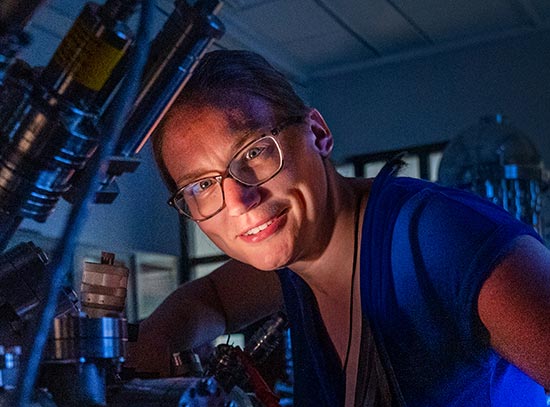
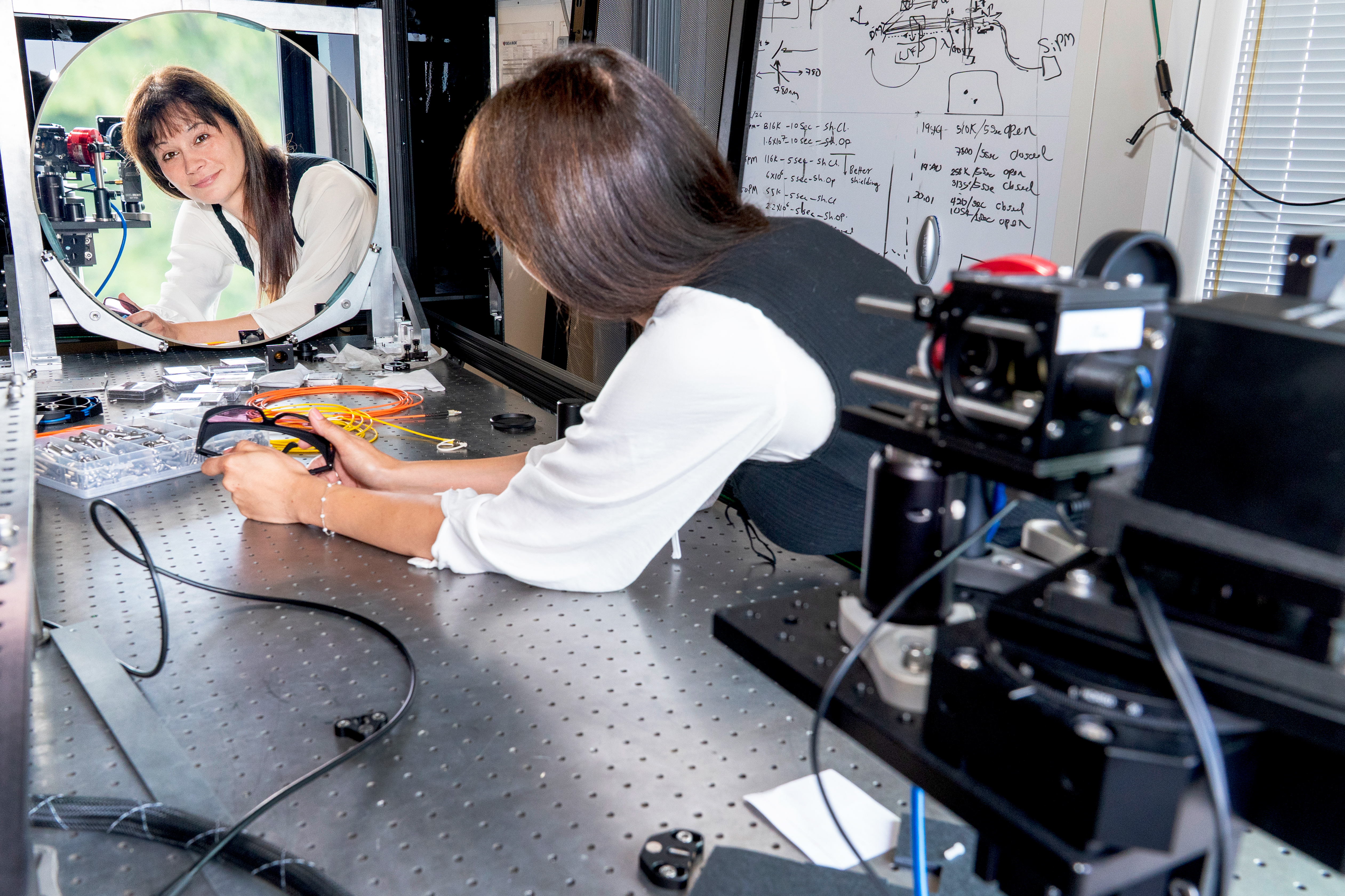
Brookhaven Lab scientist Justine Haupt looks in a mirror in the Quantum Lighthouse — one of three state-of-the-art facilities making up the free-space-optical link that adds a wireless component to the nation's longest quantum network. This mirror is the heart of the telescope technology Haupt developed to enable the transmission of light particles containing quantum information through open air. (David Rahner/Brookhaven National Laboratory)
There’s a new lighthouse on Long Island. But instead of shining light to guide ships through waterways, this one transmits and receives particles of light that carry quantum information.
Perched atop a seven-story building at the U.S. Department of Energy’s (DOE) Brookhaven National Laboratory, the “Quantum Lighthouse” is a key pillar of the free-space optical (FSO) link spanning Brookhaven Lab, the State University of New York at Stony Brook (Stony Brook University), and Yale University.
“An FSO link is analogous to the wireless technology that allowed today’s classical internet to expand beyond wired connections to orbiting satellites, as well as our cell phones,” said Justine Haupt, Brookhaven Lab’s lead scientist on the cross-institutional FSO link project. “It’s one of the key technologies needed to make a quantum internet truly useful.”
This FSO link — the first permanent one of its kind — adds a wireless component to the nation’s longest quantum network, which spans 161 miles across Long Island and the New York metropolitan area.
Through this network, researchers transmit entangled photons — pairs of light particles that are intrinsically linked by the laws of quantum mechanics, even when separated by long distances. As a result, measuring one photon instantly reveals information about its counterpart, a unique property that could one day enable ultra-secure communications, advanced quantum sensing, and networked quantum computing.
 enlarge
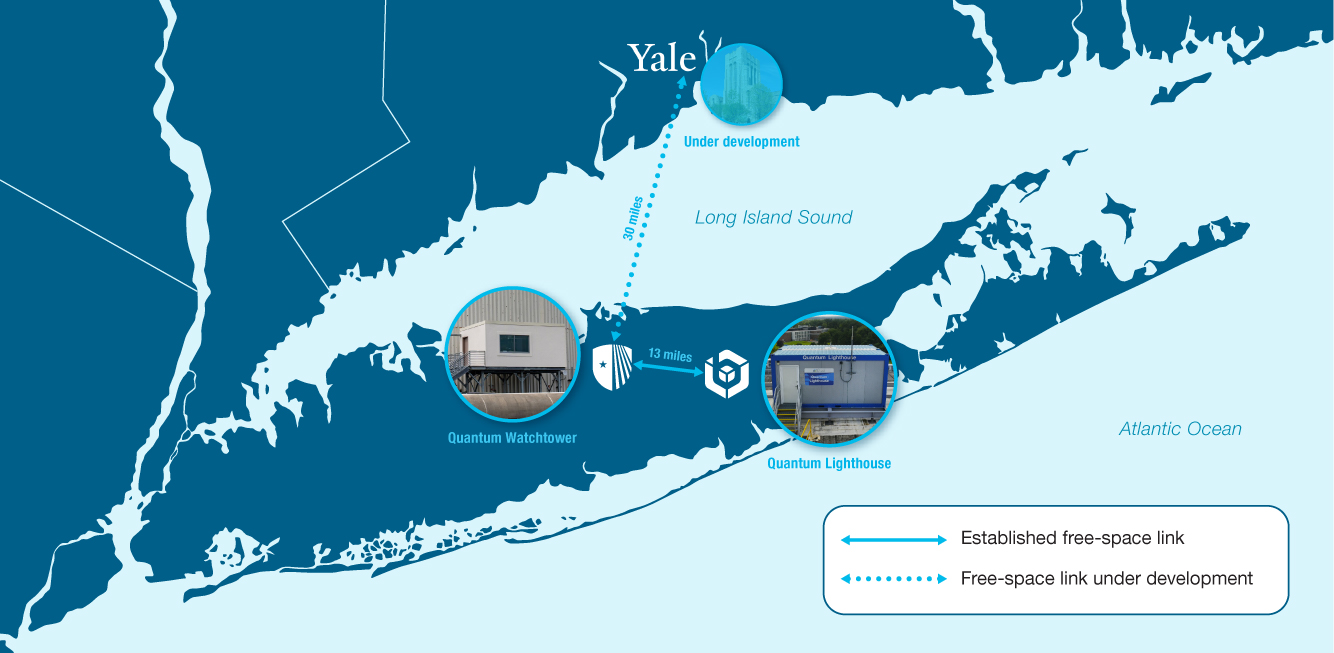
A map shows Brookhaven National Laboratory, Stony Brook University, and Yale University — the three institutions hosting facilities that form a free-space optical (FSO) link. The FSO link, used to transmit particles of light containing quantum information between institutions, adds a wireless component to the nation's longest quantum network. Researchers have successfully transmitted entangled photons from Stony Brook's Quantum Watchtower to Brookhaven's Quantum Lighthouse. The connection between Stony Brook and Yale is currently under development. (Jennifer Abramowitz/Brookhaven National Laboratory)
With the FSO link incorporated into the network, researchers can now send entangled photons 13 miles (21 kilometers) through the air between Brookhaven’s Quantum Lighthouse in Upton, New York, and Stony Brook University’s Quantum Watchtower in Stony Brook, New York. Soon, a third identical facility at Yale in New Haven, Connecticut, will begin operations, enabling researchers to also send entangled photons 30 miles (48 kilometers) across the Long Island Sound.
“We are moving past the era of developing quantum devices in the laboratory and entering an age where we actively engineer large quantum systems, such as our long-distance quantum network,” said Eden Figueroa, director of Stony Brook’s Quantum Institute, endowed presidential professor of physics in the Department of Physics and Astronomy in the College of Arts and Sciences, and a joint appointee at Brookhaven Lab. “By bridging our labs with deployed fiber and free-space optical quantum links, we are building Einstein’s ‘spooky action at a distance’ thought experiments, while also establishing secure quantum networks and training the brilliant minds who will run them.”
From fiber to free space
Researchers generate entangled photons at network nodes, like Brookhaven’s Quantum Information Science & Technology (QIST) Laboratory, by shining a laser into a specially designed crystal or optical device. This splits one photon into an entangled pair that can then be separated and transmitted through commercial cable to other network nodes.
But once these particles reach FSO link nodes, like the Quantum Lighthouse, researchers can no longer rely on cable. Instead, they leverage telescopes.
Haupt and her colleagues in Brookhaven’s Instrumentation Department are well-versed in telescope technology, having built key components for the Vera C. Rubin Observatory — a mountaintop astronomy facility equipped with the world’s largest digital camera — among many other astronomy projects. But in some ways, building telescopes that transmit light between institutions was more challenging than building ones to observe faraway celestial objects.
“When you look at the horizon over such a distance, it’s very blurry because of the atmosphere,” Haupt said. “It doesn’t matter how much you magnify it or how big your lens is, so we have to correct for that in real time.”
 enlarge
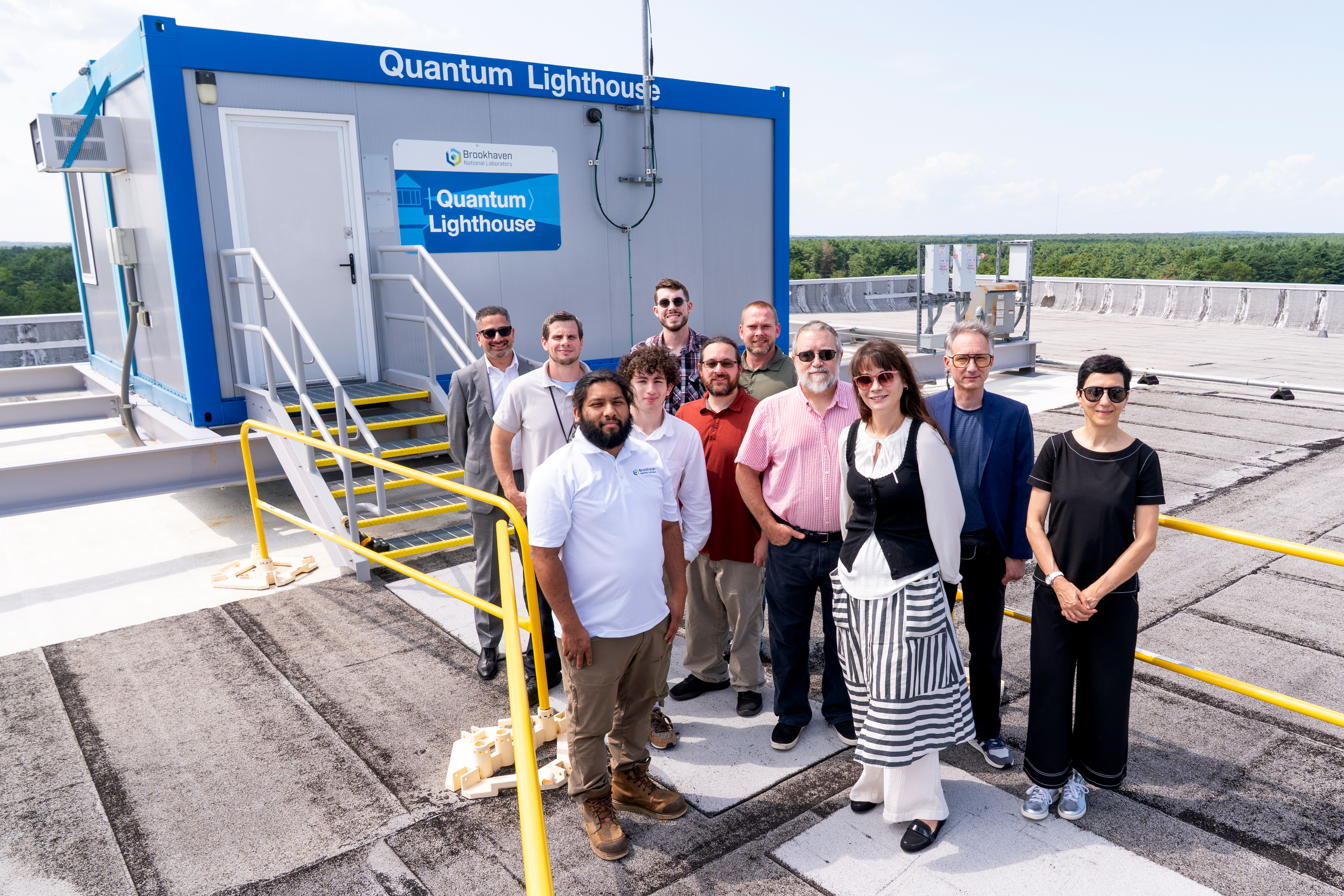
A Brookhaven Lab team of scientists, engineers, students, and leaders stand outside the Lab's Quantum Lighthouse — a state-of-the-art facility located on the rooftop of a seven-story building. This collaboration developed the adaptive optics technology essential for the free-space optical link connecting Brookhaven, Stony Brook University, and Yale University. Back row, left to right: Shresht Joshi, John Jerome, Samuel Woronick, Chris Otto, Sven Herrmann, and Gabriella Carini. Front row, left to right: Steven Andrade, Lev Leites, Matthew Rumore, Paul Stankus, and Justine Haupt. Team members not pictured include Michael Keach, Sonali Gera, and Aaron Mueninghoff. (David Rahner/Brookhaven National Laboratory)
Light is like a flat plane moving through space, Haupt explained. But as it encounters the turbulent atmosphere, that plane gets crinkled. To “uncrinkle” the light, engineers use adaptive optics technology, including mirrors thin enough to be warped into different shapes. Thousands of times per second, these mirrors are automatically pushed and pulled into specific shapes that can counter the atmosphere-induced crinkling in real time, producing a clear final image.
This technology was originally developed to sharpen images captured by ground-based telescopes, which also must compensate for distortions caused by Earth’s atmosphere. But despite the much shorter distance, there is significantly more turbulence between Brookhaven Lab and Stony Brook University than there is between Earth and the stars. This is because most atmospheric turbulence occurs close to the ground, where buildings, trees, and varied terrain interact with the wind, stirring the air. Different ground materials, like grass or asphalt, also absorb energy from the sun and release heat at different rates, creating further variation in the atmosphere.
When astronomers look up at the stars, only a fraction of what they’re looking through is highly turbulent — and many observatories are located at high elevations to further minimize distortions. The FSO link, by contrast, sends light through the turbulent ground layer for its entire journey. As a result, the adaptive optics system must make even more sophisticated corrections to ensure the light reaches the receiving telescope.
But correcting atmospheric distortions is only one part of the problem. The fiber that transports entangled photons between network nodes is only about 5 microns in diameter — less than one-tenth the diameter of a human hair.
To successfully transmit photons across 13 miles of atmosphere, the researchers use advanced adaptive optics techniques to expand that pinprick of light to 25 inches (0.6 meters) in diameter — to coincide with the size of the mirror at the heart of the telescope — and then focus it back down to a pinprick to enter the fiber on the receiving side.
Despite these incredible engineering feats, there are still other, more mundane conditions that must be met for the FSO telescopes to operate optimally.
 enlarge
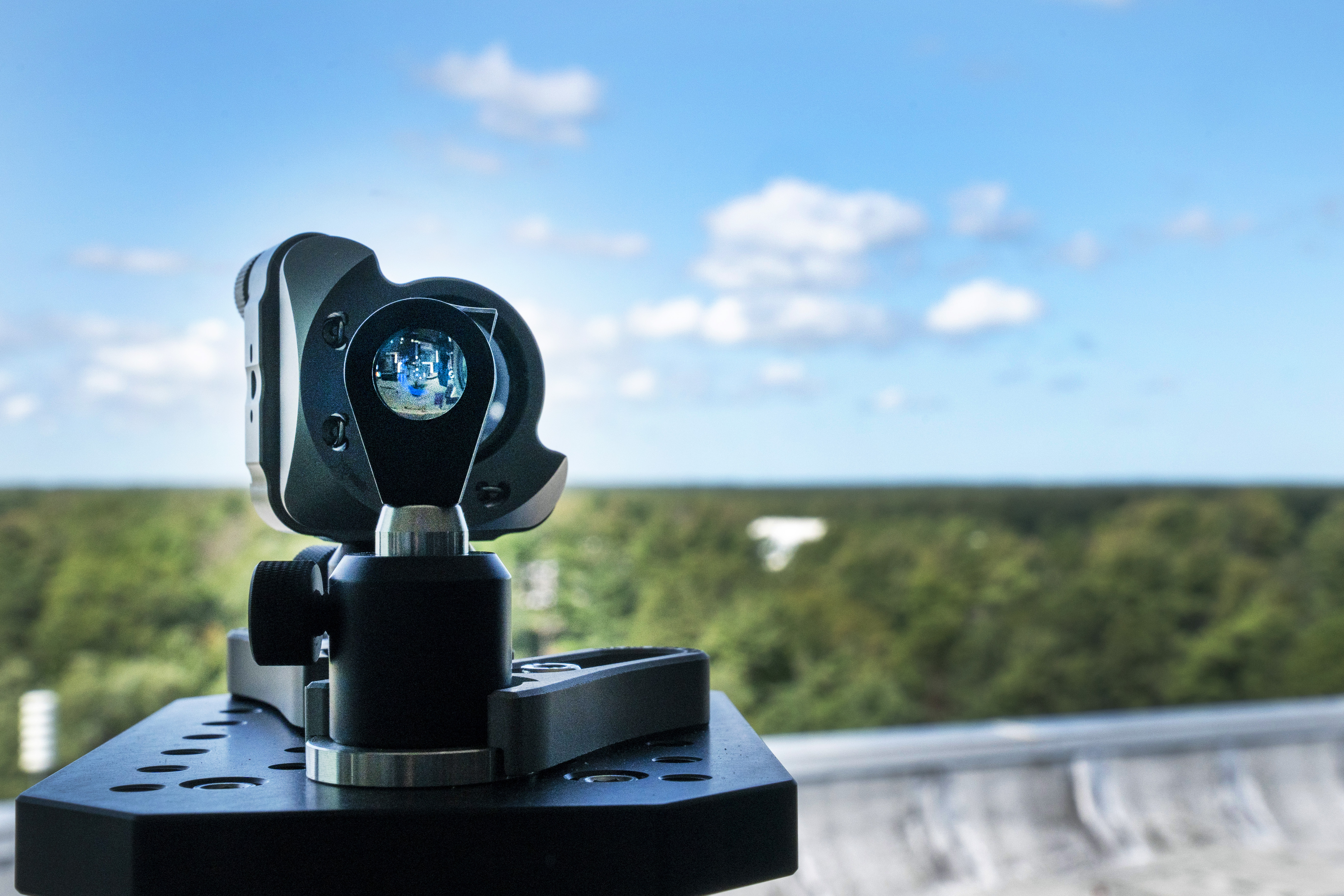
Adaptive optics compensate for turbulence-caused noise on photons traveling across the Brookhaven National Laboratory-Stony Brook University free-space link. (David Rahner/Brookhaven National Laboratory)
First and foremost, Stony Brook University needs to be visible from Brookhaven Lab, and vice versa, to successfully transmit entangled photons from one site to the other. This is why the Quantum Lighthouse is built on top of the only building at Brookhaven Lab with a clear line of sight to the Quantum Watchtower at Stony Brook University. But this also means that fog prevents successful photon transmission. The sun, on the other hand, is also problematic as it increases atmospheric turbulence and makes it more difficult for instrumentation to detect the transmitted photons against an abundance of background light.
“It’s like shining a flashlight from a rooftop,” Haupt said. “You wouldn’t see that in sunlight.”
However, Haupt noted that because they are only sending one photon at a time, normal sensors or eyes cannot detect the light, even at night.
“Someone could stare right into the beam; it’s too dim to see or cause any harm,” she said.
In these early stages of the FSO link, the researchers plan to primarily send photons at night during clear weather. But they aim to develop technology that will enable single photon transmission at any time of day and during any type of weather.
“The FSO link is a testament to Brookhaven's unique combination of expertise in advanced instrumentation, optics, and quantum information science,” said Brookhaven Lab Associate Laboratory Director for Discovery Technologies Gabriella Carini. “But this is just the beginning. The infrastructure we’ve built will help researchers advance quantum science from basic research toward real-world technologies.”
A testbed for the quantum future
According to Haupt, “The most exciting part of the FSO link is that we might be able to do really groundbreaking kinds of science using this setup.”
Incorporating a satellite into the network, for example, could help bring secure quantum communications to rural or remote locations with minimal ground-based telecommunications infrastructure. Similar to the expansion of the classical internet, this could transform the quantum network from a regional one to a global one.
As government agencies and private companies develop quantum-specific satellites for the United States, the Brookhaven team plans to begin tracking traditional satellites from the Quantum Lighthouse. These efforts will demonstrate the optical stabilization and tracking capabilities needed to incorporate a quantum satellite in the future.
Starting with a traditional satellite in the meantime is, in many ways, an intuitive next step because the lenses, mirrors, and other optical instruments in the Quantum Lighthouse also abide by the laws of classical physics. Rather than generating or processing quantum information, they will transmit entangled photons between network nodes, just like the underground cables.
Haupt and her colleagues plan to eventually push beyond quantum communication and explore what new quantum sensing capabilities the FSO link might unlock. Those advances could one day enable technologies ranging from medical imaging and camera systems to astronomical instruments capable of probing the universe in unprecedented detail.
“The quantum sensing prospects motivate me scientifically, but this work also fires me up personally,” Haupt said. “I get to work with lasers and big telescopes on rooftops! As someone who just loves developing technology, it really scratches all my itches.”
This work is primarily supported by the DOE Office of Science.
Brookhaven National Laboratory is supported by the Office of Science of the U.S. Department of Energy. The Office of Science is the single largest supporter of basic research in the physical sciences in the United States and is working to address some of the most pressing challenges of our time. For more information, visit science.energy.gov.
Follow @BrookhavenLab on social media. Find us on Instagram, LinkedIn, X, and Facebook.
2026-23097 | INT/EXT | Newsroom