Physicists Celebrate World's Most Versatile Particle Collider
RHICfest: a lookback at the Relativistic Heavy Ion Collider, from before the start of construction to final collisions
August 19, 2026
 enlarge
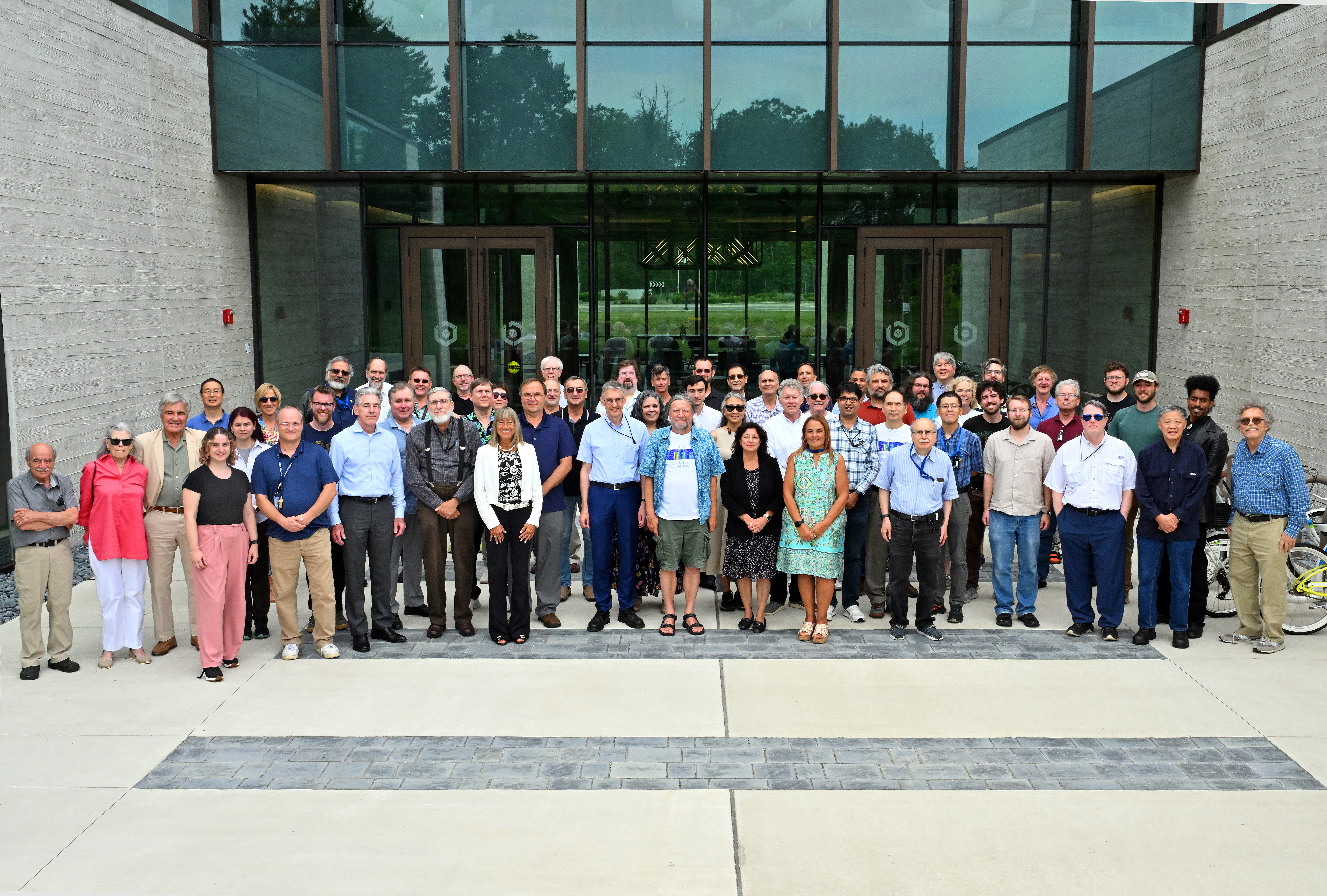
Current and former scientists, engineers, technicians, and others gathered to celebrate the accelerator achievements of the Relativistic Heavy Ion Collider (RHIC) at "RHICfest" July 9-10, 2026, in Brookhaven Lab's Science and User Support Center. The meeting recapped RHIC's earliest days and greatest technological triumphs. (Kevin Coughlin/Brookhaven National Laboratory)
What does it take to build the world’s most complex and versatile particle collider? Attendees at a two-day celebration held at the U.S. Department of Energy’s (DOE) Brookhaven National Laboratory July 9-10 got a glimpse with an in-depth lookback at the steps that brought the Relativistic Heavy Ion Collider (RHIC) — one of the most successful nuclear physics research facilities ever built — into reality.
Attendees at “RHICfest,” which was organized in large part by Brookhaven Lab accelerator physicist Stephen Peggs, heard stories from the time when this DOE Office of Science user facility was just the flicker of an idea in the early 1980s all the way through its final collisions in February 2026. Speakers, including many RHIC “alums,” recounted tales from the collider’s planning, construction, and 25 years of operation at Brookhaven Lab. They described the incredible challenges they faced and conveyed how teamwork and a spirit of determination among scientists, engineers, technicians, and support staff made RHIC’s remarkable performance possible.
“By inviting alumni and retirees to recall the joy, excitement, and difficulties of early RHIC operations — and how all those challenges led to the collider’s ultimate success — our goal was to celebrate and survey RHIC’s accelerator physics and engineering legacy,” Peggs said.
The talks also featured inspiration and lessons for those seeking to build and operate future colliders — including the Electron-Ion Collider (EIC), now under construction at Brookhaven Lab.
“RHIC has delivered on its promise and much beyond,” said Abhay Deshpande, Brookhaven Lab’s associate laboratory director for Nuclear and Particle Physics, science director for the EIC, and a professor of physics at Stony Brook University. “One reason we have the EIC at Brookhaven is because of what was built into RHIC: the versatility.”
Deshpande hailed the RHIC accelerator and its designers’ and operators’ accomplishments — including producing near-light-speed particle smashups using 49 different combinations of atomic nuclei, collision energies, and collision configurations during its 25 runs. Since the first gold-gold smashups in June 2000 through countless proton-proton runs and a whole gamut of atomic species, physicists have scoured the remnants of these collisions to discover and map out the details of the quark-gluon plasma — a state of matter made of nature’s fundamental building blocks interacting as they did in the very early universe — and to explore the sources of proton spin.
Hundreds of scientific publications have come out of that effort — with many more still to come — including papers about RHIC’s accelerator innovations that have generated double the number of citations of any other facility operating for a comparable period.
With that, Deshpande set the stage for the meeting’s detailed focus on the design and capabilities of the machine that made it all possible.
 enlarge
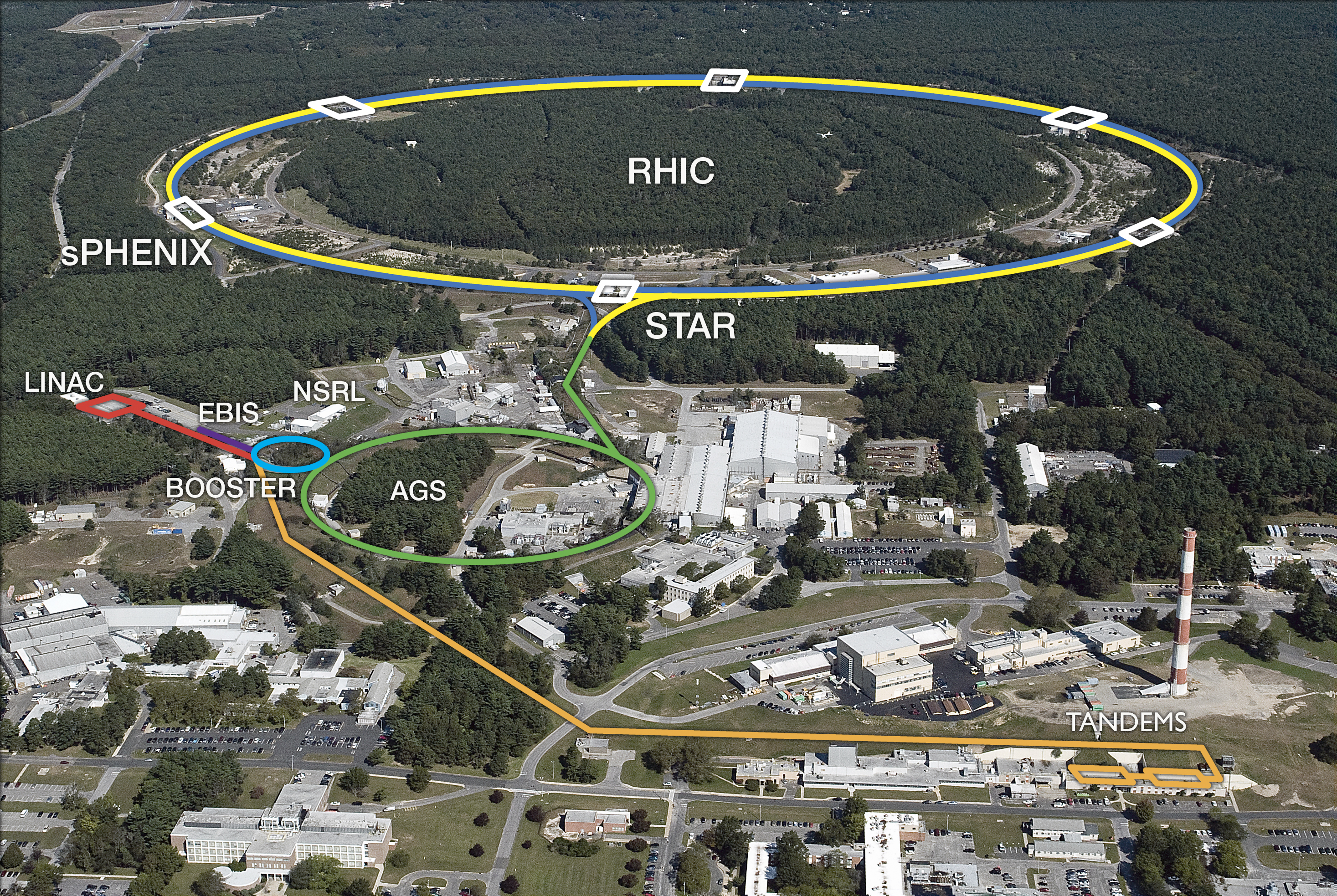
The accelerator complex of the Relativistic Heavy Ion Collider (RHIC) included several sources for beams: the LINAC for protons and the tandems and later the Electron Beam Ion Source (EBIS) for a wide range of ions. Both types of beams were pre-accelerated in a small Booster ring followed by the Alternating Gradient Synchrotron (AGS) before entering RHIC's twin 2.4-mile-circumference storage rings in opposite directions. This image shows the STAR and sPHENIX detectors installed to capture collision data at two of the points where RHIC's counter-circulating beams crossed. (Brookhaven National Laboratory)
Designed for success
“Much of RHIC’s success relies on how the machine was designed and what you can do with that,” said Wolfram Fischer of the Lab’s Collider-Accelerator Department (C-AD) and co-organizer of the RHICfest celebration. Fischer recapped the “heavy-ion story,” including pre-RHIC heavy ion collisions into fixed targets using Brookhaven’s Alternating Gradient Synchrotron (AGS), and an even earlier go at building a proton-proton collider called Isabelle — later known as the Colliding Beam Accelerator (CBA). Cancellation of CBA in 1983 left an empty 2.4-mile circumference ring-shaped tunnel to eventually be filled by RHIC.
RHIC’s two nearly independent rings and connections to other components of the Lab’s accelerator infrastructure — including the AGS and a Booster ring that was built as part of the RHIC project — gave the accelerator enormous flexibility, Fischer said. “There were a lot of very good design choices that allowed for significant upgrades,” he said.
Brookhaven Lab accelerator physicist Steven Tepikian described the RHIC lattice design and optics — the various choices for how the accelerator magnets, accelerator cavities, and other components would be arranged to accelerate, focus, and steer two separate beams in opposite directions through the twin rings of the accelerator. Early tests revealed “some wiring issues that needed to be fixed” in sextupole magnets. Thomas Roser, a retired chair of C-AD, commented that the wiring was backwards in the counterclockwise ring because, at that point, “code was only written for clockwise accelerators.”
Fulvia Pilat, a former Brookhaven Lab accelerator physicist now at DOE’s Oak Ridge National Laboratory, said, “I remember a lot of excitement because we thought maybe we had discovered something, but it turned out to be only the wiring.” Stephen Peggs noted that simulating what had happened “with an ancient code … showed that the simulations worked and that we were tooled up to find [and fix] such things.”

This slideshow contains images from RHIC's early days, including some of the people who spoke at the RHICfest celebration in July 2026. Hover over the controls to see all the images or click on an image to view the slideshow on Flickr and see captions for the photos.
Primed for polarization
Roser described another one of RHIC’s unique design features — it’s unmatched ability to accelerate and collide spin-polarized protons so scientists can learn more about how the proton’s constituent quarks and gluons contribute to their intrinsic magnetism.
“The polarized proton program wasn’t included in the original RHIC design. It required many things that had never been done before,” said Roser. In fact, he said, it may have been more difficult to get approval to start RHIC construction if these requirements had been part of the initial plan. “But RHIC was already approved so we could think of how to improve it for polarized protons.”
The unproven technologies Roser and his colleagues developed included a source for generating high-intensity polarized proton beams — that is, beams of protons that had their spins aligned in a controlled direction. They also needed polarimeters to measure the beams’ polarization without destroying the tiny protons’ spin alignment. An innovation at RHIC actually helped reduce that challenge: the inclusion of specialized spiral magnets known as Siberian snakes. Two partial snake magnets in the AGS and four full snakes in RHIC regularly flip the protons’ spin alignment without the constant need for polarization measurements. These flips keep the beams of protons precisely aligned even as they collide thousands of times per second, Roser said.
Later in the meeting, Vadim Ptitsyn — a Brookhaven Lab accelerator physicist who is now working on the EIC and designed the twist of one of these magnets as a graduate student — gave a talk on “how to tame a snake.”
Magnets make the accelerator
Those snakes are just a few of the more than 1,700 magnets that make up RHIC — quadrupoles, dipoles, sextupoles, and several other specialized types.
“If the magnets didn’t work, there wouldn’t be a lot to talk about,” said Mike Anerella, who was in the magnet division at the time of RHIC construction and later led the group.
Consequently, building these “beads” to string together the accelerator was the first major step in getting RHIC built, said Mike Harrison, who served as the accelerator project lead for RHIC construction and is now retired.
“Brookhaven was well known for its magnet facility. It was a very strong group,” Harrison said, noting that most “standard” magnets for the accelerator were made by industry and the non-standard ones were built in house. But the path to industrial production had a lot of zig zagging.
The magnets made by industry — along with all the others — were “designed by three guys down the hall: Gary Morgan, Pat Thompson, and Ramesh Gupta,” Anerella said. Speaking of the magnets designed for industrial production, he said, “This is a really well-designed magnet, kind of bullet proof. But it had to be built properly.”
So even before the Brookhaven team put the contract out to bidders, they built pre-production prototypes and listed all the detailed specifications. Anerella noted that it was fortuitous that Northrup Grumman, a company “down the road,” got the contract. The industry and lab teams had weekly meetings, and “we had people going back and forth to the plant to help as needed.”
In the end, there were zero magnet failures, and the Northrup Grumman magnets achieved a level of field uniformity that Anerella says is still the best in the world for accelerator magnets. And the Grumman fabricators were impressed with the efficiency of the Lab’s in-house specialized magnet production to meet the specialized needs of RHIC.
Evolving to tackle challenges and meet science demands
Speakers throughout the meeting described RHIC’s growing pains and challenges and how accelerator physicists, engineers, and technicians regularly developed solutions that improved performance. There were many advances that pushed RHIC far beyond its original design specifications to reach territory RHIC’s experimental collaborations wanted to explore that were unimaginable prior to RHIC.
“The evolving physics program drove innovation,” Fischer said. “There was very strong community support [among RHIC’s experimental physicists] and from the Office of Nuclear Physics at DOE.”
One of the most striking examples of RHIC’s performance evolution was the substantial and sustained increase in the collider’s luminosity, or rate of particle collisions, over its operational lifetime. Collision rates are largely dependent on how tightly packed the particles are as they whiz around the accelerator. The tighter the particles are packed, the more likely they are to collide when the two beams cross.
Lots of things can mess with luminosity. First off, all those positively charged particles — whether single protons or heavy ions such as gold supercharged with 79 protons — would rather push one another apart. Another source of beam spread occurs when one beam passes through another at the collision point. And, as the particles move around the ring at close to the speed of light, they also tend to heat up and spread out — another source of beam expansion.
Fortunately, RHIC physicists have developed many ways to compensate for the spread and maximize the beam’s density at the collision points. These were described in several talks throughout the meeting.
One example is stochastic cooling, which was successfully used for the first time ever in beams made up of bunches of particles at RHIC. Brookhaven Lab accelerator physicist Michael Blaskiewicz, one of the main architects for designing this system, explained how sensors measure tiny fluctuations in the distribution of about a billion particles that make up each bunch in the beam. Specialized relays send those signals to radiofrequency “kickers,” which use that information to nudge all the particles back toward the center of the bunch. Over time, RHIC physicists implemented systems to deliver these corrective nudges in all three spatial dimensions, thus reducing the random motion of the particles within each bunch. The result is smaller beam sizes and better collision rates.
As Fischer noted, this cooling method was a key technology in ultimately producing luminosities 44 times RHIC’s initial design, allowing very high collision rates and the collection of enormous volumes of data. Plus, Fischer said, it saved “at least $100 million” by eliminating the need for a more costly upgrade to the accelerator. Desphande, who was part of the team reviewing the more costly upgrade, recounted that the successful implementation of stochastic cooling at RHIC “saved the day.”
Blaskiewicz is now working on a similar system for cooling ion beams at the EIC.
Brookhaven Lab accelerator physicist Alexei Fedotov, who is also developing technologies for the EIC, described another beam-cooling approach — injecting a beam of relatively cool electrons into the stream of accelerated ions to take away some of their heat in much the same way the coolant in a refrigerator draws heat away from your milk and butter. This approach is particularly challenging at low acceleration energies, where the spreading out of ions is more exaggerated. Its successful implementation allowed RHIC physicists to explore regions of the nuclear phase diagram where the phase change between ordinary nuclear matter and the quark-gluon plasma showed particularly interesting features.
Michiko Minty, head of Brookhaven Lab’s accelerator operations and research division, added a few more examples in her talk summarizing RHIC’s 25 years of operations, including the implementation of “electron lenses.” Minty also described the Accelerator Physics Experiments — or APEX — program, where accelerator physicists ran carefully planned experiments to try out new accelerator technologies or techniques during dedicated shifts lasting approximately 12 hours every other week. These tests in a real-world collider environment have been crucial to improvements in RHIC’s performance and for developing accelerator approaches for the future EIC.
“It’s one thing to develop technologies and another to optimally integrate them into operations,” Minty said. “RHIC did it — in many cases! Its legacy includes major advances in collider technology and operational methodologies important to next-generation facilities, including the future EIC — all the result of the exceptional initiatives, innovations, and accomplishments of the RHIC accelerator physics, controls, operations, engineering, and technical staff whose collective achievements were partially summarized here.”
To learn much more about the presentations during RHICfest, you can view a video replays of the entire meeting (Day 1 and Day 2) or view the timetable and presentation slides from individual talks.
###
Brookhaven National Laboratory is supported by the Office of Science of the U.S. Department of Energy. The Office of Science is the single largest supporter of basic research in the physical sciences in the United States and is working to address some of the most pressing challenges of our time. For more information, visit science.energy.gov.
Follow @BrookhavenLab on social media. Find us on Instagram, LinkedIn, X, and Facebook.
2026-23108 | INT/EXT | Newsroom