Researchers Develop Method to Measure Microplastics in the Air Using an Uncrewed Aerial System
The study, funded by the CIRES Innovative Research Program, will help scientists track microplastics in the atmosphere and remote regions
November 6, 2026
Editor’s note: The following news release was originally published by the University of Colorado Boulder (CU Boulder). Gijs de Boer, director of the Environment & Energy Division and interim deputy associate laboratory director for Innovation, Science, and Security at the U.S. Department of Energy’s Brookhaven National Laboratory, co-authored the study. De Boer was a faculty research scientist at the Cooperative Institute for Research in Environmental Sciences at CU Boulder when the project was funded and served as a principal investigator. At Brookhaven, de Boer continues to support interdisciplinary atmospheric research like that described in the study. For more information about atmospheric research at Brookhaven Lab, contact Kelly Lazzaro, klazzaro@bnl.gov, 631-344-8825.
Microplastics have been found in our bodies and the food we eat — and even in remote environments around the world, including seawater and ice in the Arctic. Despite their prevalence, little is known how they move through the atmosphere. New CIRES-led research, which demonstrates a new method for sampling microplastics in the atmosphere using an uncrewed aerial system (UAS), aims to change that.
“Atmospheric microplastics are usually sampled from a rooftop, ground-based location, or ship,” said Radiance Calmer, a former CIRES researcher who is now working at the Norwegian Polar Institute and lead author of the paper. “Our proof-of-concept study shows we can sample atmospheric microplastics using UAS flights for a specific height.”
Their results not only indicate microplastics are present 100 meters high in the atmosphere near areas with intense human activity but also confirm the team's UAS sampling method is a feasible approach for measuring microplastics in the atmosphere. They are the first team to successfully use an environmental cyclone sampler on a UAS to collect microplastics.

Microplastics sampling instrument mounted on the UAS.
The work, funded by the CIRES Innovative Research Program (IRP), establishes a potential framework for atmospheric microplastics sampling in remote environments, including above the ocean and in the lower atmosphere, where traditional sampling methods are limited and often cost-prohibitive.
“Microplastics can be transported to places people aren’t looking for them, making them hard to track,” said Gijs de Boer, the Environment & Energy Division director at Brookhaven National Laboratory and co-author who was a faculty research scientist at CIRES and CU Boulder when the study was funded.
Tracking these tiny particles is important because they are potentially harmful to human health and have unknown impacts on important Earth system processes, such as cloud formation and sea ice melting.
Developing the UAS sampling method
The new project was an engineering and atmospheric science puzzle, bringing together experts from CIRES, CU Boulder, and the University of Rhode Island (URI).
First, the team adapted an instrument commonly used in aerosol monitoring — an environmental cyclone sampler — to capture particles from 1 to 10 micrometers in size and attached it to a small UAS. Since the concentration of microplastics in the atmosphere is small, they then had to adapt their sampling method to ensure they captured enough particles.
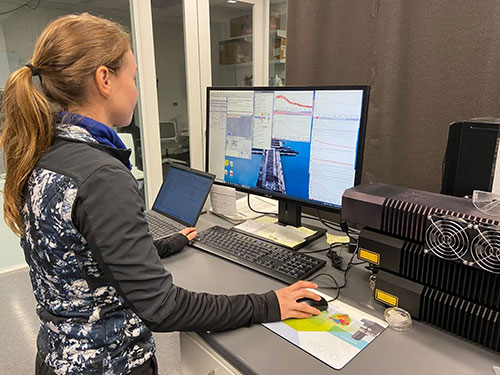
Scientist analyzes microplastics material.
“The challenge was to sample a large enough volume of air to ensure that some microplastics were present among all the particles,” Calmer said. “It was not easy because of the limited UAS flight time, which was around 25 minutes.”
In fall 2024, the team deployed their instrument above two sites in Colorado: near a heavily trafficked highway in Erie and residential areas and a landfill in Arvada.
After the UAS flights, the samples were pre-processed at CU Boulder to separate the microplastics from organic particles. The samples then traveled to URI, where researchers counted and identified each particle by plastic type.
Their samples were dominated by clusters of plastic and environmental material called hetero-aggregates, which are often found near highways and areas with high levels of human activity.
CIRES IRP support
Calmer and de Boer, who were principal investigators on the project, emphasized that the CIRES IRP was key to getting this research off the ground. The program is an internal competition that supports novel or unconventional research that might be difficult to fund through traditional approaches.
“IRP projects can serve as a springboard to start something small and get it rolling down the hill — like a snowflake turning into an avalanche,” de Boer said. “Innovation often happens at interfaces, and the IRP encourages interdisciplinary efforts like this, bringing together atmospheric science with aerospace engineering.”
The team hopes their work will open new doors in atmospheric microplastic research, especially studies related to the long-range transport and origin of microplastics.
“I hope this proof-of-concept is the launching point for another scientific research project,” Calmer said. “And because we all enjoy challenging and hard work, we are aiming for the Arctic.”
2026-23265 | INT/EXT | Newsroom