Two Brookhaven Lab Physicists Named Fellows of the American Physical Society
Yoshitaka Hatta and Mark Palmer honored for contributions to understanding the building blocks of matter and advancing accelerator systems, respectively
December 4, 2025
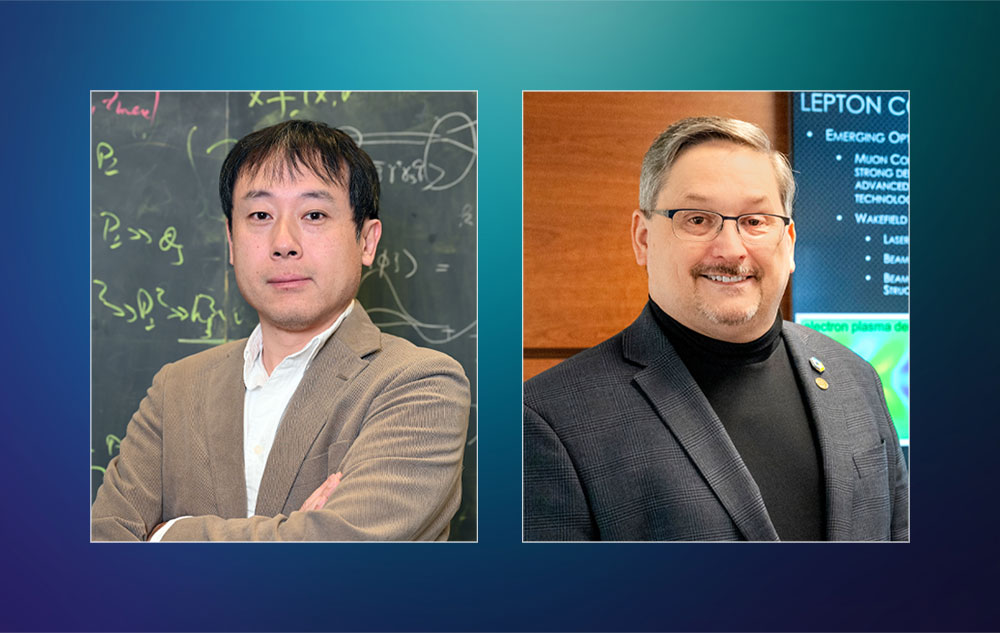
Yoshitaka Hatta and Mark Palmer (Brookhaven National Laboratory)
UPTON, N.Y. — Two physicists at the U.S. Department of Energy’s (DOE) Brookhaven National Laboratory have been named 2025 Fellows of the American Physical Society (APS). The honor recognizes their excellence in physics and exceptional service to the physics community. This year’s Brookhaven Lab honorees, Yoshitaka Hatta and Mark Palmer, are among a class of 151 Fellows selected from among APS’s membership of more than 50,000 physicists in academia, national laboratories, and industry in the United States and around the world.
Yoshitaka Hatta, Distinguished Scientist, Nuclear Theory Group, Physics Department
For important contributions to strong-interaction physics, including the spin and gravitational structure of the nucleon, small-x tomography of nucleons and nuclei, and the phases of QCD.
 enlarge
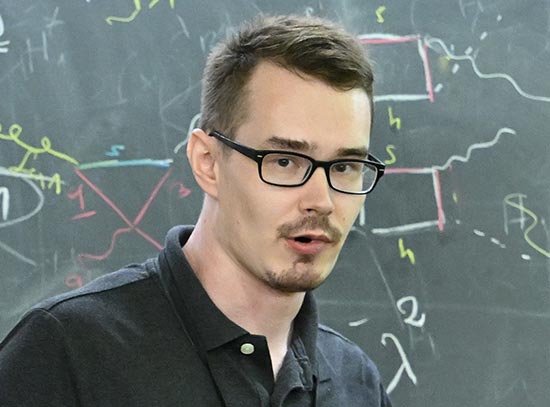
Yoshitaka Hatta, a theorist in the Nuclear Theory Group in the Physics Department at Brookhaven National Laboratory, was named an APS Fellow for his contributions to understanding the building blocks of matter. (Kevin Coughlin/Brookhaven National Laboratory)
Yoshitaka Hatta, a theorist in the Nuclear Theory Group in Brookhaven Lab’s Physics Department, has made important contributions to theoretical models and calculations essential for understanding the fundamental building blocks of the atoms that make up all visible matter. His work focuses on developing theoretical predictions and explanations for experiments investigating how quarks and gluons — the fundamental components of protons and neutrons, which are collectively called nucleons — interact via the strongest force in nature and contribute to the structure and properties of nucleons and nuclei. This work is of fundamental importance for understanding how the properties of nucleons arise from quantum chromodynamics (QCD), the theory that underlies these strong-force interactions.
Hatta’s efforts have helped to clarify predictions of how the orbital motion of quarks and gluons each contributed to nucleon “spin” — a longstanding mystery in nuclear physics — laying the groundwork for experiments to measure these contributions. He’s also developed calculations for mapping out the distribution of gluons within nucleons, particularly in protons and nuclei accelerated to high energy, where numerous low-momentum gluons appear to dominate nucleon structure and play an outsized role in contributing to nucleon mass. His predictions will play an important role in upcoming research at the Electron-Ion Collider (EIC), which will provide experimental data to help test this understanding of matter.
Hatta has also made important contributions to the exploration of the phases of nuclear matter generated in collisions of atomic nuclei over a wide range of energies at the Relativistic Heavy Ion Collider (RHIC), a DOE Office of Science user facility at Brookhaven Lab. His calculations provide key insights and observables needed to map out the “QCD phase diagram” and, in particular, to locate the QCD critical point. His theoretical work will help scientists understand how quarks and gluons transform from a hot “soup” known as the quark-gluon plasma — which existed in the very early universe — to the confined configurations within protons and neutrons that make up the atomic nuclei of our world today.
“I am truly humbled and honored to be elected a Fellow of the American Physical Society,” said Hatta. “I am deeply grateful to APS and those who supported my nomination, as well as to my colleagues and collaborators. I will continue to dedicate my research to the physics of the Electron-Ion Collider, an important future project of Brookhaven Lab.”
Yoshitaka Hatta earned his Bachelor of Science, Master of Science, and Ph.D., all in physics, from Kyoto University in Japan in 1999, 2001, and 2004, respectively. He began his association with Brookhaven Lab as a junior research associate in the RIKEN-BNL Research Center (RBRC) in 2002, continuing as a RBRC postdoctoral fellow from 2004 to 2006. He then worked as a postdoctoral fellow at Saclay, France from 2006 to 2008, and he worked at the University of Tsukuba as an assistant and then an associate professor from 2008 to 2013, joining the Yukawa Institute of Kyoto University as an associate professor in 2013. He returned to Brookhaven Lab in 2018 and is now a distinguished scientist. He has authored or co-authored more than 140 scientific publications.
Mark Palmer, Chair, Accelerator Science & Technology Department
For outstanding leadership and technical contributions, including driving the MICE experiment to the successful demonstration of ionization cooling, that have brought the design and development of muon colliders closer to their practical realization.
 enlarge
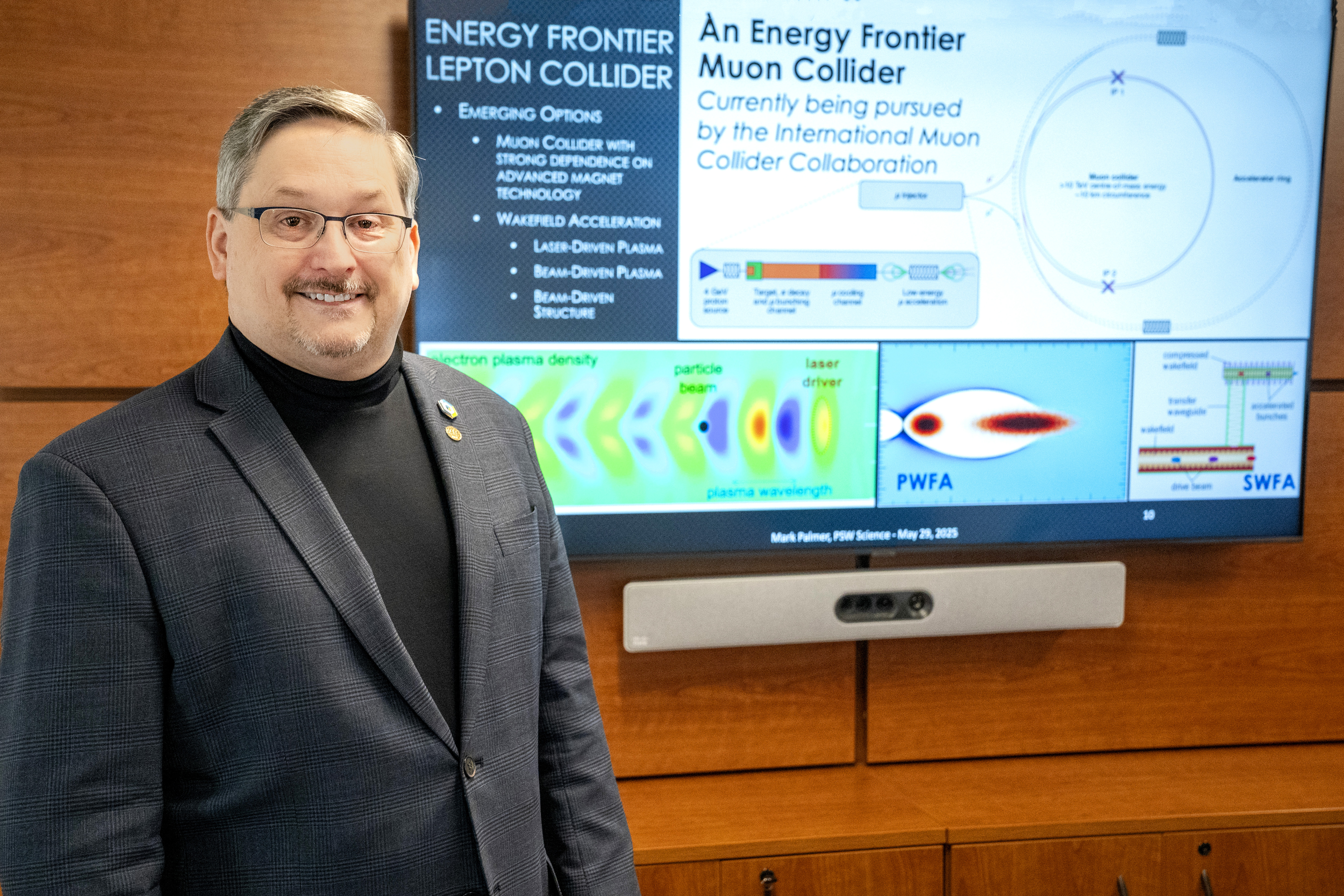
Mark Palmer, chair of the Accelerator Science & Technology Department at Brookhaven National Laboratory, was named an APS Fellow for his leadership and contributions to advances in accelerator technologies for a future muon collider. (David Rahner/Brookhaven National Laboratory)
Mark Palmer is well known among the worldwide community of accelerator physicists and engineers for his exceptional and sustained contributions and broad scientific leadership. His work has helped to shape the future of advanced accelerator technologies, with major specific contributions in designing and testing transformational technologies needed to make future muon colliders possible.
Colliding muons could lead to new particle discoveries. Like electrons, their lighter-weight cousins, muons are fundamental particles with no internal building blocks. They produce extremely “clean” collisions where all their energy is transformed into creating new particles. Accelerated to the same energy, muon collisions would effectively release 10 times the energy of proton-proton smashups, which disperse some energy in their messier subcomponent interactions. Muons could be accelerated to physics-frontier-expanding energies in relatively compact circular machines, unlike protons, which would require a much larger circumference, or electrons, which would require more costly linear designs.
But generating and accelerating muon beams quickly enough to produce collisions presents huge challenges. Palmer has been working to address these challenges for nearly two decades — as head of the U.S. Muon Accelerator Program based at DOE’s Fermi National Accelerator Laboratory (Fermilab), at Brookhaven Lab, as a member of the International Muon Collider Collaboration, and as a leader in the international Muon Ionization Cooling Experiment (MICE) at the Rutherford Appleton Laboratory in the United Kingdom. MICE was a pioneering effort to effectively “squeeze” muon beams into an intense, laser-like focus for efficient acceleration and collider operation. Under Palmer’s guidance, the experiment overcame major challenges, integrating muon production, transport, energy-manipulation, and focusing technologies with high-precision beam diagnostics to demonstrate the practicality and effectiveness of this approach.
Palmer’s expertise in beam dynamics and accelerator design extends to many other projects. His insight from concept to experiment and ability to foresee how facility designs will impact scientific output have helped him define a bold vision for U.S. accelerator R&D. As longtime director of the Accelerator Test Facility (ATF) — a DOE Office of Science user facility at Brookhaven Lab — he has ensured world-class operations while expanding capabilities. He is also widely respected for mentoring junior scientists, building productive teams, and fostering international collaboration.
“I’m honored by this recognition of my efforts, which have largely focused on the R&D and design work required to deliver advanced accelerator capabilities that will let us address some of the most fundamental questions about our universe,” Palmer said. “A muon collider, a central focus of my work, offers tremendous potential for cost-effectively delivering a U.S. facility operating at the frontiers of particle physics.”
Mark Palmer earned his Bachelor of Arts, Master of Arts, and Ph.D., all in physics, from Princeton University in 1986, 1989, and 1993, respectively. He held appointments as a Fullbright Fellow at the Rijksuniversiteit Groningen in the Netherlands from 1986 to1987, a National Science Foundation Fellow at Princeton from 1987 to 1989, and a Wilson Fellow at Cornell University from 1994 to 2000. In 1993, he joined the University of Illinois at Urbana-Champaign (UIUC) as a postdoctoral research associate in particle physics, continuing there as a visiting research assistant professor from 1996 to1999 and as a research assistant professor from 1999 to 2000. From 2000 to 2012, he worked in the accelerator group in the Laboratory for elementary particle physics at Cornell University, then joined Fermilab from 2012 to 2016. He came to Brookhaven Lab as a senior scientist/management executive in 2016. He served as director of ATF from 2016 to 2024; assistant deputy director for Accelerator Science & Technology from 2018-2020; director of the Accelerator Facilities Division, Advanced Technology Research Office from 2020 to 2024, and has been chair of the Accelerator Science & Technology Department since 2024.
At each stage of his career, Palmer worked on major accelerator-based experiments and projects, including the CLEO Experiment at UIUC, the Cornell Electron Storage Ring (CESR) and CESR Test Accelerator at Cornell, and the International Linear Collider. He served as head of the Fermilab Muon Accelerator R&D Department and director of the U.S. Muon Accelerator Program. He has also served on numerous advisory boards and panels, including most recently/prominently for the National Academies of Science, Engineering and Medicine; the National Science Foundation Magnetic Field Laboratory at Florida State University; and the 2023-2024 U.S. High Energy Physics Particle Physics Project Prioritization Panel. He is senior member of the Institute of Electrical and Electronics Engineers and chair-elect of the Division of Physics of Beams of APS. He has given numerous invited talks at scientific conferences and is an author on more than 200 scientific publications.
Brookhaven National Laboratory is supported by the Office of Science of the U.S. Department of Energy. The Office of Science is the single largest supporter of basic research in the physical sciences in the United States and is working to address some of the most pressing challenges of our time. For more information, visit science.energy.gov.
Follow @BrookhavenLab on social media. Find us on Instagram, LinkedIn, X, and Facebook.
2025-22690 | INT/EXT | Newsroom