From First Light to First Experiments
NSLS-II's upcoming Coherent Diffractive Imaging beamline prepares for early user science
March 6, 2026
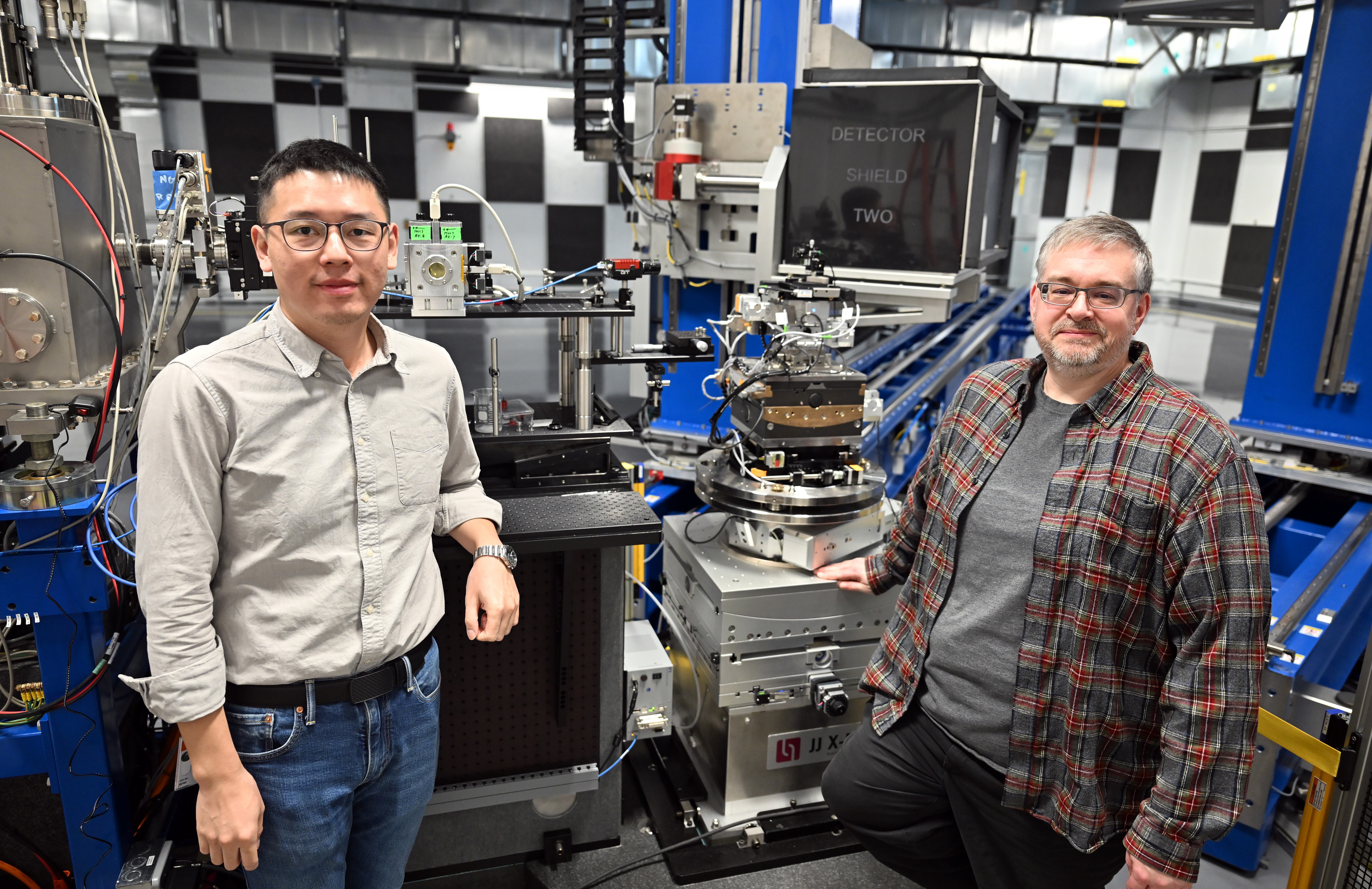 enlarge
Beamline scientist Yuan Gao (left) and lead beamline scientist Garth Williams (right) stand near one of the Coherent Diffractive Imaging beamline's two area detectors. (Kevin Coughlin/Brookhaven National Laboratory)
Excitement is building as the National Synchrotron Light Source II (NSLS-II), a U.S. Department of Energy (DOE) Office of Science user facility at DOE’s Brookhaven National Laboratory, prepares for the launch of its newest beamline. The Coherent Diffractive Imaging (CDI) beamline features an innovative optical design that lets scientists fine-tune both the size and the coherence of the X-ray beam to match the needs of each experiment. With its ability to deliver exceptionally bright, highly coherent X-rays, CDI will enable powerful new imaging and scattering techniques. These capabilities will enable researchers to explore materials at the micron scale with nanometer resolution, opening new windows into the structure and evolution of complex materials.
As part of commissioning activities, the team at CDI is preparing for a virtual workshop and starting to consider early science commissioning proposals from prospective users. These will help guide the final steps of bringing CDI into regular operations and optimizing it for user science.
Novel capabilities to facilitate new discoveries
The NSLS-II Experimental Tools II (NEXT-II) Project, funded by the DOE Basic Energy Sciences program, was established to build a suite of cutting-edge beamlines to meet the evolving needs of the research community. This includes CDI, as well as the Soft X-ray Photoemission and Scattering Imaging (ARI) beamline and the Soft X-ray Nanoprobe (SXN) beamline. The project aims to have all three beamlines operational by 2027.
CDI has come a long way from its initial conceptualization, recently celebrating one of its biggest milestones: first light. This is the moment when powerful X-rays first enter the beamline and some of the most important tests of its capabilities can begin. The beamline’s unique design brings a new range of capabilities to NSLS-II through its innovative instrumentation. It employs two detectors with impressively large horizontal angles, each independently positionable.
“This is helpful when there are studies that require us to measure multiple Bragg peaks or studies that require us to measure a particular Bragg peak at the same time as we're measuring a surface scattering signal, a small angle X-ray scattering (SAXS) signal, a SAXS surface scattering signal, or the forward scattering,” said Garth Williams, the lead beamline scientist for CDI. “In other words, CDI’s design can help scientists capture several types of signals at the same time, allowing them to collect multiple complementary data sets for a more comprehensive description of their samples.”
Bragg peaks are strong signals originating from the atomic structure of materials. The position and amplitude of these peaks can be used to learn more about how those atoms are arranged.
While detectors like these exist elsewhere at NSLS-II, the capability to independently position two detectors over a very large region of reciprocal space is a new capability. To increase the field of view for high-resolution diffraction, achieving more data points per peak, CDI also makes use of two 10-meter-long arms.
Serving the user community
Early science proposals for CDI will likely include experiments that use the two detectors in novel ways. This kind of research will help demonstrate unique applications of the detector arms, paving the way towards in-situ and operando science opportunities. This will enable scientists to study materials in different environments and conditions.
While applications for CDI span a variety of fields, there has already been interest in using the beamline to study battery materials and investigate substrate strain in microelectronics. There are also applications in quantum materials science, such as looking at bulk structures for materials for quantum computing, that aim to complement some of the current techniques at other beamlines.
“Simultaneous measurements with two detectors can provide both complementary information and additional data redundancy,” said Yuan Gao, a beamline scientist at CDI. “This capability can significantly improve structure retrieval for samples that are difficult, or even impossible, to solve using current algorithms, including highly strained crystals, crystalline objects with complex domain structures, and weakly strained crystals on the several-micron scale.”
Gao is also working to adapt this method to large crystalline objects. Unlike traditional methods used currently, the two detector arms will be able to measure multiple Bragg peaks from very large samples.
As CDI moves from first light toward its first experiments, the focus is now on translating its novel capabilities into real scientific impact. The upcoming virtual workshop and early science commissioning proposals will give prospective users a chance to engage with the beamline team, shape experimental approaches, and help refine CDI’s performance ahead of full user operations.
Brookhaven National Laboratory is supported by the Office of Science of the U.S. Department of Energy. The Office of Science is the single largest supporter of basic research in the physical sciences in the United States and is working to address some of the most pressing challenges of our time. For more information, visit science.energy.gov.
Follow @BrookhavenLab on social media. Find us on Instagram, LinkedIn, X, and Facebook.
2026-22771 | INT/EXT | Newsroom