Designing Cutting-Edge Detector Systems for the Electron-Ion Collider
Jefferson Lab mechanical engineer Alex Eslinger helps design subdetectors for imaging photons — particles of light — emerging from collisions at the Electron-Ion Collider
August 27, 2025
 enlarge
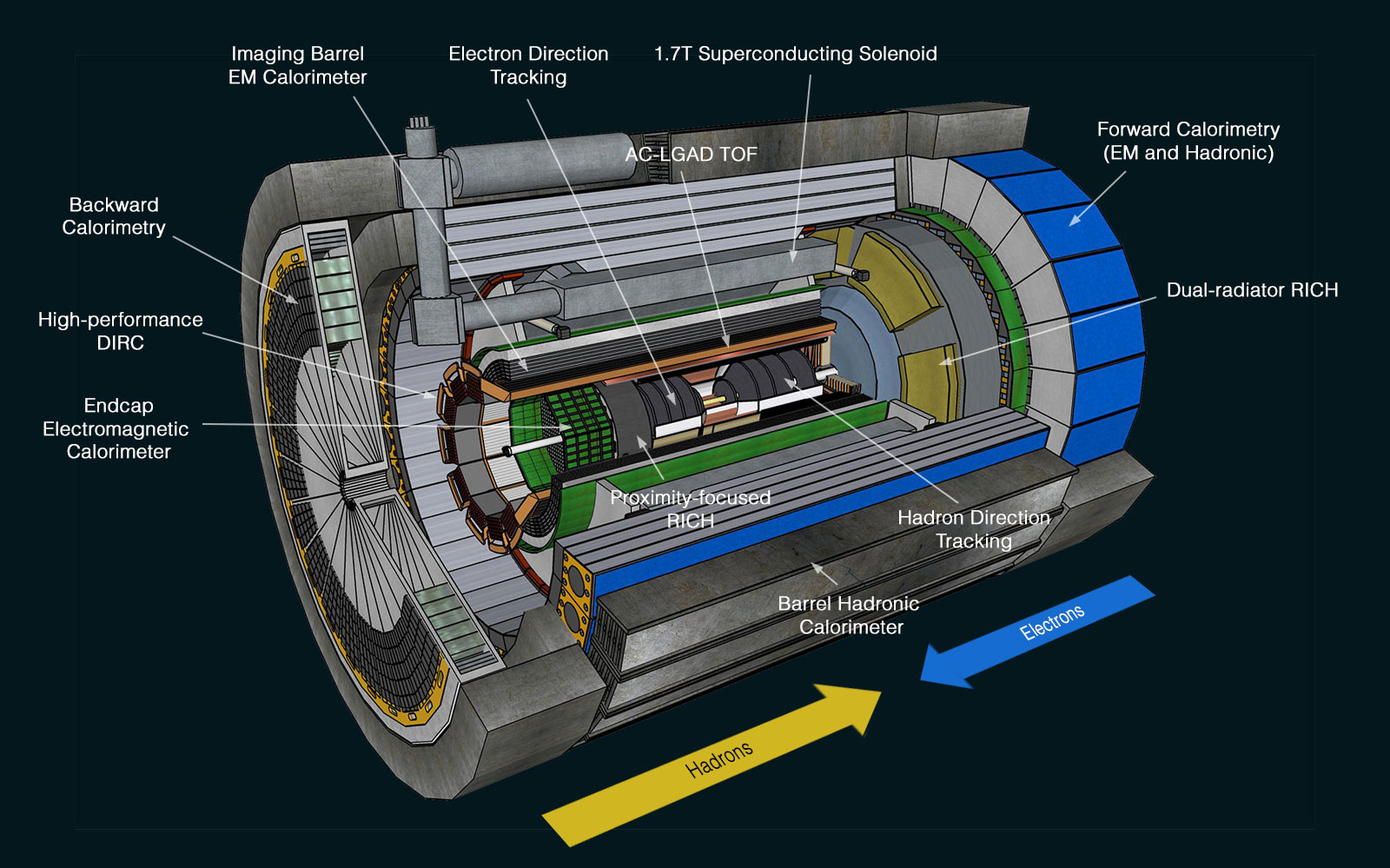
The Electron-Ion Collider (EIC) detector, known as ePIC, will use cutting-edge technologies to detect particles created in collisions between high energy electrons and protons or ions (the nuclei of larger atoms) moving close to the speed of light. (Brookhaven National Laboratory)
Editor’s note: This story is a part of a series of profiles highlighting the scientists, engineers, and other professionals who are helping to design the Electron-Ion Collider (EIC), a next-generation nuclear physics research facility being built at the U.S. Department of Energy’s (DOE) Brookhaven National Laboratory in partnership with DOE’s Thomas Jefferson National Accelerator Facility (Jefferson Lab) and collaborators around the world.
What is your role?
I work with multinational teams to design subdetectors, like the proximity-focusing ring-imaging Cherenkov (pfRICH) detector with Brookhaven National Lab and the dual ring-imaging Cherenkov (dRICH) detector with a team from Italy. I also work with the team that integrates these subdetectors into the overall Electron-Proton/Ion Collider (ePIC) detector system.
What do the pfRICH and the dRICH do exactly?
There’s something deeply fulfilling about contributing to something that helps move science — and society — a little further forward.
— Alex Eslinger
An analogy for these RICH subdetectors would be that they act in a similar manner to cameras. The pfRICH can get really close due to its design, its position within ePIC, and the materials it’s made of. It captures rings of light made by fast-moving particles when they pass through a special material. These rings tell scientists what kind of particle it is — kind of like scanning a fingerprint. The dRICH can capture particles at different speeds by using both a gas and a solid — in essence, it has one lens for close-ups and another for long-range shots.
Why is this important to the EIC?
We’re trying to bring new technologies into tried-and-true designs. RICH-style detectors have been around for a while and are great at identifying the particles that pass through them. But the ePIC detector for the EIC is totally new, so we have to adapt those existing designs to meet our specific space and performance needs.
The integration part is crucial, too, because nothing can be designed in isolation. Every component interacts with others, so we have to think through every detail. As a team, we focus on how to install, support, and remove each piece while making sure nothing conflicts with the rest of the system.
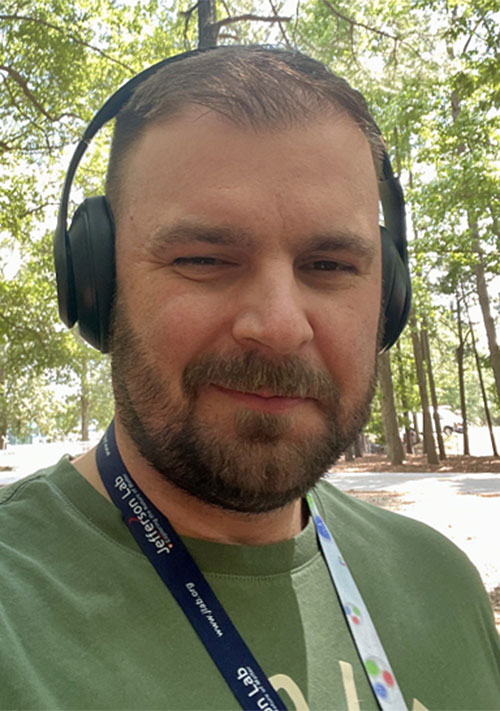
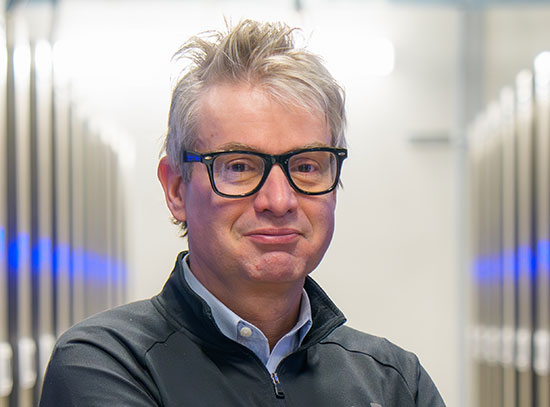
Alex Eslinger, pictured here, adapts mechanical designs and techniques to meet the scientific goals of the Electron-Ion Collider's central detector. (Alex Eslinger/Thomas Jefferson National Accelerator Facility)
What's the most exciting aspect of your job?
From a technical perspective, I’d say it’s the steep learning curve. Every day, I’m learning new ways to apply different mechanical designs and techniques to tackle problems. Getting to work with much more experienced engineers has been an amazing opportunity for me as we keep pushing the designs forward.
On a bigger picture level, it’s super exciting to be part of such an international team. I get to collaborate with physicists and engineers from all over the world — different labs, top universities, you name it — every single day. Honestly, I don’t think there are many jobs out there that offer that kind of global interaction.
What is challenging for you and your group right now?
To be honest, one of the biggest challenges for me — and for a lot of the teams I work with — is the distance and keeping communication consistent. I’d love to have more face-to-face time with the people I work with daily, especially those putting in the hard work to design the ePIC detector. But, of course, we live in a digital world, so that kind of thing isn’t always easy to pull off. That said, I’m lucky that the project supports me whenever I feel it’s crucial to be on site during a key moment.
Tell us about your career journey.
I jumped right in when I started [at Jefferson Lab]. Within no time, I was working on EIC-related projects and leading the design of pfRICH’s predecessor, the modular ring-imaging Cherenkov (mRICH) detector. I ended up being the main engineer in charge of two competing designs and got to present both, which was a wild and rewarding experience.
I still think of myself as early in my mechanical engineering career, but this isn’t my first rodeo. Before this, I spent nearly 10 years handling contracts for the Department of Defense. Before that, I was a certified automotive technician. So, I’ve lived a few different lives, and each one’s added something unique to how I work and solve problems today.
Do you have advice for early career folks or those in your field?
Dive in with an open mind and a real willingness to learn. No one walks in knowing everything, and that’s okay. What matters most is being curious, asking questions, and staying humble enough to admit when you don’t know something.
There’s a lot to be gained just from listening — especially to the folks who’ve been doing this for a while. Their experience is invaluable and, chances are, they’ve been exactly where you are now. Don’t be afraid to reach out or ask for help. We’re lucky to work alongside some truly outstanding people and, more often than not, they’re just a message or quick conversation away.
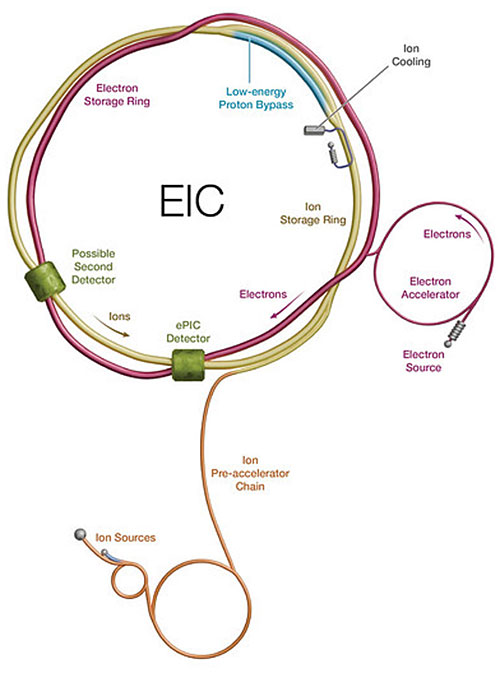
A schematic of the planned Electron-Ion Collider which will consist of an existing ion storage ring, a new electron storage ring and electron accelerator ring, and the ePIC detector (six o'clock), which will capture collisions of polarized, or spin-aligned, electrons and ions. (Brookhaven National Laboratory)
What are some non-work facts about you?
I have two kids; my son is three and my daughter is six. I am always up to learn new things. I grew up in Kentucky and love my ‘Cats — that’s Wildcats, the team for the University of Kentucky. My hobbies typically revolve around making or fixing things.
Finally, what excites you about the EIC?
To be fair, I don’t fully grasp all the complex physics behind the EIC and ePIC detector, but I do understand the bigger picture. Every time we create a new tool to look deeper into the universe, we uncover things we never knew existed. That kind of discovery pushes the boundaries of what we know and opens the door to entirely new questions.
I’m genuinely proud to be a part of that effort. Even if my role is just a small piece of a much larger puzzle, it still matters. There’s something deeply fulfilling about contributing to something that helps move science — and society — a little further forward. That’s where my excitement comes from: the idea that what we’re building today might help shape how we understand the world tomorrow.
Brookhaven National Laboratory is supported by the Office of Science of the U.S. Department of Energy. The Office of Science is the single largest supporter of basic research in the physical sciences in the United States and is working to address some of the most pressing challenges of our time. For more information, visit science.energy.gov.
Follow @BrookhavenLab on social media. Find us on Instagram, LinkedIn, X, and Facebook.
2025-22572 | INT/EXT | Newsroom