A Silicon-Compatible Path Toward Scalable Quantum Systems
Brookhaven Lab researchers built superconducting quantum devices using a new material and a technique adapted from electronics manufacturing processes
April 14, 2026
 enlarge
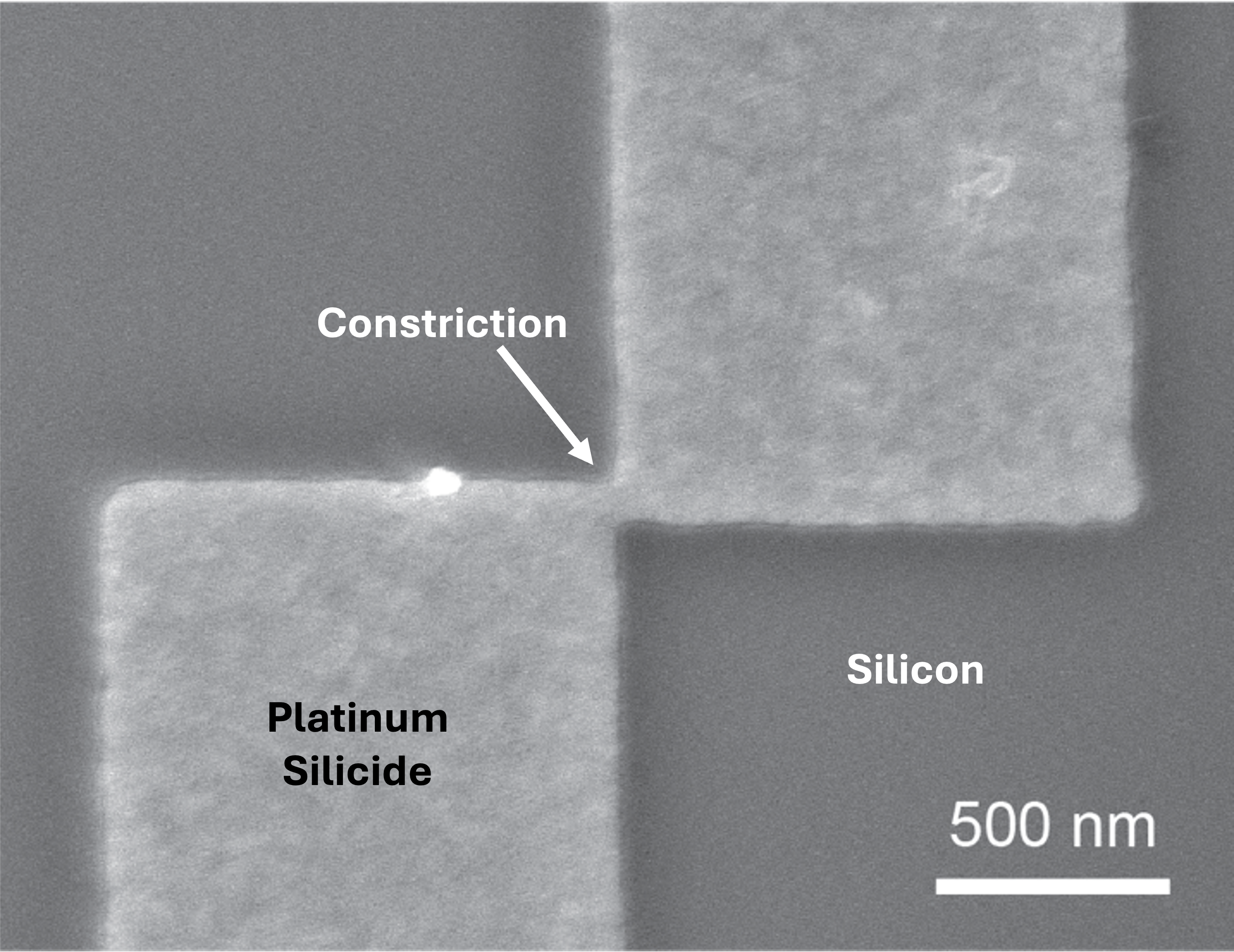
This scanning electron microscope image shows a superconducting quantum interference device (SQUID) made with a silicon-compatible class of materials called transition metal silicides. Built upon a silicon substrate, the SQUID includes two layers of superconducting platinum silicide connected by a constriction junction. (Brookhaven National Laboratory)
Beginning in the 1950s, silicon transformed the electronics industry by enabling smaller and faster devices that could be reliably manufactured at scale. More than six decades later, silicon-based semiconductors remain at the heart of many modern technologies, including so-called “classical” computers.
In pursuit of new quantum technologies, scientists and engineers have turned to specialized materials for building qubits — the fundamental components of quantum systems. For example, many qubits are made from superconducting materials deposited on sapphire substrates. But transitioning from laboratory demonstrations to scalable systems will require scientific and manufacturing infrastructure capable of supporting robust and reliable qubit fabrication.
Marking a milestone toward bridging that gap, researchers at the U.S. Department of Energy’s (DOE) Brookhaven National Laboratory have built superconducting quantum interference devices (SQUIDs) using a silicon-compatible class of materials called transition metal silicides. The research was conducted as part of the Co-design Center for Quantum Advantage (C2QA), a recently renewed National Quantum Information Science Research Center led by Brookhaven Lab.
 enlarge
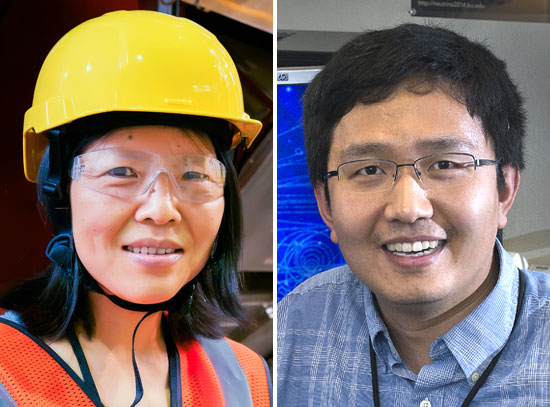
Co-design Center for Quantum Advantage (C2QA) Director Charles Black (left) and C2QA researcher Mingzhao Liu (right) led a Brookhaven Lab-NY Creates team that developed — and successfully used — a manufacturing-friendly technique for building quantum devices from a silicon-compatible class of materials. (Kevin Coughlin, David Rahner/Brookhaven National Laboratory)
“Making quantum devices with transition metal silicides is an approach that’s designed to feed right into the engine that’s been used for semiconductor technology,” said Charles Black, C2QA director, deputy associate laboratory director for Brookhaven’s Energy and Photon Sciences Directorate, and co-lead author on the paper that recently published in Nano Letters.
The researchers collaborated closely with NY Creates, a C2QA partner, to develop a fabrication process informed by advanced microelectronics manufacturing techniques. Using the lithography and etching capabilities available in the nanofabrication facility at the Center for Functional Nanomaterials (CFN) — a DOE Office of Science user facility at Brookhaven Lab — the researchers adapted a technique that is regularly used to synthesize the transition metal silicides used in microprocessors.
“We took this manufacturing-friendly approach so that, in the future, we could implement it at larger scales in the NY Creates facility,” explained Mingzhao Liu, a senior scientist at CFN, C2QA researcher, and co-lead paper author.
In this work, the researchers fabricated each SQUID with two superconducting constriction junctions, rather than using more conventional Josephson junctions, which have two superconducting layers separated by an insulator. The authors previously proposed that this architecture, in which the superconducting layers are connected by a thin wire, has potential to make transmon qubits more amenable to mass production. This new work marks their first experimental demonstration of constrictions in functioning quantum devices.
The SQUIDs served as a diagnostic tool, offering insights into how the constriction junctions were operating. Using CFN’s low-temperature measurement capabilities, the researchers cooled the devices to ultracold temperatures as low as 350 millikelvin and measured how current flowed through the SQUIDs under different applied magnetic fields.
“We learned that the design of the device as a whole can dampen the performance of the constriction junction,” Liu said. “But overall, the experiments showed us that the constriction junctions exhibit key properties, like nonlinearity, that are required for high-performing qubits.”
 enlarge
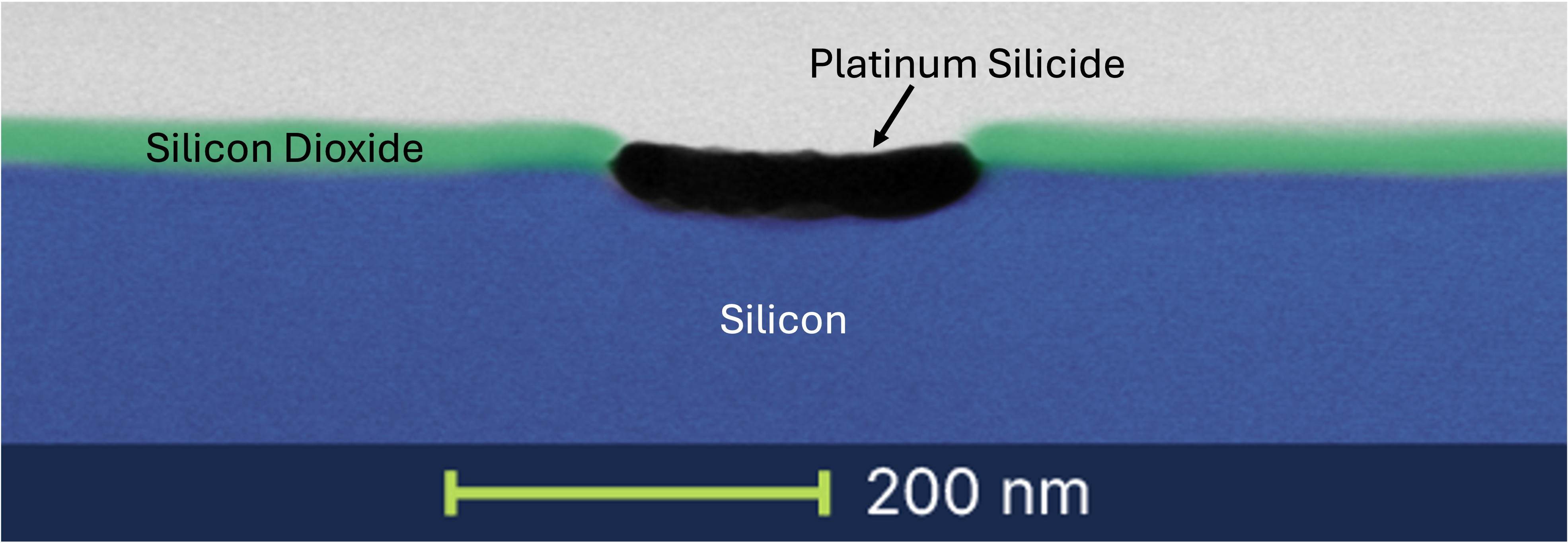
This transmission electron micrograph with false color shows a cross section of a platinum silicide nanowire. Researchers from Brookhaven National Laboratory fabricated the sample by depositing platinum (not shown) on a silicon substrate (blue), which is partially covered by silicon dioxide (green). When heated, platinum and silicon react only where they are in direct contact to form platinum silicide (black), and any remaining platinum is removed with an acid. (NY Creates Metrology Department)
From nanoscale measurements to center-wide collaboration
Advances like this are enabled by the integrated, multidisciplinary approach inherent to C2QA. By uniting expertise and infrastructure from national laboratories, universities, applied research and development organizations, and industry, the Center is accelerating progress toward high-performing qubits made from manufacturable, silicon-based materials.
Ekta Bhatia, NY Creates research scientist in quantum technologies and co-author on the paper remarked, "This publication reflects the power of our strong partnership with Brookhaven under C2QA and accelerates the development of scalable quantum computing. We look forward to building on this work with Brookhaven to drive quantum innovation together.”
Beyond the Brookhaven-NY Creates collaboration, other C2QA researchers continue to deliver breakthroughs in silicon-based quantum devices. In November 2025, for example, C2QA researchers at Princeton University reported record-breaking coherence times in superconducting qubits built on top of silicon substrates, demonstrating that silicon-based platforms can rival and surpass more traditional sapphire platforms.
By approaching the scaling problem from several perspectives — including device design, materials science, and large-scale manufacturing — C2QA researchers are delivering a synergistic impact that is greater than the sum of their individual achievements.
Black said, “We’re developing a pipeline to take advantage of the strengths of each C2QA partner — and making strides toward scalable quantum systems.”
C2QA is supported by the DOE Office of Science.
Brookhaven National Laboratory is supported by the Office of Science of the U.S. Department of Energy. The Office of Science is the single largest supporter of basic research in the physical sciences in the United States and is working to address some of the most pressing challenges of our time. For more information, visit science.energy.gov.
Follow @BrookhavenLab on social media. Find us on Instagram, LinkedIn, X, and Facebook.
2026-22775 | INT/EXT | Newsroom