Student Advances Precision Optics Characterization at NSLS-II
Ruochen Xu helps NSLS-II scientists create software to accurately assess complex mirror shapes
July 10, 2026
 enlarge
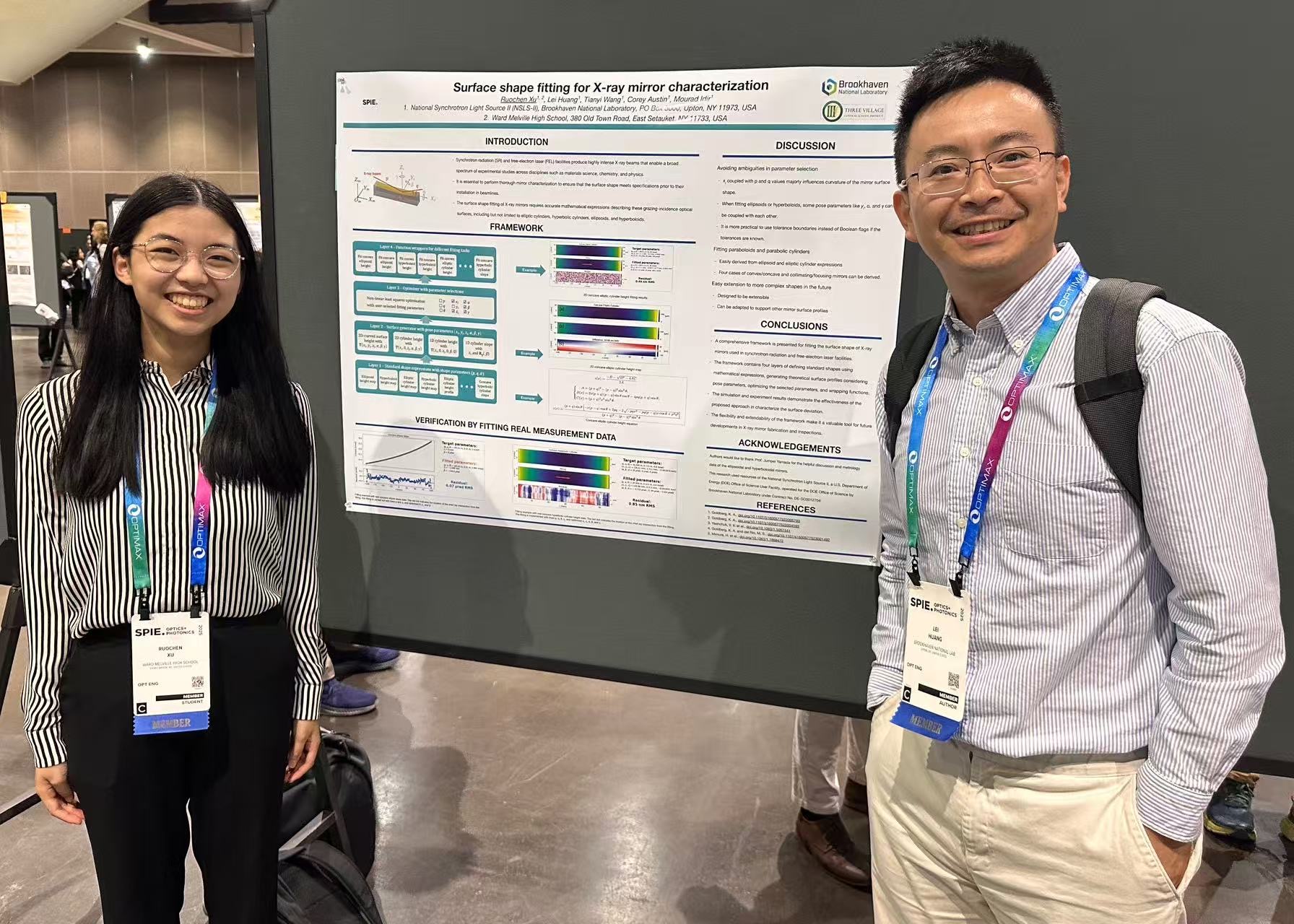
Ruochen (Racheal) Xu and Lei Huang display a poster on their optics characterization research at the SPIE Optics +Photonics conference. (Ruochen Xu)
When Lei Huang, a scientist in the Optics and Metrology group at the National Synchrotron Light Source II (NSLS-II) — a U.S. Department of Energy (DOE) Office of Science user facility at DOE’s Brookhaven National Laboratory — signed up to mentor a high school student, he knew that they wouldn’t arrive with a background in X-ray optics. It’s a highly specialized field that develops mirrors, lenses, and prisms for X-ray beams. Those X-ray optics enable scientists to peer into materials at the nanoscale with unprecedented resolution and sensitivity.
X-ray mirrors that are used at synchrotron light sources look and behave very differently from the ones in an everyday home. Unlike a bathroom mirror, which reflects light at a wide range of angles, X-ray mirrors must guide light at extremely shallow, “grazing” angles. X-rays need to bounce off of the surface at these shallow angles, like a stone skipping on a pond, otherwise they will penetrate the mirror and will not reflect.
Designing, creating, and maintaining these mirrors requires precision measurement techniques and advanced analysis and simulation tools. The mirrors come in very specific shapes, need surfaces polished to near-atomic smoothness, and have coatings applied at precisely controlled thicknesses to enhance reflectivity. Even tiny errors in these optics can degrade the quality of the reflected X-ray beam. Gauging all of that can be extremely challenging.
As expected, Ruochen (Racheal) Xu, a student at Ward Melville High School at the time, didn’t arrive at NSLS-II with a deep background in X-ray optics or metrology, the scientific study of measurement, but she did have a passion and talent for advanced mathematical problems. By translating a complex X-ray mirror metrology problem into a mathematical one, Huang created an accessible entry point that allowed Xu to contribute meaningfully and sparked a long-lasting interest in this unique field.
Real experience, real science
Brookhaven’s High School Research Program (HSRP) is a six-week program that gives high school students the opportunity to collaborate on real-world research with scientists and engineers across the Lab. It offers a window into day-to-day work in a range of STEM careers and gives students hands-on experience that helps build their knowledge and skills as they explore different paths in science and technology.
During her time in HSRP at NSLS-II, Xu collaborated with the Optics and Metrology team on a software program to fit measured mirror data to ideal mirror shapes. The goal was to determine whether a mirror matches its intended design and, if not, how it should be corrected. The program can handle several common mirror shapes, including elliptic, hyperbolic, ellipsoidal, hyperboloidal, and diaboloidal mirrors, and it works with different types of measurements, like characterizing surfaces and capturing the angles that beams deflect at. It also accounts for mirrors that are slightly shifted or tilted in the measuring instrument, rather than assuming perfect alignment.
Xu contributed to the development of this new software framework. Traditionally, these calculations had to be redone from the beginning for each new type of mirror. By standardizing the process, the framework significantly reduces computation time while giving scientists greater flexibility and control over their analyses.
“She not only understood the problem quickly, but went further, deriving simpler formulas by hand instead of relying on the complex equations derived through the Matrix Laboratory (MATLAB) programming language,” Huang said. “She compared her solution with the existing MATLAB codes for fitting simulated data to a shape equation and successfully reimplemented it into the computer using python code, demonstrating a strong understanding across both programming languages.”
The team’s work was published in the Journal of Synchrotron Radiation. The paper demonstrated several real-data examples to test the program, and the code is open source in both MATLAB and Python. It is a general, reusable tool for mirror metrology that makes X-ray mirror characterization easier, more consistent, and more transparent.
“The program cuts down on how much time a scientist has to spend doing derivations and rearranging equations,” Xu said. “That gives them more time to actually run experiments and focus on what they need.”
The benefits of mentorship go both ways
For Huang, the experience underscores the value of well-designed mentorship: By choosing focused, approachable topics, students who are new to a field can engage in real research, gain insight into scientific careers, and see firsthand how classroom math applies to cutting-edge science.
“We can’t expect students to master everything in a few months, but they can understand the core problem and meaningfully contribute,” Huang said. “She derived simplified formulas by hand, translated our existing MATLAB code into Python, and implemented functions for new cases. That was a significant contribution to the project.”
The experience also opened up new opportunities for Xu. She presented a poster on the topic at the SPIE Optics and Photonics conference in San Diego, meeting researchers whose papers she had been citing face to face.
Now preparing for college, where she plans to study engineering, Xu hopes to continue building on this research. She is particularly interested in expanding the framework and contributing to open-source scientific tools.
“Even if I don’t go directly into this field, I still want to keep working on it,” she said. “I’m really proud of what we’ve done and excited to see where it goes next.”
Brookhaven National Laboratory is supported by the Office of Science of the U.S. Department of Energy. The Office of Science is the single largest supporter of basic research in the physical sciences in the United States and is working to address some of the most pressing challenges of our time. For more information, visit science.energy.gov.
Follow @BrookhavenLab on social media. Find us on Instagram, LinkedIn, X, and Facebook.
2026-22906 | INT/EXT | Newsroom