X-Ray Diffraction to Predict Stronger Welds in Reactor Steel
April 8, 2026
 enlarge
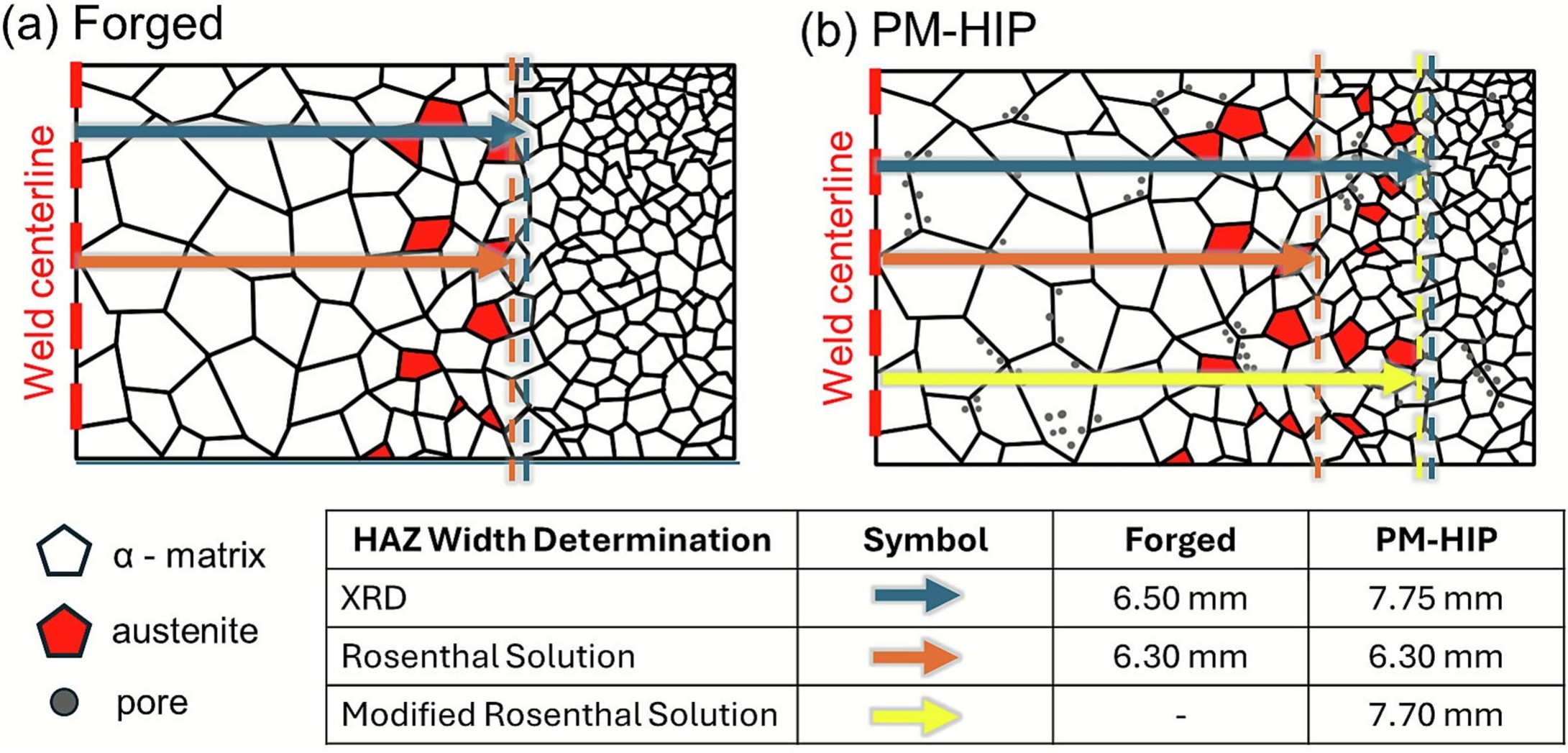
This chart compares how wide the heat-affected zones (HAZs) are using three different methods: Synchrotron X-ray diffraction (XRD) measurements (green arrows) , a standard heat-flow model (Rosenthal equation) (orange arrows), and a new, modified version of that model (yellow arrows). These methods were used on two types of samples: (a) forged and (b) powder-based (PM-HIP) samples, both after heat treatment. Red segments represent austenite and tiny green spots represent pores.
The Science
Scientists demonstrate how manufacturing and heat treatment shape weld structure in reactor steels and introduce a more accurate model to predict heat-affected zones (HAZs).
The Impact
Improved prediction of weld performance could enable safer and more reliable designs of nuclear reactor components and other advanced manufactured materials.
Summary
Nuclear reactor pressure vessels (RPVs) are critical safety structures that must withstand extreme conditions for decades. This study examines how different manufacturing methods and heat treatments affect the microscopic structure of the steel used in these vessels, particularly around welds.
Researchers from Purdue University, the University of Illinois, and the National Synchrotron Light Source II (NSLS-II), a U.S. Department of Energy (DOE) Office of Science user facility at DOE’s Brookhaven National Laboratory, compared two ways of making RPV steel: traditional forging and a newer method called powder metallurgy with hot isostatic pressing (PM-HIP), which compresses metal powder into shape using high heat and pressure. Both were joined using electron beam welding, then given different heat treatments.
Samples that only underwent a standard post-weld heat treatment retained small amounts of austenite, a specific crystalline form of iron, in the weld's heat-affected zone. This can create mechanical weak points in the material. Samples given a more intensive heat treatment, called austenitization, resulted in a much more uniform microstructure throughout, no retained austenite, and a more consistent hardness.
The heat-affected zone (HAZ) is the region around a weld altered by welding heat. Standard methods underestimated the HAZ width in PM-HIP materials by about 1.4 mm. The reason is that PM-HIP steel has more porosity and finer grains, which slow heat dissipation and widen the affected zone. Based on this, the team was able to develop a modified mathematical model accounting for porosity that predicted the HAZ width with less than 1% error.
Researchers used the X-ray Powder Diffraction (XPD) beamline to perform synchrotron X-ray diffraction on their steel samples. This technique’s high resolution and sensitivity enabled the detection of very small amounts of retained austenite (fractions of a percent by weight) that other lab instruments might miss. They were also able to precisely track how the microstructure changed across the weld, heat-affected zone, and base metal.
Knowing where and how a weld affects surrounding material with accuracy and precision is critical for predicting how a reactor vessel will hold up under radiation, pressure, and temperature over its lifetime. This work provides better tools for designing and characterizing welds, especially as newer manufacturing methods like PM-HIP become more widely used in the nuclear industry.
Download the research summary slide (PDF)
Related Links
Contact
Maria A. Okuniewski
Purdue University
mokuniew@purdue.edu
Publications
Emerson, J. N., Marrero-Jackson, E. H., Nemets, G. A., Topsakal, M., Gill, S., Wharry, J. P., & Okuniewski, M. A. (2026). Influence of fabrication on microstructure and heat affected zone width in weldments of nuclear reactor pressure vessel steel. Materials & Design, 263, 115521. https://doi.org/10.1016/j.matdes.2026.115521
Funding
This work was partially supported by the U.S. Nuclear Regulatory Commission through grants 31310021M0052 and 31310021M0035, and by the U.S. Department of Energy Office of Nuclear Energy contract DE-NE0008907. J.N.E. would like to acknowledge that this research was supported under a DOE, Office of Nuclear Energy University Nuclear Leadership Program Graduate Fellowship. The SXRD experiments were facilitated by the U.S. Department of Energy (DOE), Office of Nuclear Energy under DOE Idaho Operation Office Contract DE-AC07-05ID14517 as part of Nuclear Science User Facilities. This research used resources 28-ID-2 of the NSLS-II, a U.S. DOE Office of Science User Facility operated for the DOE Office of Science by BNL under Contract No. DE-SC0012704.
2026-22930 | INT/EXT | Newsroom