Building out the Quantum Computing Toolkit
More quantum primitives can unlock new problem domains with a quantum advantage
July 13, 2026
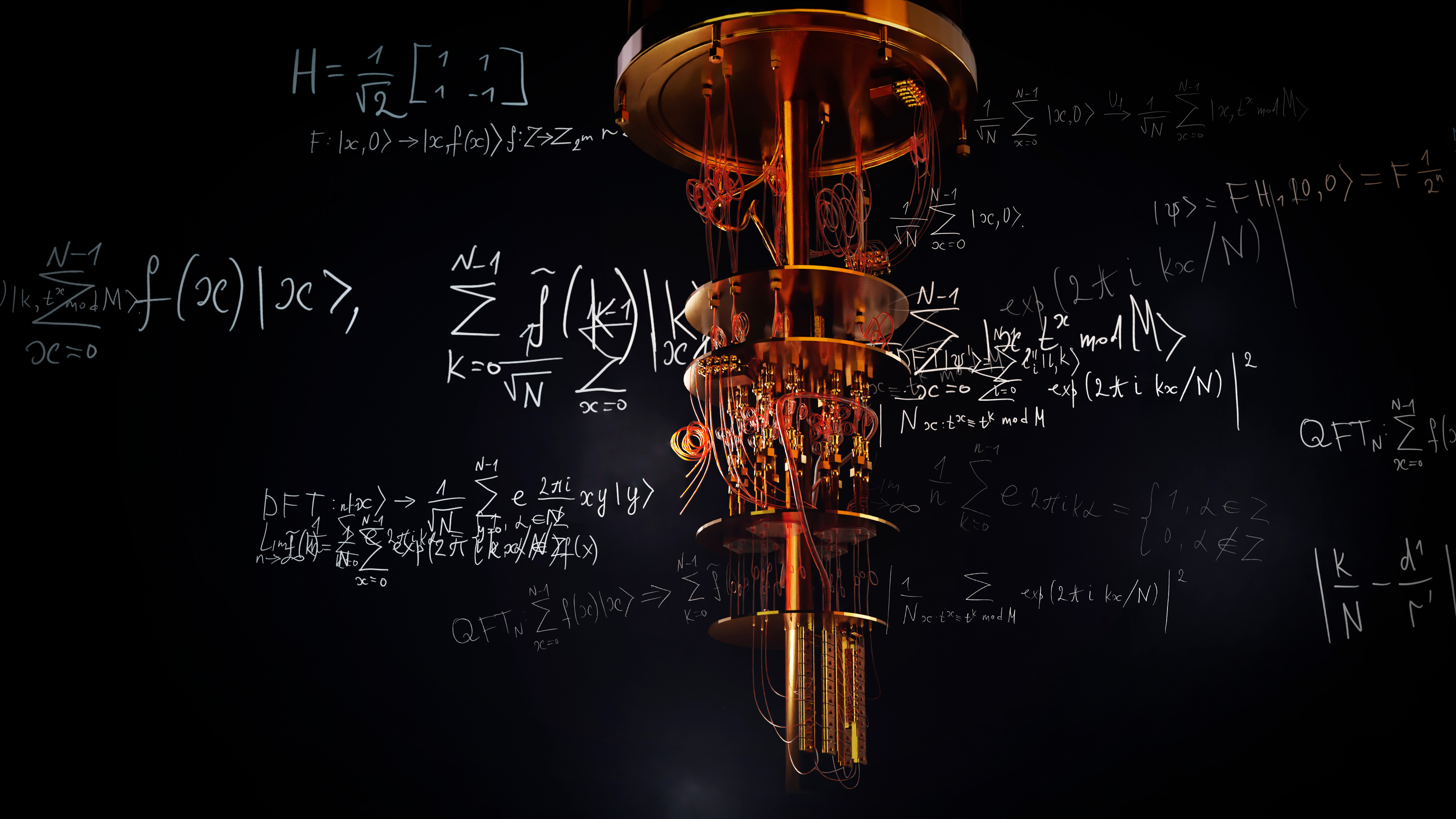
Quantum computers lack useful functionality without the right algorithms to facilitate their operation. Presently, there are few simple, standardized operations, known as “primitives,” in the quantum toolkit that can help deliver the unique quantum behaviors required for such computers to achieve results beyond classical systems. With that in mind, researchers at the U.S. Department of Energy (DOE)’s Brookhaven National Laboratory, Northeastern University, Google Quantum AI, and University of Texas at Austin (UT) came together to build a better quantum algorithm. The resulting quantum Hermite transform is the quantum equivalent of a well-used classical mathematical primitive with the added potential to expand quantum computing’s impact on real-world science, including artificial intelligence (AI) applications.
“The quantum Hermite transform is a quantum algorithm that implements the Hermite transform on a quantum state,” said Ning Bao, an assistant professor at Northeastern University with a joint appointment in Brookhaven Lab’s Computing and Data Sciences Directorate. “It is structurally quite distinct from existing quantum primitives, which could lead to more quantum algorithms that solve unique problems.” Bao’s initial work on a DOE-funded project led to the interactions concerning the Hermite transform that resulted in the team’s collaboration.
From classical math to quantum computing
Hermite transforms are actively used across engineering and physics, especially to describe the energy levels of the quantum harmonic oscillator, a fundamental physics model that captures how particles vibrate in a predictable way. Hermite functions also underlie many Gaussian systems common in machine learning and data science. However, switching into this Hermite-based representation on a quantum computer is a slow and unwieldy slog.
The research team solved the “slog problem” by constructing an efficient quantum circuit that performs the transform with only logarithmic overhead — one step versus many — even for extremely large quantum states. The quantum Hermite transform, or QHT, also relies on precise approximations of Hermite functions with the ability to “fast-forward” the harmonic oscillator, allowing a quantum computer to jump directly to the system’s future state within a few operations.
When combined with new methods the team developed to build specific quantum states, known as “state preparation,” where qubits are placed in the proper starting configuration inside a quantum computer, QHT emerges as a practical, high-precision quantum primitive that offers a powerful new way to analyze and represent data.
“Fast forwarding a quantum system means to directly compute its state at a specific moment in time,” Bao explained. “If the time evolution is over a very long duration, this can give drastic savings on the amount of time needed to prepare a quantum state. Basically, I can either prepare it directly in a small amount of time or physically evolve it for a very long time.”
According to Bao, this work matters because quantum computing suffers from a dearth of core algorithmic primitives, the “building blocks” that are essential to create more complex quantum algorithms. Quantum algorithms usually rely on variations of the same techniques, such as the quantum Fourier transform or stabilizer-based methods. In turn, these methods often get applied to similar problems.
In principle, new primitives like QHT can expand the types of problems quantum computers tackle beyond engineering and physics research. An enhanced quantum algorithm toolkit that can take advantage of quantum effects to build more complex operations can move quantum systems into broader domain areas, including materials science, energy security, advanced scientific modeling, and AI. Moreover, QHT does so exponentially faster than known classical methods.
Ideas that expand quantum possibilities
Although the progress with QHT represents a multi-institutional effort, the research’s early seeds were planted at Brookhaven Lab. Bao originated the idea with Stephen Jordan at Google Quantum AI while leading a project funded by DOE’s Advanced Scientific Computing Research program. Ultimately, Bao and his Google colleagues joined forces with students at UT who were working on a related problem. The collaboration proved fruitful.
“There was no specific aha moment,” he said. “We had a strategy that we thought was going to work, and many of the obstacles that we thought would get in our way resolved in relatively simple ways.”
In creating the quantum Hermite transform, the team’s work further strengthens a core pillar of the DOE’s mission to advance algorithmic foundations of quantum computing.
“Quantum computers are powerful, but without quantum algorithms, the realm of applicability of this power is very limited,” Bao added. “Having new primitives enables solving broader suites of problems, including those relevant to real-world science. The quantum Hermite transform is a root rather than an endpoint — another staple, reusable operation, like the quantum gate, that empowers quantum computers to realize their advantage over classical systems.”
The team presented the paper at the 58th Annual Association for Computing Machinery Symposium on Theory of Computing (STOC 2026) in Salt Lake City, Utah, on June 22-27, 2026.
Brookhaven National Laboratory is supported by the Office of Science of the U.S. Department of Energy. The Office of Science is the single largest supporter of basic research in the physical sciences in the United States and is working to address some of the most pressing challenges of our time. For more information, visit science.energy.gov.
Follow @BrookhavenLab on social media. Find us on Instagram, LinkedIn, X, and Facebook.
2026-23007 | INT/EXT | Newsroom