Groundbreaking Electron Microscope Installed at CFN
Brookhaven Lab's Center for Functional Nanomaterials has installed a new, state-of-the-art electron microscope with unprecedented capabilities
July 27, 2026
 enlarge
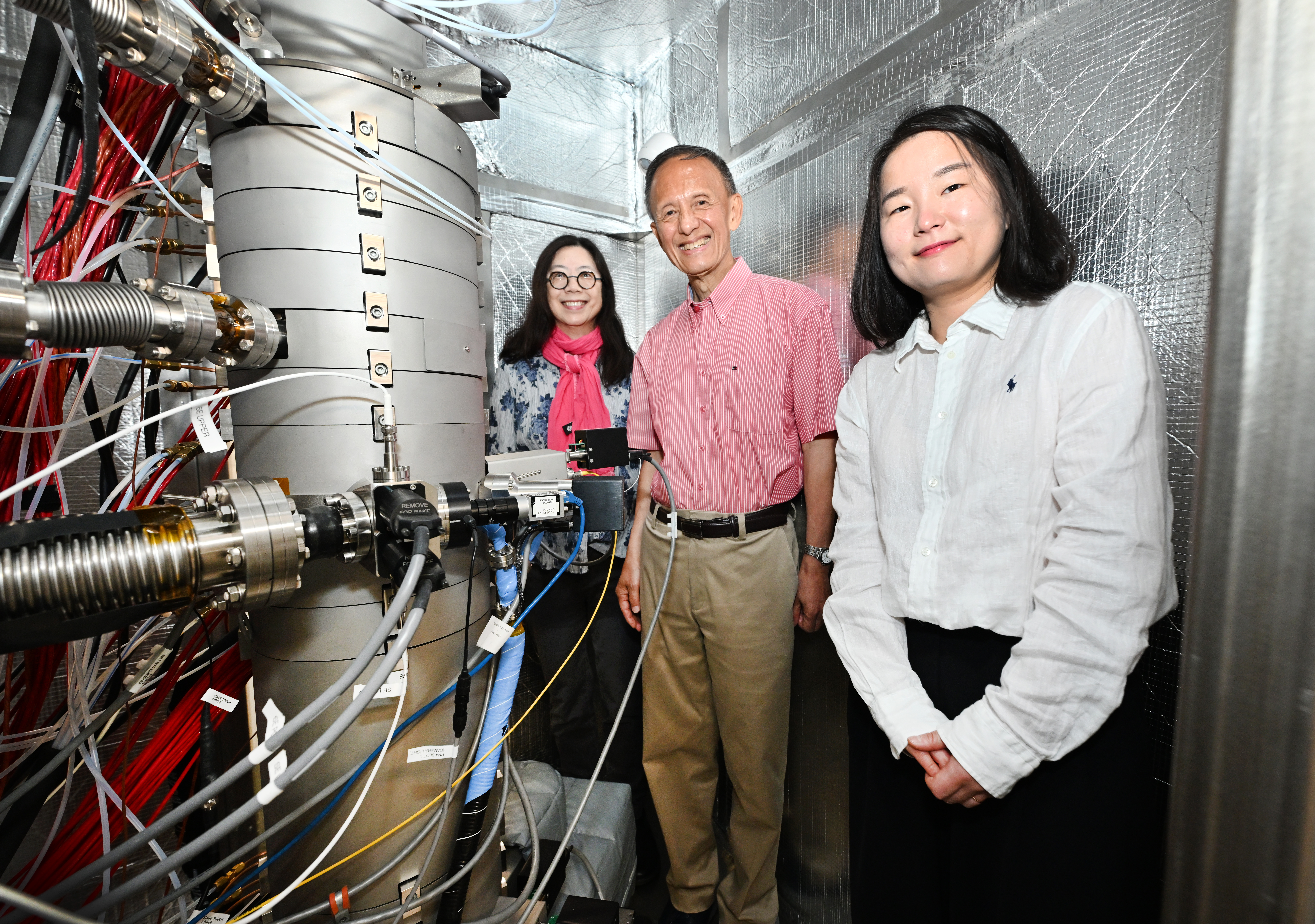
Researchers Judith Yang, Yimei Zhu, and Sooyeon Hwang stand with a new electron microscope at Brookhaven Lab's Center for Functional Nanomaterials. The microscope offers unprecedented capabilities that could lead to new breakthroughs in energy technologies, quantum materials, microelectronics, and beyond. (Kevin Coughlin/Brookhaven National Laboratory)
The Center for Functional Nanomaterials (CFN) at the U.S. Department of Energy’s (DOE) Brookhaven National Laboratory recently installed a new state-of-the-art scanning transmission electron microscope that could lead to new breakthroughs in energy technologies, quantum materials, microelectronics, and beyond.
The microscope was custom-designed and built for CFN to complement the facility’s existing suite of microscopes, as well as the X-ray capabilities at the National Synchrotron Light Source II (NSLS-II). CFN and NSLS-II are DOE Office of Science user facilities at Brookhaven Lab.
X-ray beamlines, such as those at NSLS-II, can probe materials at ultra-small scales and reveal information that is difficult to uncover from other techniques. But recent advances in electron microscope designs are opening new doors for comparable measurements. CFN’s new microscope enables researchers to connect a material's atomic structure, chemistry, and electronic properties with a single instrument.
“For many years, it had been my dream to bring advanced capabilities traditionally only associated with synchrotron beamlines into an electron microscope platform,” said Yimei Zhu, leader of the Lab’s Advanced Electron Microscopy and Nanoscale Structure and Structural Defects group within the Condensed Matter Physics and Materials Science Division (CMPMS). Researchers at CMPMS are regular “users” of CFN and NSLS-II. “As Professor L. M. Brown of Cambridge University famously envisioned nearly three decades ago, our goal has been to create 'a synchrotron in a microscope.'”
New capabilities, new research, and new users
On top of a solid foundation of standard electron microscope features, this microscope offers four new, unparalleled capabilities. First, it is equipped with two secondary electron detectors, which can simultaneously probe the top and bottom surfaces of a sample with atomic resolution. This enables researchers to see extraordinary detail on a sample’s surface that typical transmission electron microscopes can’t capture — while still revealing important internal features.
This capability is especially valuable for studying catalysts, where chemical reactions occur on materials’ surfaces. Catalysts speed up chemical reactions and are integral to energy conversion and storage processes. Understanding how they work on an atomic level will be invaluable to energy sciences and addressing the nation’s energy needs.
“With this equipment, we can examine both sides of a catalyst before and after a reaction to gain a more complete understanding of how its structure changes and how those changes influence its chemical performance,” said Judith Yang, leader of the Electron Microscopy group at CFN.
This timelapse video shows how scientists and technicians installed a new electron microscope at Brookhaven Lab's Center for Functional Nanomaterials. (David Rahner/Brookhaven National Laboratory)
Standard electron microscope techniques such as electron energy-loss spectroscopy (EELS) also received a major upgrade. With EELS, scientists can measure how much energy electrons lose after passing through a sample. A new optical design has extended this microscope’s measurable energy range by over a factor of five, enabling scientists to study a much broader range of electronic excitations and probe transition metal elements. Researchers can use this information to study oxidation states of materials, such as chemical bonding in a battery as it charges and discharges.
CFN’s new microscope has a unique energy filtering system that achieves an energy resolution 200 times better than current microscopes. This enables scientists to perform momentum-resolved EELS for studying phonons, magnons, plasmons, and electronic excitations. These quasiparticles determine how materials conduct heat, respond to magnetic fields, and interact with light and electricity. Understanding these phenomena is essential for developing next-generation materials and microelectronics, as well as advancing quantum computing research.
The new microscope has one final superpower: operating at an extended range of low voltages. Most electron microscopes operate between 100 and 300 kiloelectron-volts (keV). CFN’s new microscope is capable of operating at 20 keV, enabling researchers to image sensitive samples while maintaining atomic-scale resolution.
“We have really pushed the current microscope instrumentation limit,” Zhu said. “This voltage is particularly designed for two-dimensional quantum materials, which are often one or a few atomic layers thick. Lower voltage electrons not only have higher scattering power but also can minimize damage to sensitive materials.”
Many of these individual capabilities will produce data that was previously only attainable through comparable techniques at certain X-ray beamlines. Integrating them into a single electron microscope platform with atomic-scale resolution gives researchers unprecedented flexibility. With more techniques for carrying out their experiments, across both X-ray and electron microscopy facilities, scientists will get the chance to visualize quantum materials and unlock mysteries of underlying physics in more detail than ever before.
“Even the most advanced X-ray imaging techniques are generally limited to spatial resolutions on the scale of tens of nanometers, whereas modern electron microscopes can provide atomic-scale information,” said Sooyeon Hwang, who made significant contributions to the acquisition of the microscope and was a scientist in CFN’s Electron Microscopy group at the time. She is now an associate professor at Dongguk University.
According to Yang, the microscope’s arrival marks the start of a “renaissance of electron microscopy.” With its ability to perform multiple leading-edge techniques, the microscope is a multimodal instrument that solves a problem comically depicted in the age-old parable of blind scientists studying an elephant. As each scientist only feels one part of the elephant, they come to conflicting conclusions: the elephant’s tail is a rope, its trunk is a snake, its leg is a tree, and so on. “With this new instrument, we are now able to feel more of the elephant,” Yang said. “We can finally get at the truth, what’s really there, and I think that’s pretty exciting. It’s what we all want to do as scientists.”
This is an exciting time for CFN users, who come from a wide variety of fields and with ambitious project proposals. The new microscope will allow CFN to take on a variety of new proposals. The microscope’s python-based software will also be much more accessible to users, support remote operation, and potentially enable autonomous and machine-learning-accelerated electron microscopy.
“This instrument opens the door to entirely new experiments," Hwang said. "It will enable CFN to tackle scientific questions that were previously beyond reach, and we're excited to see what users will discover."
Soon, those users will be able to discover even more with the arrival of a second new electron microscope. Together, these instruments mark the start of a promising new era for CFN. They have been a long time coming, and they will certainly be worth the wait.
Brookhaven National Laboratory is supported by the Office of Science of the U.S. Department of Energy. The Office of Science is the single largest supporter of basic research in the physical sciences in the United States and is working to address some of the most pressing challenges of our time. For more information, visit science.energy.gov.
Follow @BrookhavenLab on social media. Find us on Instagram, LinkedIn, X, and Facebook.
2026-23066 | INT/EXT | Newsroom