Stony Brook AI Expert Highlights Grid Innovation at Genesis Mission Summit
August 4, 2026
 enlarge
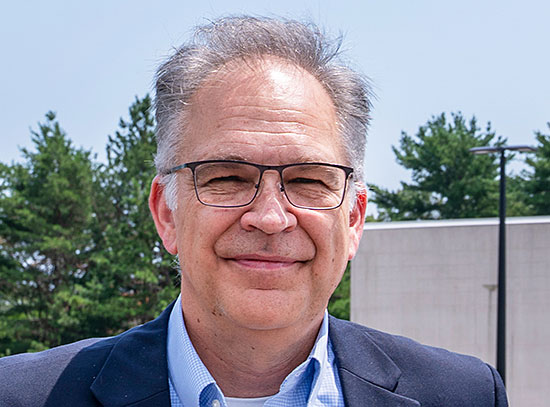
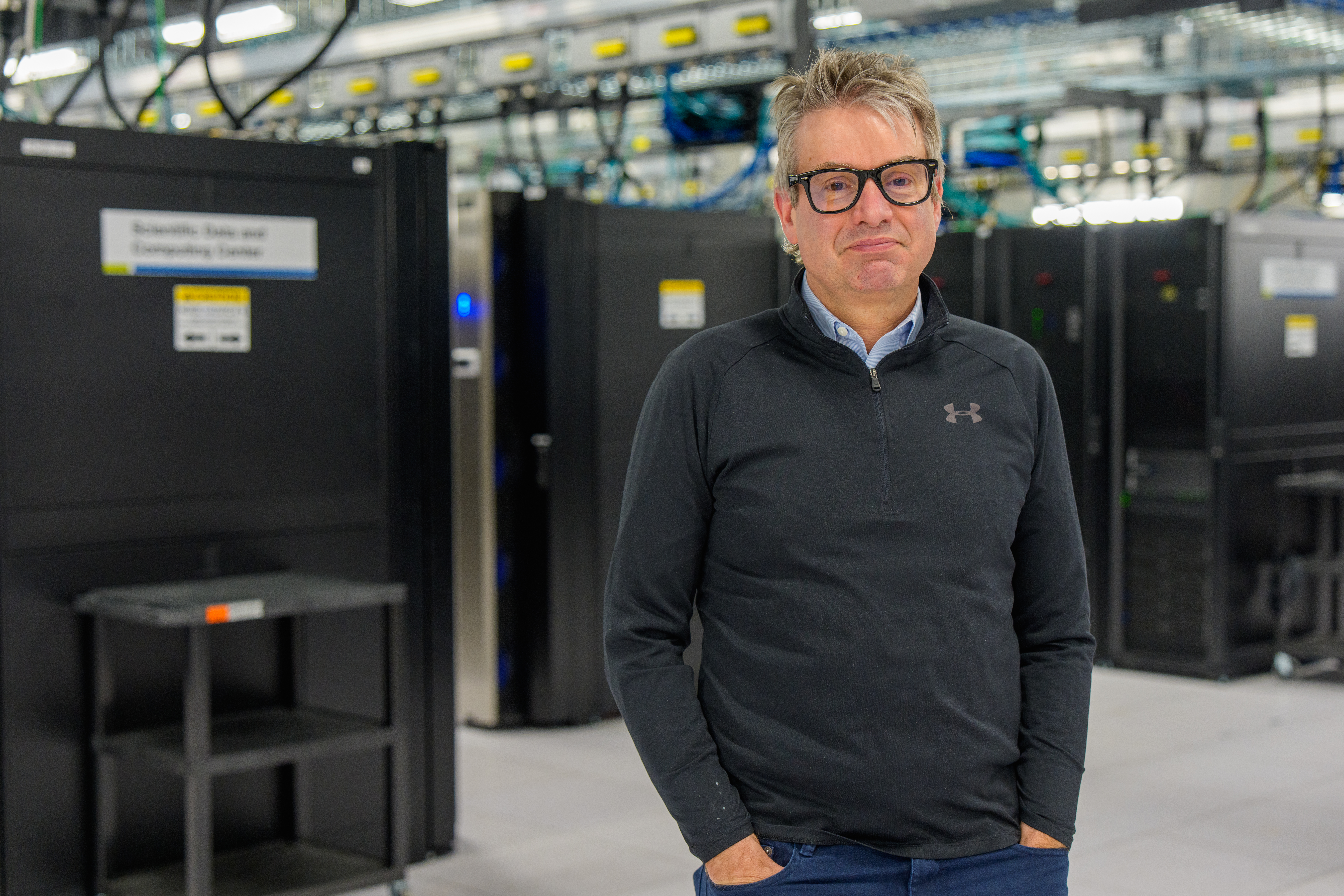
Hendrik Hamann is pictured at Brookhaven National Laboratory's Scientific Computing and Data Facilities. (Timothy Kuhn/Brookhaven National Laboratory)
Editor's note: The following feature story was originally published by Stony Brook University.
As demand for electricity continues to grow alongside advances in artificial intelligence, researchers are increasingly asking how the nation’s electric grid can keep pace. At the inaugural U.S. Department of Energy Genesis Mission Summit, Stony Brook University researcher Hendrik Hamann offered an optimistic answer: AI itself can help solve the problem.
Hamann, a professor in Stony Brook University’s School of Marine and Atmospheric Sciences and chief AI scientist for Innovation, Science and Security at Brookhaven National Laboratory, was one of just four experts selected to deliver a technical keynote during the summit’s opening program in Washington, D.C. His presentation, “How AI Is Transformative for the U.S. Electric Grid,” highlighted how AI can help planners modernize and operate one of the nation’s most complex critical infrastructures.
The July 22 summit at the Capital Hilton launched the first round of funded projects for the Department of Energy’s Genesis Mission, a national initiative to harness AI to accelerate scientific discovery, strengthen energy systems and enhance national security. The event brought together leaders from the Department of Energy, Congress, national laboratories, universities and industry, and included the announcement of six inaugural awards involving Stony Brook researchers.
Applying AI to a National-Scale Challenge
Hamann has spent much of his career working at the intersection of physical science, artificial intelligence, high-performance computing and large-scale data analysis. Before joining Stony Brook with a joint appointment at Brookhaven, he worked for 26 years at IBM Research, where he helped lead research in climate and sustainability and contributed to the development of geospatial foundation models for weather and Earth observation.
His current research centers on AI for science, including physics-informed foundation models capable of learning from and emulating complex natural and engineered systems. He has spearheaded the development of foundation models for the electric grid, with the goal of improving grid resilience and accelerating modernization. Hamann has authored more than 260 scientific papers, holds more than 180 patents and is a fellow of the American Physical Society. His honors include the American Institute of Physics Prize for Industrial Applications of Physics and the Cozzarelli Prize from the National Academy of Sciences.
Hamann is also the founder of GridFM.org, a nonprofit community comprising more than 200 organizations and 500 members. GridFM promotes open-source collaboration to develop and deploy foundational AI technologies for the electric grid.
At the summit, Hamann began by emphasizing the scale and importance of the system his research seeks to address.
“The electric grid is arguably the most important critical infrastructure, powering literally everything we depend on,” Hamann said. “The electric grid is also one of the largest and most complex systems humanity has ever built.”
Maintaining that system requires operators to balance the flow of electricity across a vast network, not only in real time, but also while planning hours, days, months and years into the future. Those decisions must account for uncertain demand, weather conditions, power generation and the integration of new energy resources.
When those variables are combined, Hamann explained, the number of plausible future conditions can reach into the billions. Conventional modeling approaches, however, typically allow researchers and grid planners to examine only a small selection of possible scenarios.
“Today we only analyze a few, which is crazy considering that we are in the midst of a massive and unprecedented expansion of our grid,” he said. “Now, here’s where AI can come in. Where AI must come in.”
Learning the ‘Language of the Grid’
Traditional high-performance computing simulations generally evaluate each grid scenario individually, repeatedly running complex physics solvers from the beginning. Hamann and his collaborators are developing grid foundation models that instead learn the relationships among the grid’s physical structure, electricity demand and power generation.
Once trained across millions of grids and operating conditions, the models can rapidly predict how the system will behave under new circumstances. Hamann described the approach as training AI on the grid’s own language.
“Unlike language foundation models, which are trained on text, our models are trained on the language of the grid,” Hamann said. “That means voltages, power, frequency across a broad set of conditions. So, the model learns how to predict the physics of the grid, enabling us to evaluate billions of scenarios rapidly, not only rapidly, but also accurately and robustly.”
Developing models that operate reliably at that scale requires extensive collaboration. Hamann said the effort brings together utilities, technology companies, universities and national laboratories, each contributing data, infrastructure and specialized expertise.
The results have already demonstrated the potential to accelerate some analyses by as much as 1,000 times. Hamann pointed to data center interconnection studies, which assess whether and how major new electricity users can be added to the grid, as one example.
“Without AI, data center interconnection simulation studies take months, sometimes years,” Hamann said. “Now we can do it literally in minutes. Without AI, we plan and operate the grid scenario-poor. But with AI, we can remove the blindfolds.”
That speed would allow grid planners to evaluate far more possible conditions, identify vulnerabilities and make decisions using a broader understanding of potential outcomes. The approach could also support planning for any large, industrial-scale source of electricity demand. Hamann’s slides characterized the shift as moving from limited analyses involving thousands of scenarios to enhanced, scenario-rich planning involving billions of possibilities.
Hamann concluded by returning to the tension between AI’s growing energy needs and its potential to strengthen the system supplying that energy.
“AI is often considered to be a burden on the grid,” he said. “But with Genesis, the opposite can be true. It is a huge opportunity to build the most secure, affordable and reliable grid for the American people.”
2026-23087 | INT/EXT | Newsroom