A Career Built for Quantum Leadership
With a career trajectory paralleling the evolution of quantum computing, Charles Black now leads a national quantum research center
September 24, 2026
 enlarge
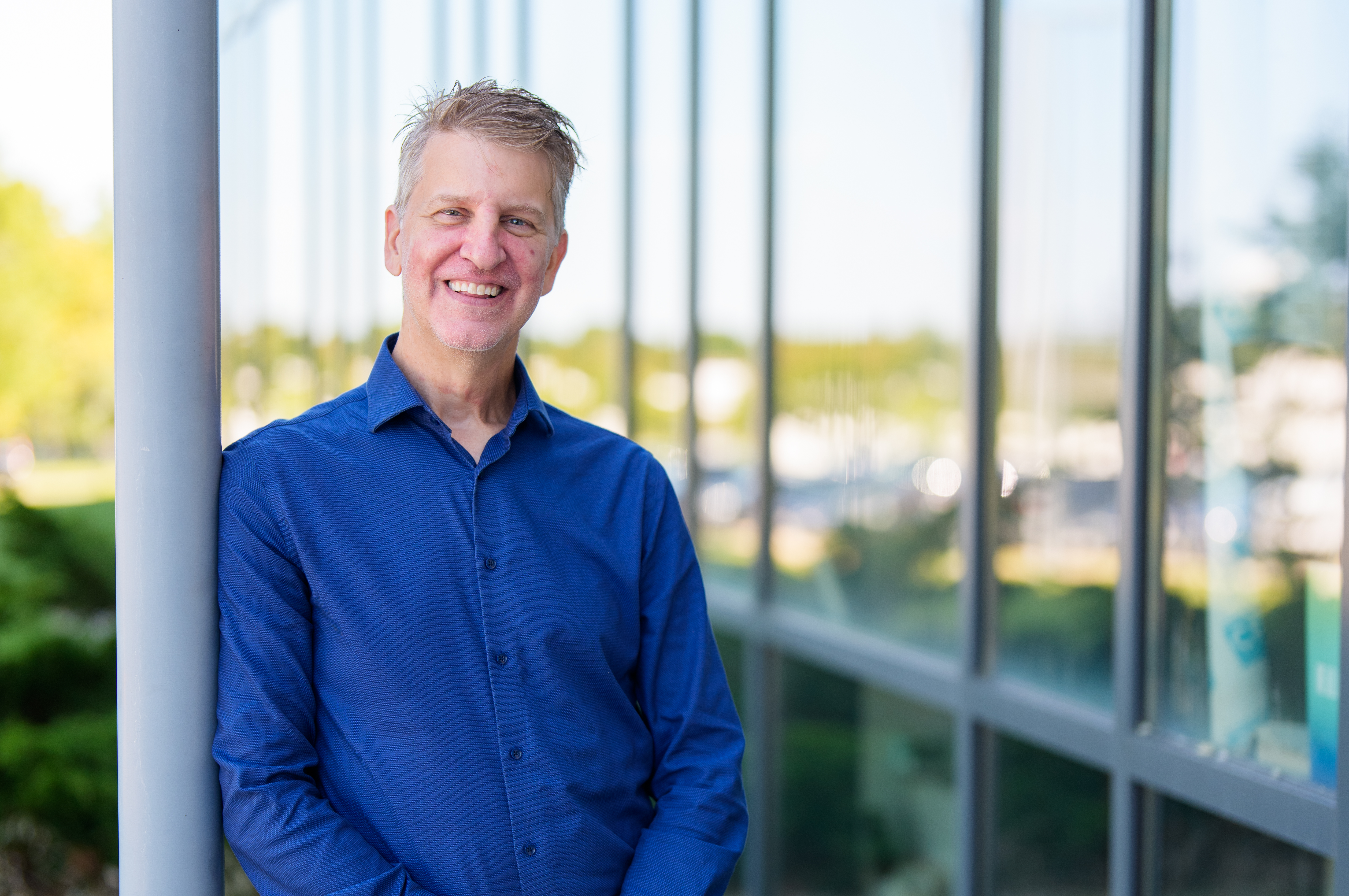
Charles Black is the director of the Co-design Center for Quantum Advantage. (Timothy Kuhn/Brookhaven National Laboratory)
When Charles (Chuck) Black was a doctoral student at Harvard University, he, like many other physicists, used superconducting materials as vehicles for exploring fundamental physics questions. The materials — which can conduct electricity without losing energy when cooled to very cold temperatures — had niche technology applications at the time. But Black never expected to work with them again after earning his degree.
Now, 30 years later, superconductors have emerged as a leading platform for quantum computing — and Black leads a national research center that is using them to help build practical quantum computers.
“I feel like I’ve come full circle,” said Black, who was named director of the Co-design Center for Quantum Advantage (C2QA) in June 2025.
C2QA is a National Quantum Information Science Research Center led by the U.S. Department of Energy's (DOE) Brookhaven National Laboratory. Spanning 28 premier institutions from National Labs, academia, and industry, C2QA is delivering breakthroughs in materials science and modular system architectures to enable scalable, fault-tolerant quantum systems.
"Leading a center that's tackling the scientific challenges standing between today's quantum technologies and practical quantum computing is an exciting opportunity,” said Black, who also serves as deputy associate laboratory director for the Energy and Photon Sciences Directorate at Brookhaven Lab. “But it’s especially rewarding for me because this role draws on so many of the perspectives I've gained throughout my career.”
Materials-driven innovation
In many ways, Black’s career parallels the evolution of quantum computing, combining a foundation in fundamental physics with decades of nanoscale materials research and experience with semiconductor technology.
 enlarge
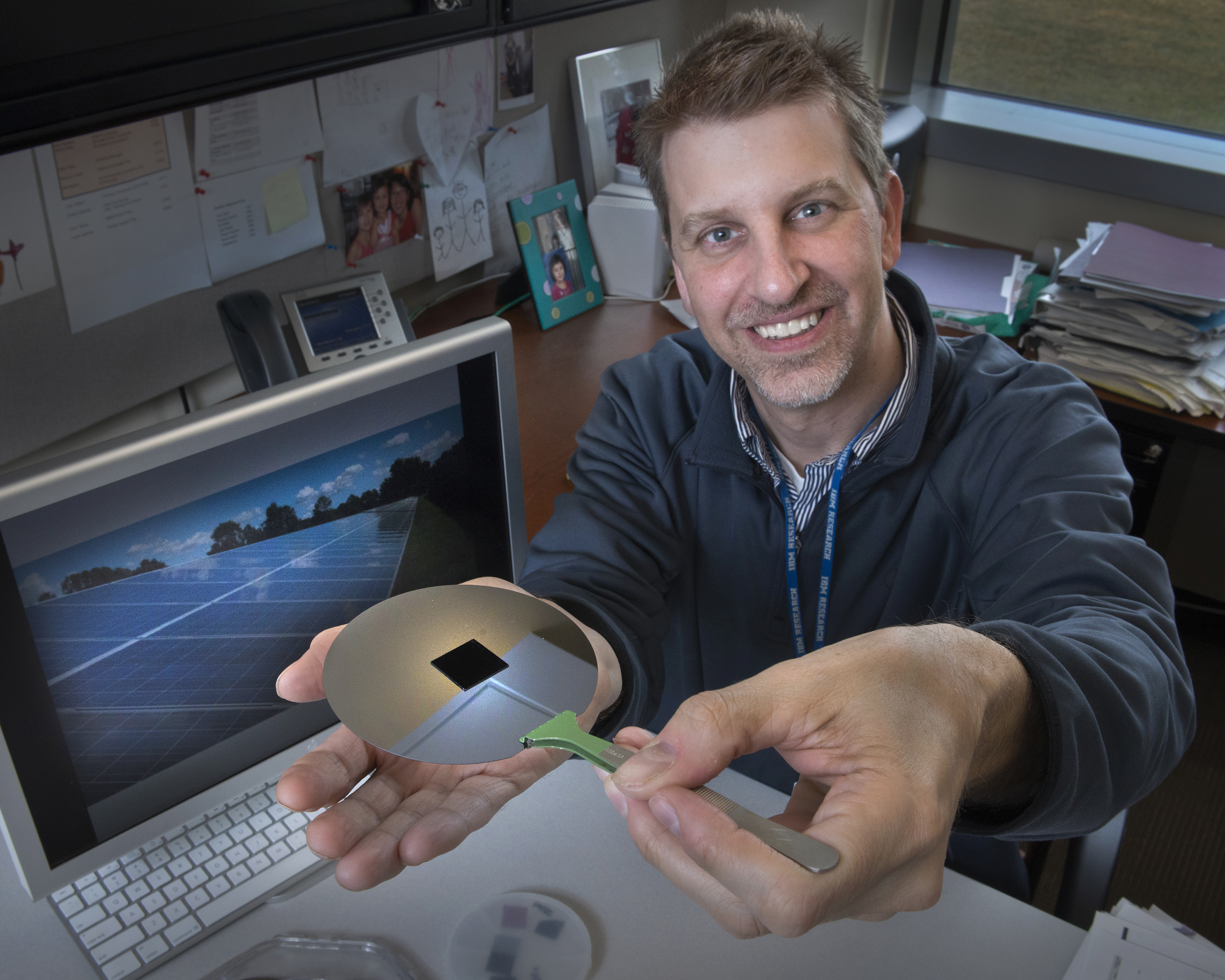
Charles Black holds a nanotextured square of silicon on top of an ordinary silicon wafer at the Center for Functional Nanomaterials in 2014. Black and his colleagues developed this antireflective surface as part of their research using nanoscale self-assembly approaches for energy applications. (Roger Stoutenburgh/Brookhaven National Laboratory)
Prior to serving as C2QA director, Black dedicated nearly two decades to the Center for Functional Nanomaterials (CFN), a DOE Office of Science user facility at Brookhaven equipped with state-of-the-art tools for fabricating and characterizing nanomaterials. He joined CFN in 2006 as one of its first group leaders and pursued research developing nanoscale self-assembly approaches for energy applications. From 2016 to 2025, Black led CFN as director. Working alongside CFN’s in-house experts and thousands of visiting researchers, Black saw firsthand how advances in materials science can enable discoveries across scientific disciplines — a principle that now plays a critical role in C2QA’s mission.
As Black was building his materials science career at Brookhaven Lab, physicists at Yale University invented the superconducting transmon qubit — a new architecture for the fundamental unit of quantum computing. But after more than a decade of developing transmons made from aluminum and niobium, superconducting qubit performance plateaued, leading physicists to question what was limiting further improvements.
When C2QA launched in 2020, the Center brought together highly accomplished physicists, including the transmon inventors, and world-leading materials scientists to investigate whether the constituent superconducting materials were limiting qubit performance.
C2QA researchers from Princeton University began building qubits with a superconductor called tantalum, instead of aluminum and niobium, because tantalum has fewer of the oxidation states suspected of degrading qubit performance. Using materials characterization capabilities at CFN and the National Synchrotron Light Source II, a DOE Office of Science user facility at Brookhaven, C2QA researchers gained an understanding of how the oxidation of tantalum’s surface impacts qubit performance. The team ultimately achieved the world’s best-performing superconducting transmon qubits with lifetimes exceeding one millisecond — the longest ever reported.
“I like remembering that the first transistors in microelectronics were made from germanium semiconductors, not silicon,” Black said. “It was the long-ago realization that silicon has better material properties that has enabled our modern electronics industry. Similarly, I wonder if it’s possible that aluminum and niobium are the ‘germaniums’ of quantum computing.”
But improving qubit performance alone will not enable scalable, fault-tolerant quantum computers. Manufacturing quantum hardware at scale is another significant challenge.
From 1996 to 2006, Black was a research staff member at the IBM Thomas J. Watson Research Center, where he and his collaborators pioneered the use of polymer self-assembly to fabricate high-performing semiconductor devices for microelectronics. This work gave Black firsthand experience with technology manufacturing challenges that mirror those now limiting the scalability of quantum hardware. That experience informs C2QA's pursuit of quantum devices built with silicon-compatible materials that align with existing manufacturing capabilities — and could enable future large-scale production.
A collaborative philosophy
Black's scientific expertise and leadership have prepared him to guide C2QA toward its ambitious goals. But his personal appreciation for teamwork and collaboration is another important element.
“I’ve always loved being on teams,” Black said. “I like the feeling that comes from working together on something hard, and accomplishing things I never could by myself.” Even so many years later, Black often recalls the exhortations of his high school orchestra teacher, who challenged the student musicians to “play their parts,” even when they were difficult. For Black, the same philosophy applies when tackling the biggest scientific challenges.
As he says to the C2QA team, “Quantum computing is one of the great scientific challenges and opportunities of our time. Whether it becomes real or not is up to scientists like us. That's so excellent. We all have our parts to play, so let's work together and play them the best we can.”
C2QA is supported by the DOE Office of Science.
Brookhaven National Laboratory is supported by the Office of Science of the U.S. Department of Energy. The Office of Science is the single largest supporter of basic research in the physical sciences in the United States and is working to address some of the most pressing challenges of our time. For more information, visit science.energy.gov.
Follow @BrookhavenLab on social media. Find us on Instagram, LinkedIn, X, and Facebook.
2026-23131 | INT/EXT | Newsroom