SYNAPS-I: Intelligent Computing Transforms X-ray Imaging, from Data Collection to Discovery
Novel imaging workflows accelerate reconstruction, reduce data collection, and move experiments toward real-time, autonomous operation
November 4, 2026
 enlarge
Scientists from several U.S. Department of Energy National Laboratories gathered at NSLS-II to explore how innovative imaging techniques are helping address common challenges in microelectronics. (Kevin Coughlin/Brookhaven National Laboratory)
Advances in machine learning and computational imaging are transforming not only how scientists analyze data but how they conduct entire experiments. At U.S. Department of Energy (DOE) user facilities, researchers are integrating machine learning directly into experimental workflows — using it to identify what to measure, reconstruct images as data are collected, and rapidly extract scientific information.
SYNAPS-I (Synergistic Neutron and Photon Science – Intelligence), a seed project under the ModCon initiative within DOE’s Genesis Mission, is bringing these capabilities together across X-ray light source and neutron facilities. Led by DOE’s Lawrence Berkeley National Laboratory’s Advanced Light Source, the multi-laboratory collaboration includes DOE’s Argonne National Laboratory, DOE’s Oak Ridge National Laboratory, DOE’s SLAC National Accelerator Laboratory, and DOE’s Brookhaven National Laboratory. The project combines expertise across the laboratories with open-source computational intelligence models, industry partnerships, and advanced computing resources to develop shared solutions for faster, more efficient imaging.
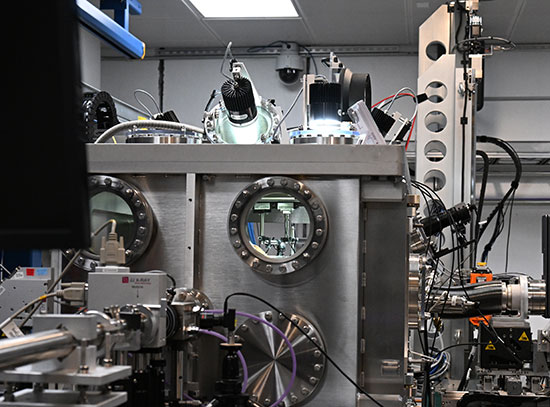
Recent demonstrations at the National Synchrotron Light Source II (NSLS-II), a DOE Office of Science user facility at Brookhaven Lab, show how these technologies can be integrated directly into beamline experiments.
“We are already seeing ways that these advanced imaging workflows can help users make better use of their limited beam time,” said Hanfei Yan, lead beamline scientist at the Hard X-ray Nanoprobe (HXN), a state-of-the-art X-ray microscope at NSLS-II for advanced 2D and 3D nanoscale imaging.
Letting data guide the experiment
In the first SYNAPS-I demonstration at NSLS-II, a collaborative team led by Yan demonstrated an automated experiment that analyzed images as they were acquired, identified scientifically interesting regions within a complex sample, and autonomously selected those areas for subsequent high-resolution measurements — without human intervention.
“This enables an automated experiment to run for hours, surveying a large area, and collect high-fidelity data only from scientifically important locations,” said Daniel Allan, who leads the Data Engineering Group within NSLS-II’s Data Science and Systems Integration (DSSI) division. “Conventional methods cannot perform this task effectively and reliably, whereas advanced computational approaches can robustly identify complex features with high accuracy.”
The demonstration points toward a fundamental change in how experiments can operate: instead of collecting a predetermined dataset and analyzing it afterward, data analysis can begin to guide the experiment itself.
This reconstruction features a small volume carved out of an integrated circuit chip for signal amplification from SLAC National Accelerator Laboratory that was fabricated using 22 nanometer technology node. The approximately 20 micrometer-wide segment was imaged and reconstructed using an advanced computational workflow for ptychographic tomography at the Hard X-ray Nanoprobe (HXN) beamline at the National Synchrotron Light Source II (NSLS-II). (Brookhaven National Laboratory and SLAC National Accelerator Laboratory)
Reconstructing images in real time
A second demonstration focused on ptychographic tomography, a computational X-ray imaging technique that produces detailed 3D images from large numbers of individual measurements.
The team demonstrated an end-to-end intelligent imaging workflow on microelectronic chips. A foundation model trained at Argonne replaced the computationally intensive iterative process traditionally used to reconstruct ptychographic images. Working with NVIDIA, the team integrated the workflow with the NVIDIA Holoscan platform and demonstrated real-time ptychographic reconstruction at 200 images per second.
Advanced reconstruction methods also dramatically reduced the amount of experimental data required to produce a 3D image. Using a model developed and trained at NSLS-II, the team reconstructed a microchip using nearly one tenth of the data normally required. This approach is particularly valuable for thin, flat samples such as microchips, where collecting complete tomographic datasets can be challenging.
Once the 3D image was reconstructed, automated analysis accelerated the next step as well. The team fine-tuned Meta’s open-weight Segment Anything Model 3 (SAM3) for chip imaging, enabling different materials, structures, and regions of interest within the volumetric dataset to be identified automatically.
Together, these capabilities can reduce scan time and radiation dose while dramatically accelerating the interpretation of complex 3D datasets.
“This technique can benefit any scientific or industrial area that requires fast, high-resolution X-ray tomography and rapid 3D data analysis,” Yan said. Potential applications range from revealing buried structures and defects in microelectronics to studying degradation in battery electrodes and characterizing complex nanomaterials.
Toward autonomous experiments
The next goal is to bring these individual capabilities together into increasingly general, real-time experimental workflows.
The SYNAPS-I team plans to develop more robust foundation models trained on diverse datasets and expand the approach to additional 3D imaging techniques. A particularly important next step is real-time tomography. Today, researchers typically collect an entire projection dataset before reconstructing and examining the final 3D image.
In a real-time workflow, reconstruction would instead begin while the experiment is still underway. An initial lower-resolution image would continuously improve as additional measurements were collected, giving scientists an increasingly accurate 3D view of a sample — and insight into its structural, chemical, and physical properties — while the experiment is still running.
Combined with automated methods that can identify scientifically important features and determine where additional measurements are needed, such capabilities move beamlines toward experiments that can adapt autonomously based on the data they are producing.
“These demonstrations illustrate how advanced computational methods are transforming beamline research and accelerating scientific discovery,” said Sean McSweeney, interim deputy for strategy at NSLS-II. “Workflows like this will be an integral component of next-generation user facilities.”
The SYNAPS-I effort also demonstrates the value of collaboration across DOE facilities. At NSLS-II, beamline scientists worked closely with DSSI staff to integrate these intelligent computational tools with the facility’s data infrastructure and move them toward broader availability for users. Across SYNAPS-I, participating laboratories are combining expertise in imaging, machine learning, data infrastructure, and computing to address challenges shared by facilities throughout the DOE complex.
"Collaboration across laboratories is rewarding and intellectually stimulating, not least because we all run into the same challenges, data volumes that outpace human analysis, reconstruction bottlenecks, and the gap between an experiment and its interpretation,” said Alexander Hexemer, a senior scientist at Lawrence Berkeley National Laboratory’s Advanced Light Source and SYNAPS-I lead point of contact. “No single facility can solve these on its own. By learning from each other and building on each other's work, we can deliver tools that none of us could have produced alone."
As these technologies mature, the goal is not simply to process experimental data faster. It is to create a tighter connection between measurement, analysis, and scientific decision-making, allowing experiments to respond to what they discover in real time.
Brookhaven National Laboratory is supported by the Office of Science of the U.S. Department of Energy. The Office of Science is the single largest supporter of basic research in the physical sciences in the United States and is working to address some of the most pressing challenges of our time. For more information, visit science.energy.gov.
Follow @BrookhavenLab on social media. Find us on Instagram, LinkedIn, Twitter, and Facebook.
2026-23173 | INT/EXT | Newsroom