2014 Sambamurti Lecture Tuesday, 7/15: Exploring the Small Size Limit of Quark Gluon Plasma
July 11, 2014
 enlarge
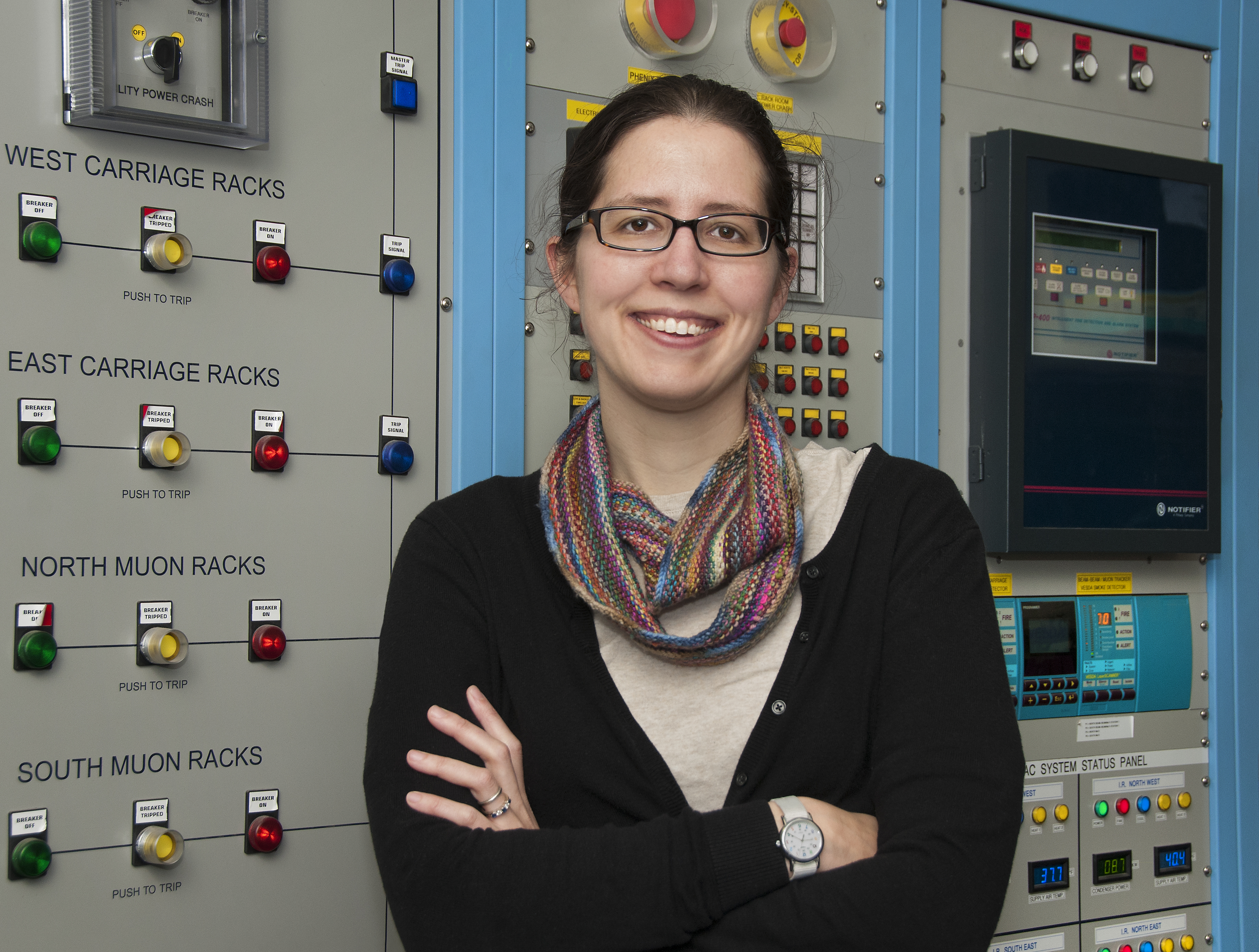
Anne Sickles, who as of this month is an assistant professor at the University of Illinois at Urbana-Champaign, will present the 2014 Sambamurti Memorial Lecture in Bldg. 510 on Tuesday, July 15.
The hottest matter in the universe, quark gluon plasma, is created when heavy nuclei race in opposing directions and crash at near light speeds at the Relativistic Heavy Ion Collider (RHIC) at Brookhaven Lab and the Large Hadron Collider at CERN in Europe. With temperatures around four trillion degrees Celsius—250 times hotter than the sun—measured during collisions at RHIC, the protons and neutrons that make up atomic nuclei "melt" into quarks and gluons.
Physicist Anne Sickles will present the 2014 Sambamurti Memorial Lecture, titled “The Smallest Drops of the Hottest Matter: Exploring the Small Size Limit of the Quark Gluon Plasma,” on Tuesday, July 15. The talk will be held in the Physics Department’s large seminar room in Bldg. 510 at 3:30 p.m. (Add to calendar)
 enlarge
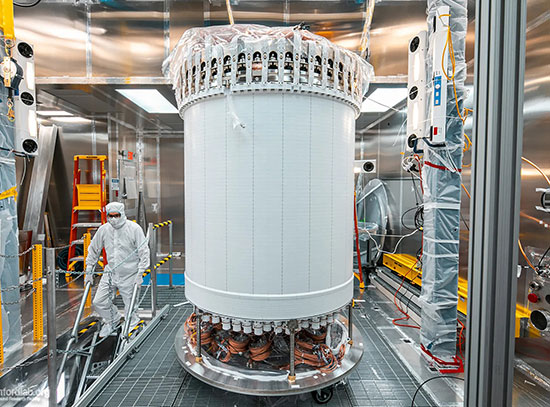
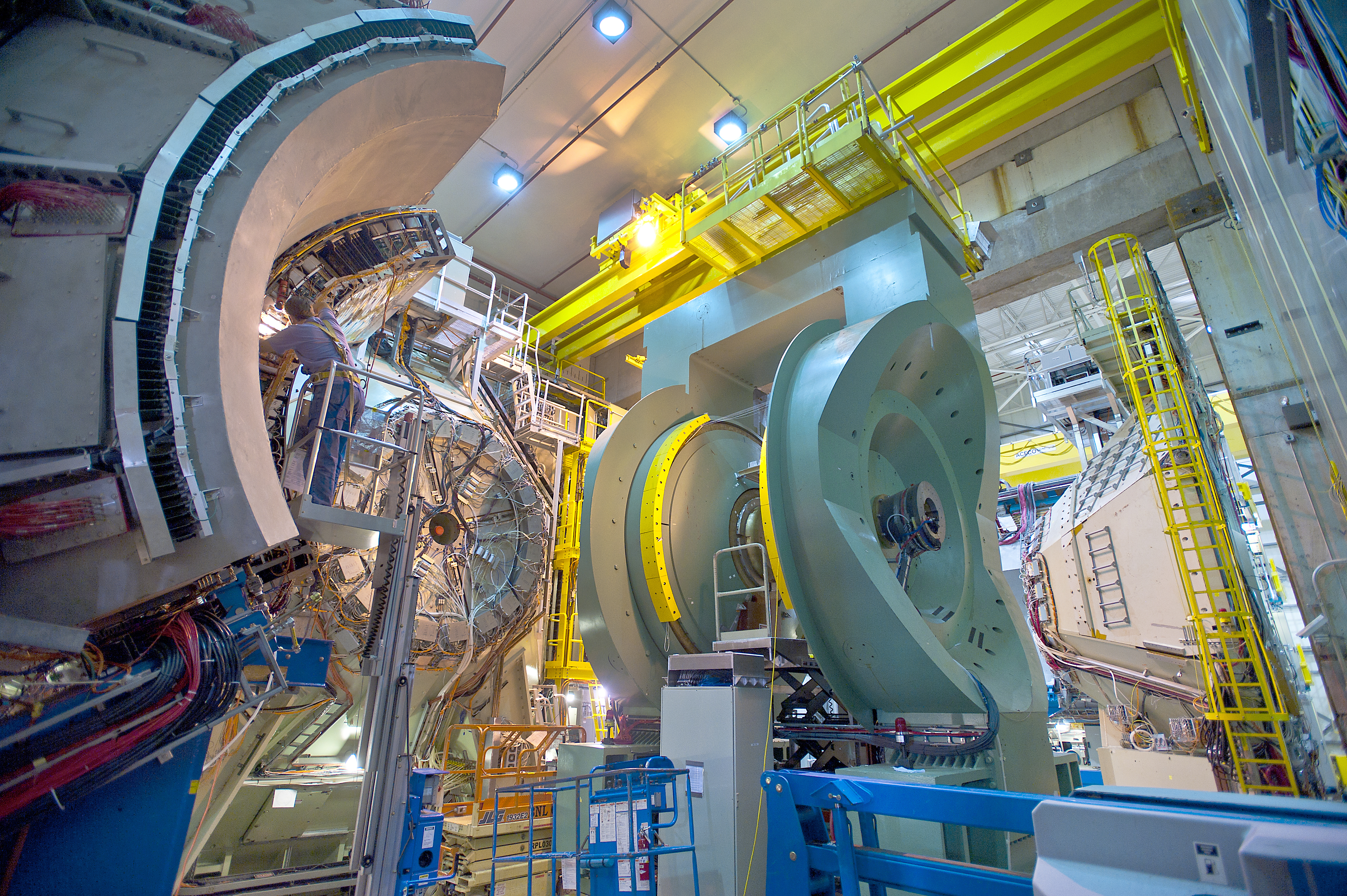
The PHENIX detector, which collects data to determine what happens before, during, and after individual particle collisions among billions at the Relativistic Heavy Ion Collider
During this lecture, Sickles will discuss how correlations between particles created in the aftermath of collisions are being used to determine the properties of matter itself. She will also explain how physicists, including those using the PHENIX detector to study collisions at RHIC, are exploring the geometry of the nuclei's impact zones to determine just how small quark gluon plasma can be.
Sickles, who as of this month is an assistant professor at the University of Illinois at Urbana-Champaign, joined the PHENIX collaboration while working toward the Ph.D. she earned from Stony Brook University in 2005. She arrived at Brookhaven Lab's Physics Department as a research associate in the PHENIX group that same year and was promoted to the role of associate physicist in 2011. She has received several awards for her work with the PHENIX collaboration, including a thesis award at the 2006 annual Relativistic Heavy Ion Collider-Alternating Gradient Synchrotron Users' Meeting and the Lab's Gertrude Scharff-Goldhaber Prize for Women in Physics.
The Sambamurti Memorial Lecture was established in 1992 to commemorate the work of Aditya Sambamurti, a young BNL physicist who died of cancer in 1992 at age 31. Each year, an outstanding young physicist whose professional interests overlap those of Sambamurti is selected to deliver the lecture.
2014-5000 | INT/EXT | Newsroom