General Lab Information

    Exploring matter at the dawn of time

    The Relativistic Heavy Ion Collider (RHIC), operational from 2000-2026, has been one of the most versatile and scientifically productive accelerator facilities in the world. In addition to its discoveries revealing a new state of matter and fresh insight into proton spin, RHIC has produced technological advances in accelerators, detectors, and computing far surpassing scientists' expectations.


    Exploring matter at the dawn of time

    The Relativistic Heavy Ion Collider (RHIC), operational from 2000-2026, has been one of the most versatile and scientifically productive accelerator facilities in the world. In addition to its discoveries revealing a new state of matter and fresh insight into proton spin, RHIC has produced technological advances in accelerators, detectors, and computing far surpassing scientists' expectations.
    RHIC Physics

    RHIC was the first machine in the world capable of colliding ions as heavy as gold.

    The Spin Puzzle

    RHIC collided beams of polarized protons to investigate the "missing" spin of the proton.

    Accelerator Science

    Before high-speed packets of protons or ions could be brought into collisions at RHIC, they first traveled through a chain of smaller particle accelerators.

    An Educational Pipeline

    Large-scale physics facilities like RHIC play a significant role in training the next generation of physicists.

    STAR Detector

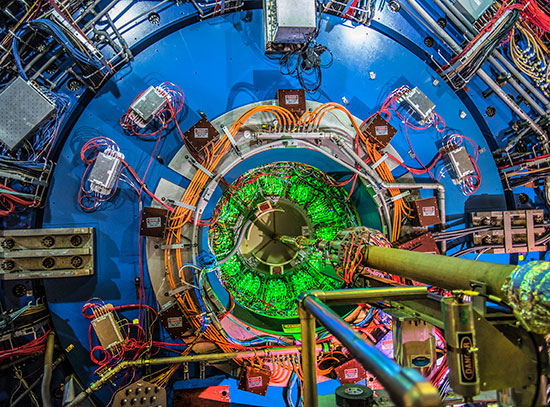
    The Solenoidal Tracker at RHIC, known as STAR, tracks the thousands of particles produced by ion collisions at RHIC. STAR is used to search for signatures of the form of matter that RHIC was designed to create: the quark-gluon plasma.

    sPHENIX Detector

    sPHENIX is a radical makeover of the PHENIX experiment, one of the original detectors designed to collect data at RHIC. It includes many new components that significantly enhance scientists' ability to learn about quark-gluon plasma (QGP), an exotic form of nuclear matter created in RHIC's energetic particle smashups.

    Electron-Ion Collider

    A breakthrough particle accelerator based on RHIC infrastructure will collide electrons with heavy ions or protons at nearly the speed of light to create rapid-fire, high-resolution “snapshots” of the force binding all visible matter. Read more...