2016 Sambamurti Memorial Lecture Monday, 8/1: 'Electron-Positron Tomography at STAR: Seeking Symmetry in the Quark-Gluon Plasma'
July 29, 2016
 enlarge
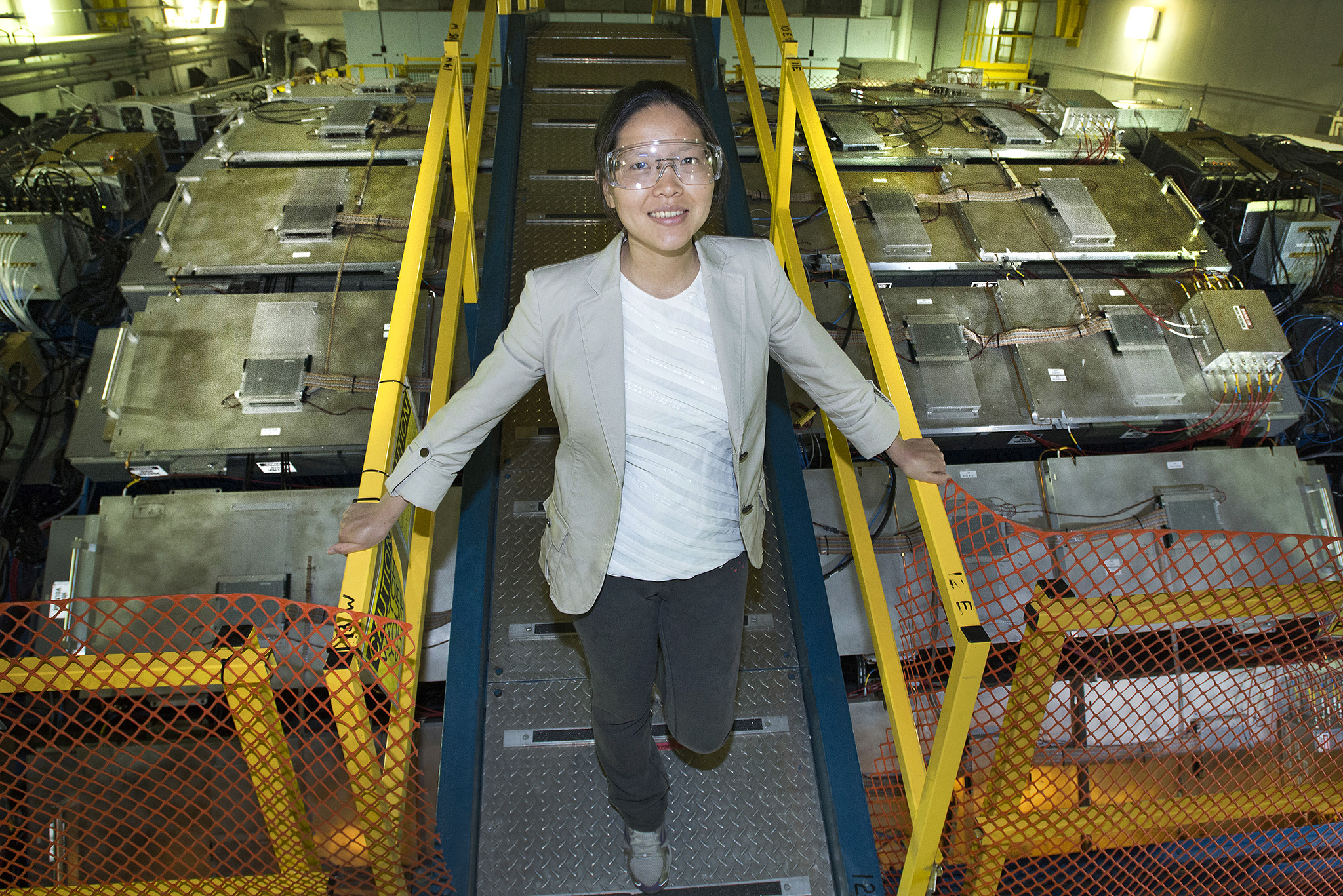
Brookhaven Lab physicist Lijuan Ruan atop the STAR detector at the Relativistic Heavy Ion Collider
Since the 1960s, Brookhaven Lab has made important contributions to advance the positron emission tomography (PET) techniques that doctors and researchers regularly use to detect cancer, study brain activity, and more. Today at Brookhaven Lab's Relativistic Heavy Ion Collider (RHIC), scientists are using a different kind of positron tomography to probe for clues in ultra-hot seas of subatomic quarks and gluons—the quark-gluon plasma that existed less than a second after the Big Bang and is re-created with particle collisions at RHIC.
What these scientists are working to find, including "mirror-like" symmetry among interactions between quarks and gluons, offers major insights about the universe's most basic building blocks, their origins, and why the physical world works the way it does.
 enlarge
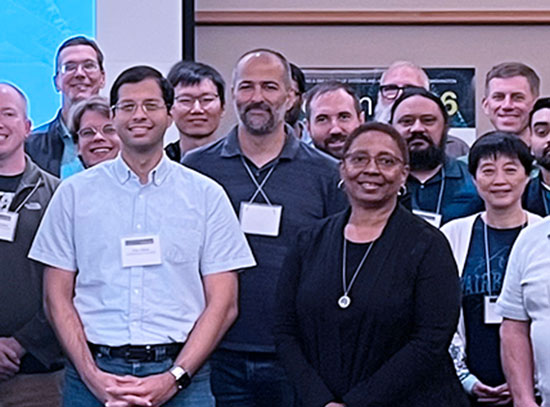
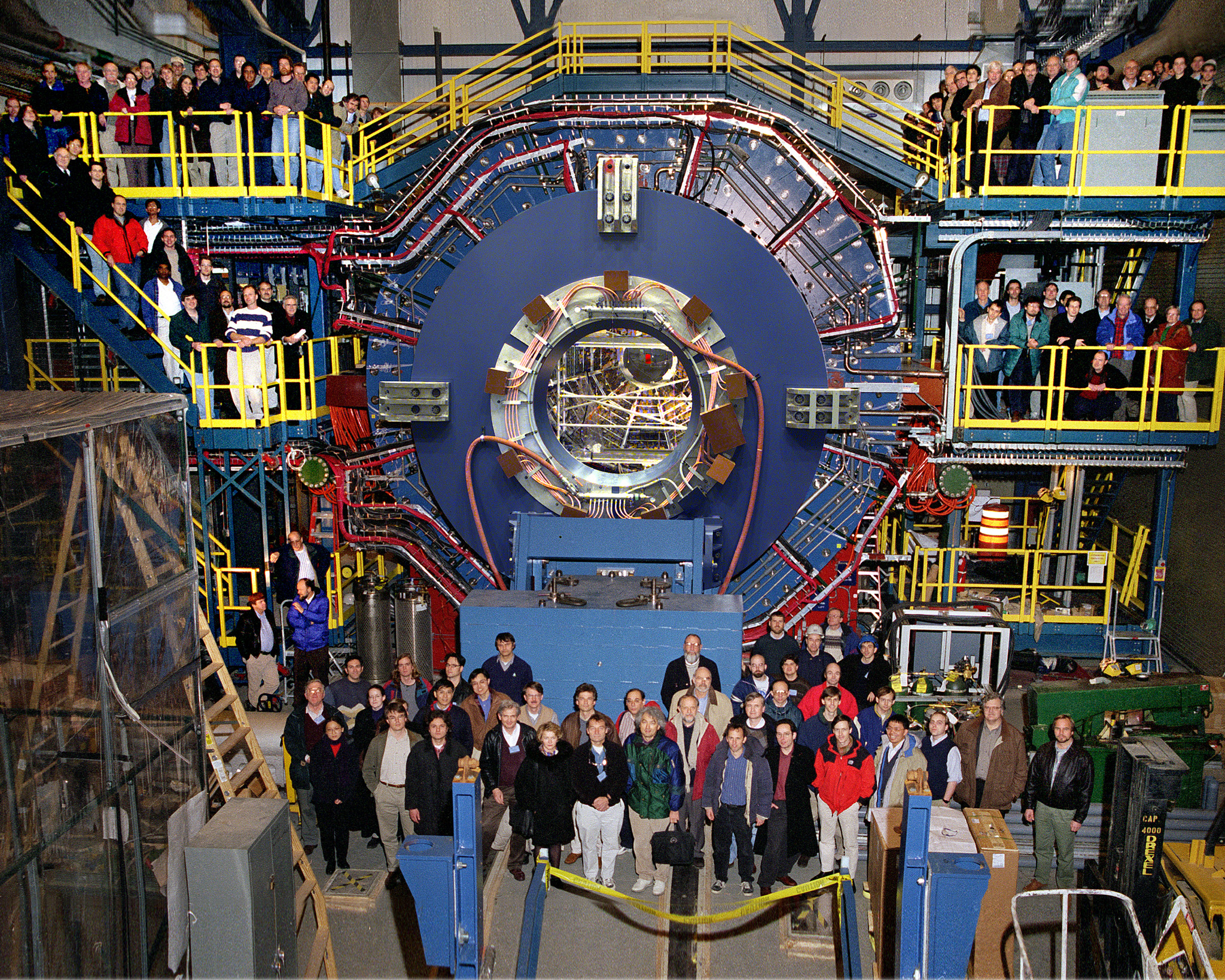
Collaborators in front of the STAR detector at the Relativistic Heavy Ion Collider, which today includes tools Lijuan Ruan helped design for electron-positron tomography to probe for clues from quark-gluon plasma
Brookhaven Lab physicist Lijuan Ruan will present the 2016 Sambamurti Memorial Lecture, titled “Electron-Positron Tomography at STAR: Seeking Symmetry in the Quark-Gluon Plasma,” on Monday, Aug. 1. The talk will be held in the Physics Department’s large seminar room in Bldg. 510 at 4 p.m.
During this lecture, Ruan will explain how she uses electron-positron tomography from quark-antiquark annihilations to study that mirror-like chiral symmetry, a characteristic that "broke"—resulting in the formation of 99 percent of the visible mass in the universe—and is thought to be restored during ion collisions at RHIC. Ruan will also talk about the STAR detector at RHIC and its special tools, some of which she helped design to track electron-positron pairs, as well as results from particle collisions spanning a range of energy levels.
About the Speaker
Ruan is a physicist and member of the STAR collaboration at Brookhaven Lab. She earned a bachelor's degree and her Ph.D. in physics from the University of Science and Technology of China in 2000 and 2005 respectively, and then spent the next two years as a postdoc at Lawrence Berkeley National Lab.
Ruan arrived at Brookhaven Lab as a Goldhaber Distinguished Fellow in 2007. This prestigious fellowship—funded by Brookhaven Science Associates, the company that manages Brookhaven Lab for the U.S. Department of Energy—is awarded to candidates with exceptional talent and credentials who have a strong desire for independent research at the frontiers of their fields. She was promoted to associate physicist in 2010 and physicist in 2012, and her tenure appointment began in 2015. The International Union of Pure & Applied Physics awarded her the Young Scientist Prize for Nuclear Physics in 2010 and the U.S. Department of Energy recognized Ruan with an Early Career Research Program Funding Award in 2013.
About the Sambamurti Memorial Lecture
The Sambamurti Memorial Lecture was established in 1992 to commemorate the work of Aditya Sambamurti, a young Brookhaven physicist who died of cancer in 1992 at age 31. Each year, an outstanding young physicist whose professional interests overlap those of Sambamurti is selected to deliver the lecture.
2016-6525 | INT/EXT | Newsroom