


A Robust, Hydrogen-Free Telecom Qubit in Silicon
C2QA researchers identified a robust new qubit in silicon, called the CN center
April 10, 2026
 enlarge
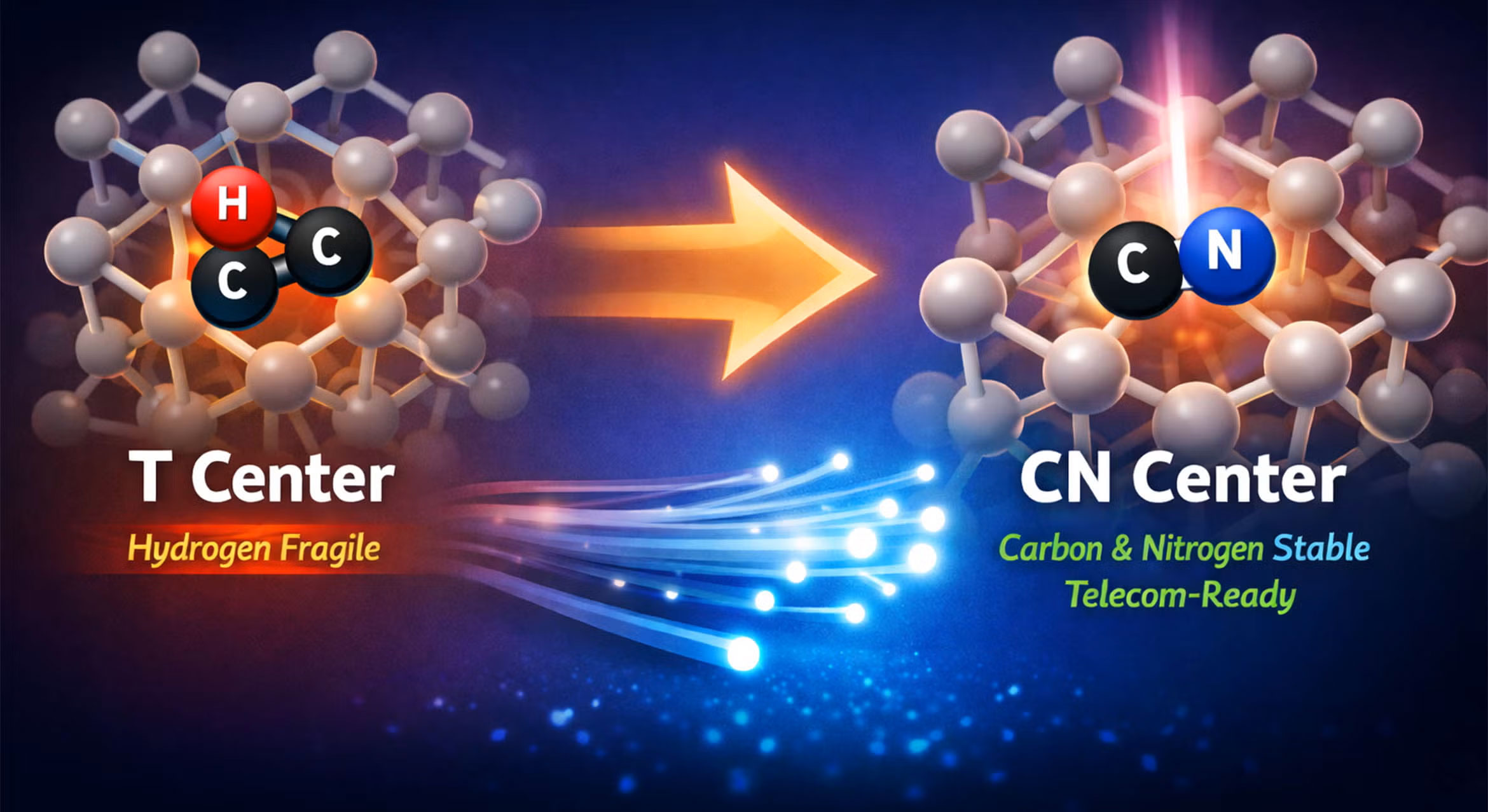
Replacing the hydrogen-containing C–H unit of the T center with nitrogen yields a stable, H-free CN defect.
Scientific Achievement
C2QA researchers proposed a carbon–nitrogen (CN) quantum defect in silicon as an alternative to the telecom-band T center. First-principles calculations show the CN center to be stable and has favorable electronic and optical properties, comparable to the T center.
Significance and Impact
T centers in silicon are promising for quantum networking, but they are sensitive to processing conditions due to their hydrogen content. The hydrogen-free CN center improves stability and process compatibility while retaining telecom emission, offering a new, scalable, silicon-based defect platform.
Research Details
- Used first-principles density functional theory to show the CN center exhibits T center–like electronic structure and emits in the telecom S-band for low-loss fiber transmission.
- Predicted radiative lifetime (4.2 µs) comparable to the T center.
Collaborating Institutions
- University of California, Santa Barbara
Publication
J. K. Nangoi, M. E. Turiansky, and C. G. Van de Walle
Carbon-nitrogen complex as an alternative to the ?? center in Si
Phys. Rev. B 113, L060101 (2026)
https://doi.org/10.1103/zy5b-fskh
Related Links
University of California, Santa Barbara press release: "A robust new telecom qubit in silicon"
Acknowledgements
This work was supported by the U.S. Department of Energy (DOE), Office of Science (SC), National Quantum Information Science Research Centers, Co-design Center for Quantum Advantage (C2QA) under Contract No. DE-SC0012704, and used computing resources provided by the National Energy Research Scientific Computing Center (NERSC), a User Facility supported by the DOE SC under Contract No. DE-AC02-05CH11231 using NERSC Awards No. BES-ERCAP0021021 and No. BES-ERCAP0028497. Additional resources were provided by the Texas Advanced Computing Center (TACC) at The University of Texas at Austin and the San Diego Supercomputer Center (SDSC) Expanse at the University of California, San Diego through Allocation No. DMR070069 from the Advanced Cyberinfrastructure Coordination Ecosystem: Services & Support (ACCESS) program, which is supported by National Science Foundation Grants No. 2138259, No. 2138286, No. 2138307, No. 2137603, and No. 2138296.
2026-22900 | INT/EXT | Newsroom