


Reshaping Noisy Quantum Channels to Boost Entanglement
C2QA researchers developed a new adaptive framework that systematically transforms noisy quantum channels into more effective ones
April 10, 2026
Scientific Achievement
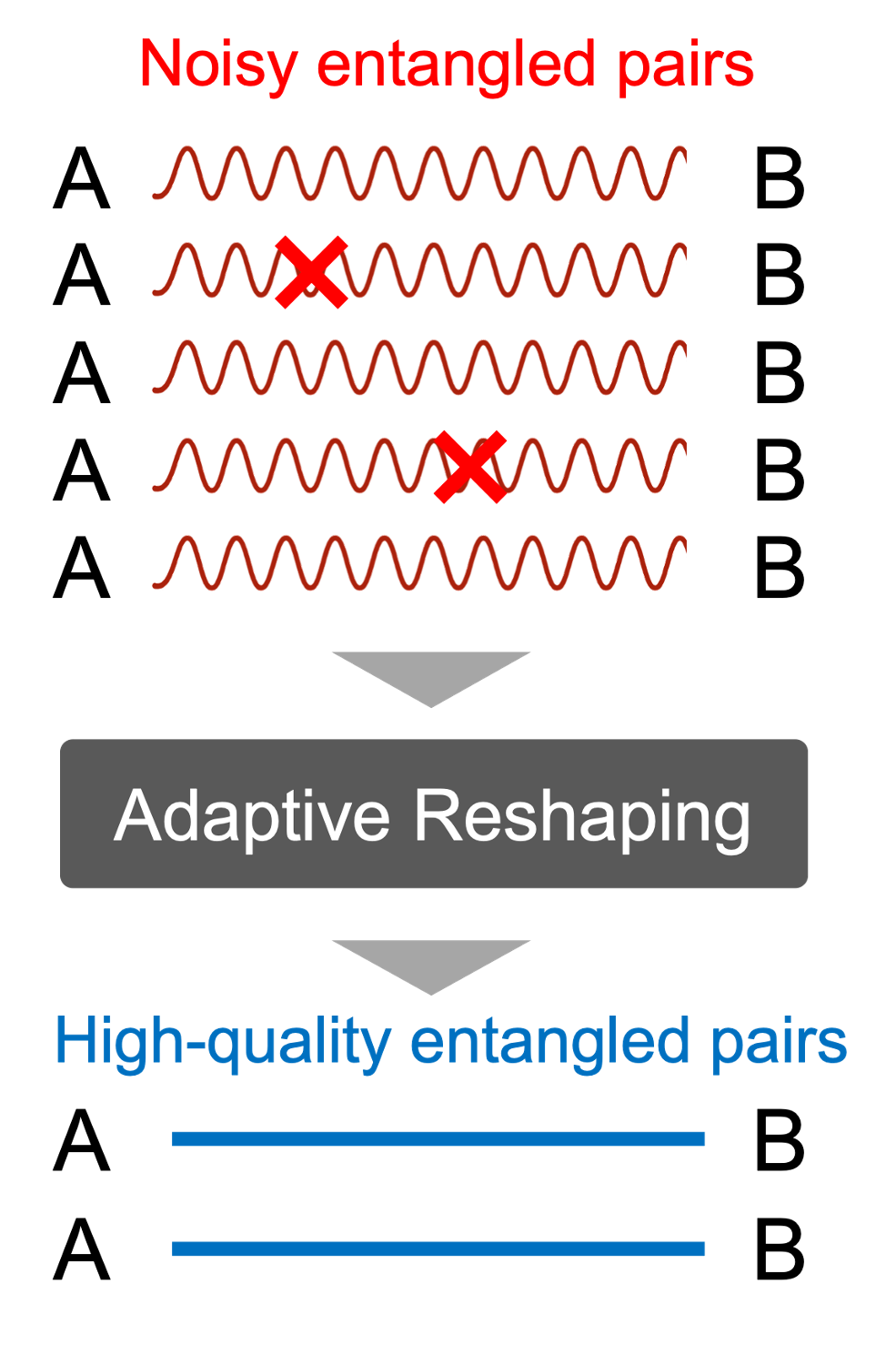
C2QA researchers at IBM developed adaptive protocols that transform highly noisy quantum channels into more favorable effective ones, enabling higher entanglement rates. This approach surpasses long-standing performance limits for common forms of quantum noise, including amplitude damping and depolarizing noise.
Significance and Impact
Entanglement distillation is essential for quantum networks and modular quantum systems. By increasing the amount of usable entanglement generated over noisy links, this work expands the performance limits of distributed systems, especially in high-noise regimes.
Research Details
- Developed adaptive parity-check protocols to reshape noisy channels.
- Introduced “Greedy recurrence” strategy with provable fidelity improvement.
- Achieved entanglement rates exceeding long-standing bounds for amplitude damping and depolarizing noise.
Collaborating Institutions
- IBM
Publication
D. Abdelhadi, T. Jochym-O’Connor, V. Siddhu, and J. Smolin
Adaptive channel reshaping for improved entanglement distillation
Physical Review Research 8, 013018 (2026)
DOI: https://doi.org/10.1103/8kdf-37gp
Acknowledgements
D. Abdelhadi is grateful to IBM T.J. Watson Research Center’s hospitality, where part of this work was carried out as part of an internship. T. Jochym-O’Connor, V. Siddhu, and J. Smolin were supported by the U.S. Department of Energy, Office of Science, National Quantum Information Science Research Centers, Co-design Center for Quantum Advantage (C2QA) under Contract No. DE-SC0012704.
2026-22901 | INT/EXT | Newsroom