Former BNL Intern Places First In NSF Poster Competition
November 14, 2008

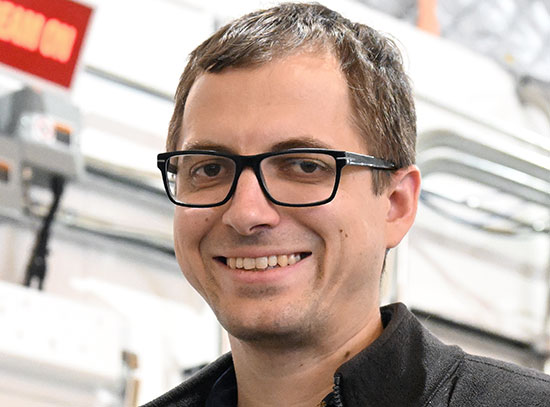
Walter Lewis, left, and his mentor, Sean McCorkle
Walter Lewis, a three-time research intern at the U.S. Department of Energy's Brookhaven National Laboratory, placed first with his research poster in the 2008 National Science Foundation Historically Black Colleges and Universities Undergraduate Program competition.
While at Brookhaven, Lewis, a senior studying computer information sciences and biology at Cheyney University in Pennsylvania, developed a more accurate computational method for characterizing certain sections of bacterial genomes, responsible for holding a bacterium's genetic information in the form of DNA. Lewis focused this technique on the bacterium Cupriavidus metallidurans, which can survive in extremely harsh environments that include heavy metals, like lead and copper.
Entire units of DNA can be shared between biological species in the form of moveable tracks called transposons. In order to trace the transfer of these units between bacterial genomes, researchers look closely at insertion sequence (IS) elements, short sections of DNA usually found on either end of the transposons.
With the guidance of Brookhaven biologist and mentor Sean McCorkle, Lewis developed a new Java-based computer program to locate IS elements in bacterial genomes from scratch. Only one other computer program created previously can do this, but Lewis set up his program to gather DNA sequence mismatches, which occur frequently during automatic genome sequencing, and report them in a format that can be better analyzed.
"Sequencing was once done entirely by hand, and it would take weeks to sequence a genome," Lewis said. "These days, sequencing can be done in minutes."
Lewis said he enjoyed working at Brookhaven with McCorkle and his team.
"I was given flexibility as a programmer, so I could work whenever I felt creative," he said. "I was taking a summer class simultaneously, and my mentor was very accommodating to my time constraints."
Lewis was also able to participate in a variety of other projects, including video production and organizing the summer talent show at the Lab. At Cheyney University, Lewis is involved with NAACP and the United Nations Association as well as working to organize computer science and mathematics clubs.
After graduation, Lewis plans to write more programs and gain more lab experience in order to pursue a PhD in bioinformatics, a field of science that employs and continuously develops computational and statistical techniques to analyze biological data.
2008-962 | INT/EXT | Newsroom