Maglev Competition Challenges Long Island Students to Think Like Engineers
Middle schoolers design and test high-speed vehicles
April 27, 2026
 enlarge
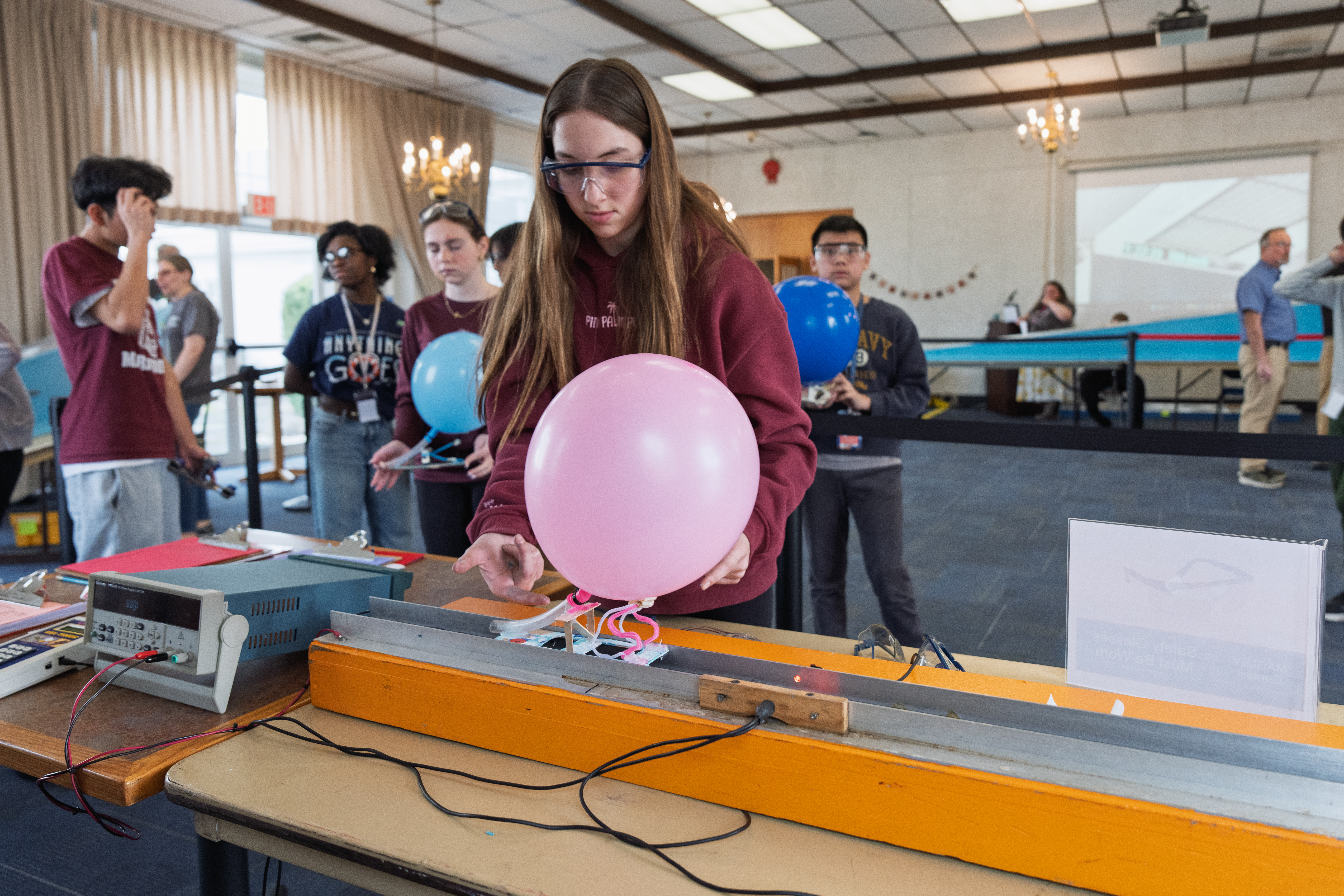
A student gently places her handmade Maglev vehicle, here affixed with a balloon, on a vertical magnet-lined track for the self-propelled category at the Maglev Competition. (Timothy Kuhn/Brookhaven National Laboratory)
UPTON, N.Y. — Middle school students from across Long Island put their engineering skills to the test at the 36th annual Maglev Competition, held March 26, 2026, at the U.S. Department of Energy’s (DOE) Brookhaven National Laboratory.
Hosted by Brookhaven Lab’s Office of Workforce Development and Science Education (WDSE), the competition challenges students to design and build small-scale magnetic levitation (Maglev) vehicles that address real-world transportation problems, such as traffic congestion. Working within cost constraints, students must balance speed, stability, and passenger capacity while applying science, technology, engineering, and math principles.
“We want them to think about real life — how to spend the least amount of money but carry the highest number of passengers,” said Daniel Trieu, an educational programs representative at Brookhaven Lab. “It’s deceptively simple.”
 enlarge
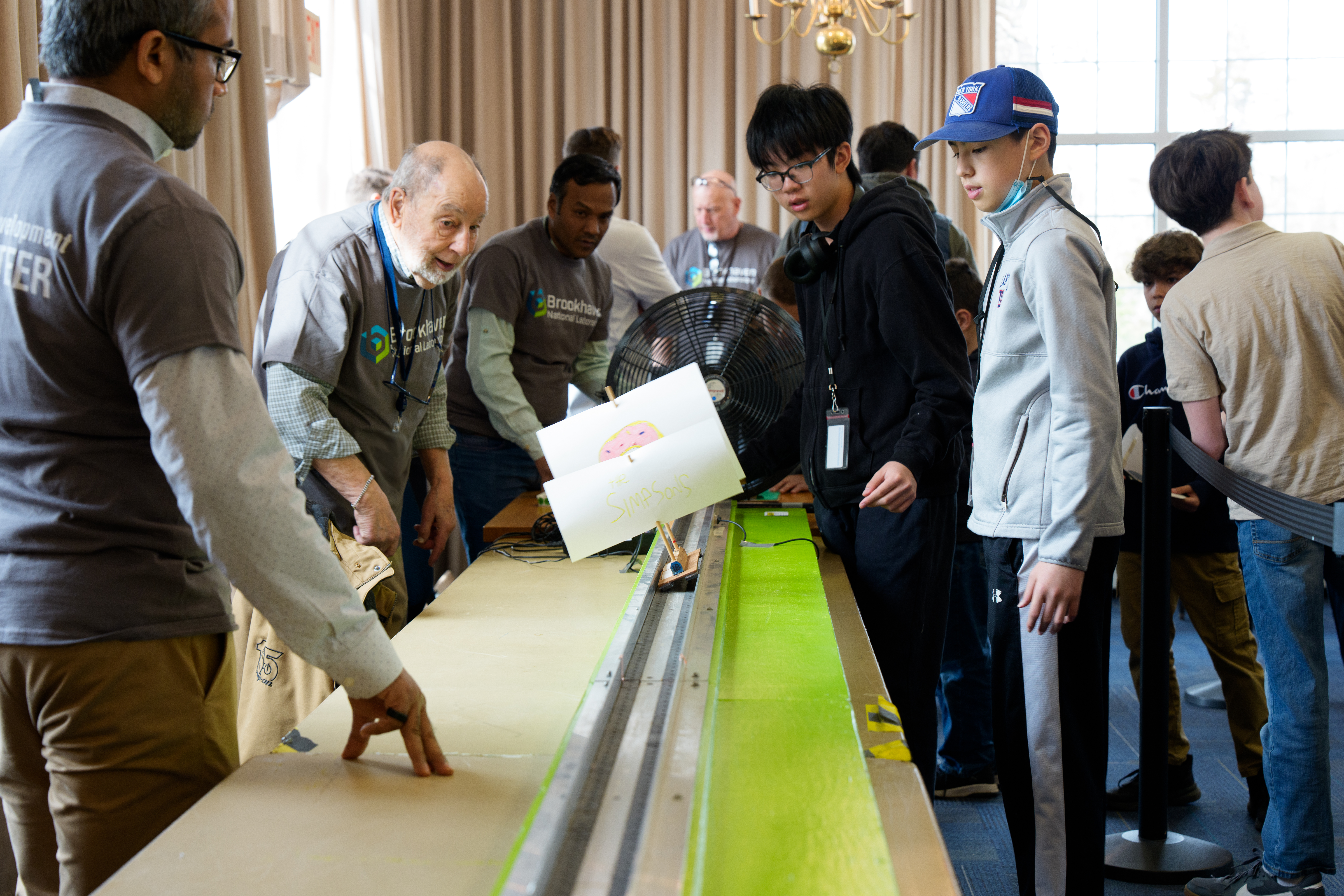
Volunteer judges watch with anticipation as a student releases his handmade Maglev vehicle for the wind power category during the Maglev Competition held at Brookhaven National Lab on March 26, 2026. (Timothy Kuhn/Brookhaven National Laboratory)
Students design vehicles roughly the size of their hand using materials such as wood, foam, or plastic, along with magnets and weights. Many teams draw inspiration from real-world transportation systems, while others bring imaginative designs to life. Each team documents its process in a detailed design portfolio, which is judged alongside vehicle performance.
The competition features two main categories — speed and appearance — with speed subdivided into wind, self-propelled, electric, and gravity tracks. On competition day, students test and refine their vehicles repeatedly, making adjustments to improve performance.
Inside the testing area, four magnet-lined tracks — two flat and two inclined — span about 16 feet each. Students carefully place their vehicles above the tracks, hoping to achieve levitation. When designs fall short, they return to workspaces to troubleshoot, modify, and try again.
“We don’t want to give them the answer,” said Matthew Anderer, a technology education teacher at Massapequa Middle School. “But they’re pretty amped up to do it.”
That cycle of testing and refinement is central to the experience.
“What students are doing here mirrors the research process itself — balancing constraints, analyzing results, and refining ideas,” said WDSE Manager Aleida Perez. “These are the same critical thinking skills that underpin scientific breakthroughs at Brookhaven Lab and are essential to solving today’s most pressing technological challenges.”
“This is where it starts. These are future engineers.”
— Arin Morton, Brookhaven Lab intern and event volunteer
That mindset is reinforced throughout the competition as students explore new tools and approaches.
“There is a lot more use of technology now — we’ve added a 3D printing category,” said Bernadette Uzzi, manager of K–12 programs at Brookhaven Lab. “But the students themselves haven’t changed. They are learning firsthand the process of engineering. They are learning perseverance.”
Judges evaluate not only performance but also creativity and reasoning.
“They have to figure out how to build and justify why they’re building it that way,” said Martin Woodle, a longtime volunteer judge and Brookhaven Lab retiree. “It’s great for critical thinking.”
Across the competition floor, designs range from aerodynamic models optimized for speed to playful creations built for visual impact. On the wind track, fan-powered vehicles glide forward, while on the appearance track, designs such as a Swedish Fish, a hot dog, and a graffiti-style train showcase students’ creativity.
 enlarge
During the Maglev Competition, students must sometimes make multiple modifications, not unlike real engineers, to their handmade vehicles to achieve a successful flotation down the tracks. Here, a student makes careful modifications to his Maglev vehicle for the electrified track category. (Timothy Kuhn/Brookhaven National Laboratory)
“It just has to make it,” said Jennifer Maceiko, a mechanical engineer at Brookhaven Lab and a judge for the appearance category.
The event also emphasizes teamwork and collaboration — skills essential to scientific discovery.
“Science isn’t one person figuring everything out — it’s teams of people working together over time,” said Daniel Rachal, federal project director at DOE’s Brookhaven Site Office. “There are still so many big questions out there, and it’s going to be up to your generation to help answer them.”
From iterative design to hands-on testing, the competition offers students a glimpse into the work of professional engineers.
“This is where it starts. These are future engineers,” said Arin Morton, a Brookhaven Lab student intern and event volunteer. “You never know who you’re inspiring.”
Competition Results
Speed categories
Self-propelled (balloon)
- First place: Sophia Rossi, Bay Shore Middle School
- Second place: Maddy Love, Bay Shore Middle School
- Third place: Violet Whitwen, Bay Shore Middle School
Self-propelled (other)
- First place: Samuel Welsh, Northport Middle School
- Second place: Jayden Fuentes, Bay Shore Middle School
- Third place: Yulia Okrazhmova, Bay Shore Middle School
Electrified track
- First place: Brynn Butler, Bay Shore Middle School
- Second place: Zannatol Mawa, Bay Shore Middle School
- Third place: Caden Morrison, Bay Shore Middle School
Wind power
- First place: Sean Lynch, Northport Middle School
- Second place: Sam Walsh, Northport Middle School
- Third place: Charlie Furmann, East Northport Middle School
Gravity
- First place: Darwin Zhao, Great Neck South Middle School
- Second place: Weston Tai, Great Neck South Middle School
- Third place: Varvara Petrovska, Bay Shore Middle School
Appearance categories
Futuristic
- First place: Abigail Matvenko, Great Hollow South Middle School
- Second place: Anna Yang, Great Neck South Middle School
- Third place: Quentin Lennox/Lucas Chang, Great Neck South Middle School
Scale model
- First place: Aleyna Hirte, Bay Shore Middle School
- Second place: Madalyn Heidenfelder, Great Hollow Middle School
- Third place: Theodor Papashuili, Alfred G. Berner Middle School
3D printed
- First place: Cassie Thode, Accompsett Middle School
- Second place: Milo Chan, Great Neck South Middle School
- Third place: Joseph Liao, Great Neck South Middle School
Brookhaven National Laboratory is supported by the Office of Science of the U.S. Department of Energy. The Office of Science is the single largest supporter of basic research in the physical sciences in the United States and is working to address some of the most pressing challenges of our time. For more information, visit science.energy.gov.
Follow @BrookhavenLab on social media. Find us on Instagram, LinkedIn, X, and Facebook.
2026-22921 | INT/EXT | Newsroom