Accelerating Drug Discovery with Fragment Screening
An innovative technique at NSLS-II's crystallography beamlines is transforming how pharmaceuticals are designed
April 22, 2026
 enlarge
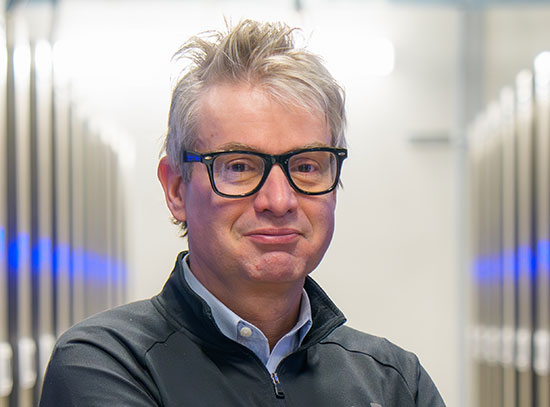
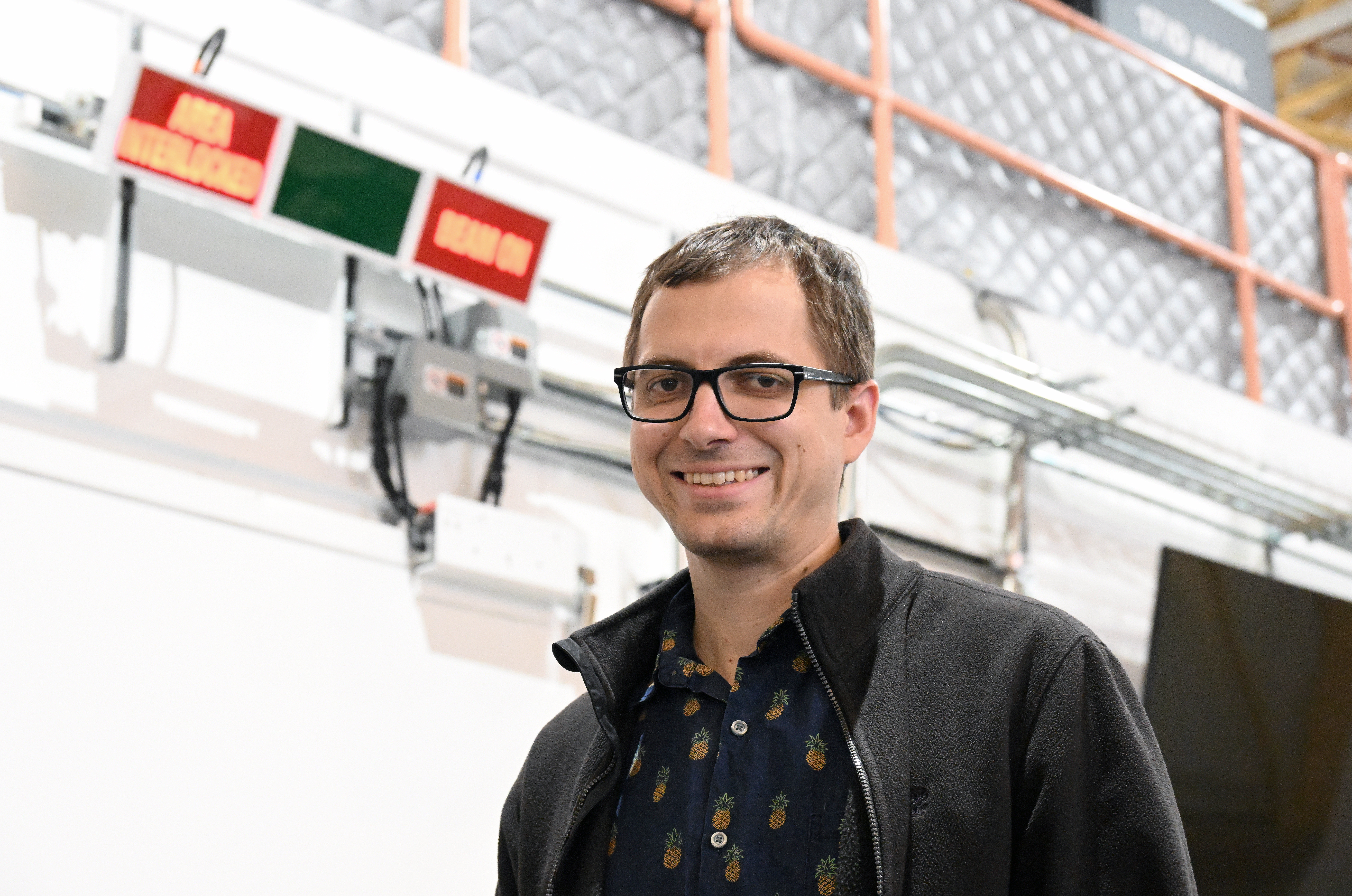
Dale Kreitler is a beamline scientist at the National Synchrotron Light Source II's Highly Automated Macromolecular Crystallography (AMX) beamline. (Kevin Coughlin/Brookhaven National Laboratory)
Modern medicine has played a significant role in improving the length and quality of our lives. While many treatments may seem like miracles, they are the result of a lengthy, rigorous research process. Drug discovery is a particularly time-consuming and costly activity that is fraught with complex challenges and labor-intensive bouts of trial and error. In many of these campaigns, scientists reconstruct 3D images of proteins at the atomic level to figure out where and how potential drug molecules might fit. The 3D picture helps research and development teams design medicines that can lock onto the protein and modify its behavior. While that sounds simple, it is sometimes a bit like working on a jigsaw puzzle without a reference image and several extra pieces that don’t quite fit for every piece that does. However, when potential therapeutics do match up with clinical targets, life-changing results can happen.
In an effort to make this essential process faster, more efficient, and less expensive, scientists at the National Synchrotron Light Source II (NSLS-II), a U.S. Department of Energy (DOE) Office of Science user facility at DOE’s Brookhaven National Laboratory, are piloting a new program that integrates a cutting-edge screening technique called Fragment-Based Drug Design (FBDD). Using Macromolecular X-ray Crystallography (MX), FBDD helps identify safe, effective drug candidates quickly and cost-effectively. In collaboration with other colleagues and facility users, the team is hoping to create a valuable resource to improve drug discovery that is the first of its kind to be publicly available in the United States.
What is Fragment-Based Drug Design?
In the search for new medicines, scientists rely on screening strategies to identify drug candidates that can latch onto specific protein targets involved in a disease process. For many years, the go-to method has been to test massive libraries of complex, drug-like molecules to see if they bind strongly to the target. These libraries can contain thousands, or even millions, of compounds. Maintaining and testing these large libraries can drive up the cost of screening very quickly.
In recent years, FBDD has gained traction as a promising alternative and complementary technique. Instead of using large molecules (typically 500 Daltons or more, with a Dalton being 1/12 the mass of a single carbon-12 atom), this approach starts with much smaller chemical fragments (about 100–300 Daltons). Since they are simpler in structure, these fragments let scientists explore chemical possibilities more thoroughly. Even with a relatively small library, researchers can screen large swaths of chemical space leading to encouraging starting points, often revealing new ways of binding that larger molecules might miss.
Fragments usually bind weakly at first, but they do so with remarkable efficiency. Because of their size, they can be optimized step-by-step into stronger, more selective drug candidates. These protein-fragment complexes make an ideal entry point for designing therapeutics with improved properties where there is room for customization of the eventual drug target.
“Fragment screening is valued not only for its precision in finding meaningful hits but also for how it streamlines the process of refining them into potent drugs,” said Dale Kreitler, a beamline scientist at NSLS-II’s Highly Automated Macromolecular Crystallography (AMX) beamline. “When paired with powerful structural tools like MX, fragment-based discovery not only identifies good starting points but also provides detailed insights into how fragments interact with their protein targets.”
Kreitler is leading the project in its early stages. This endeavor originated with a Brookhaven National Laboratory and Stony Brook University seed grant in collaboration with Markus Seeliger, a professor of Pharmacological Sciences at Stony Brook. Adding to the team is postdoctoral research associate Kaylen Meeks and beamline scientist Edwin Lazo, who brings his expertise in automation and robotics to help shape the workflow for this innovative screening approach.
 enlarge
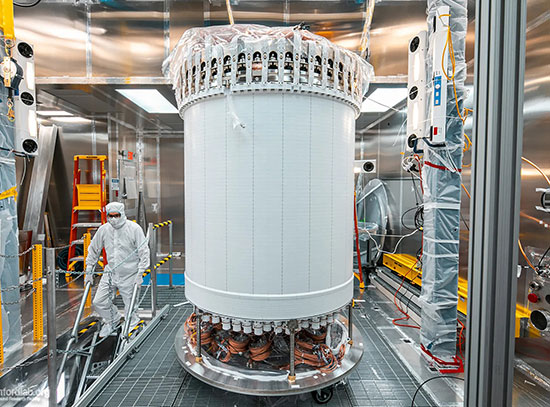
Robots like this one at the AMX beamline help automate experiments and speed up the screening process for drug discovery techniques. (Roger Stoutenburgh/Brookhaven National Laboratory)
Experiments that practically run themselves
The team is working to remove many of the manual steps involved in processing samples and harvesting protein crystals by integrating robotics, automation, and artificial intelligence (AI). They also hope to curate a sample tracking database that is automatically updated with the outcome of each experiment to make data archival and incorporation into AI models more efficient.
“MX wasn’t always as mature or as automated as it is currently,” said Lazo. “With a reliable, robust automation workflow producing high-quality data, the chances of finding a successful candidate compound increases, while saving time and money. NSLS-II is one of the first facilities in the United States that is building up the tools and expertise to do this.”
Putting the technique to the test
Now that X-ray crystallographic FBDD has been established at NSLS-II, beamline staff have begun working with external research groups from the NSLS-II user community to start employing this technique on real-world research problems. One such project has emerged on the heels of a recent collaborative experiment. A large, multi-institutional team, including Kreitler, published a study in Nature Communications that identified Biliverdin IXβ reductase (BLVRB), an enzyme involved in platelet production, as a potential therapeutic target for increasing platelet production. Using computer modeling, the team designed and synthesized new small molecules that selectively block BLVRB. Complementary techniques, such as nuclear magnetic resonance spectroscopy and MX, confirmed that two distinct types of molecules fit into the enzyme’s active site. At the AMX beamline, valuable diffraction data from crystals of BLVRB bound to their new inhibitor molecules help to create these detailed models. This discovery enabled the team to identify and test a compound that can help the body make platelets in a new way.
“There is a very real need to develop strategies to combat chemotherapy-induced platelet reduction,” said Wadie Bahou, a doctor of hematology and oncology and professor of medicine at Stony Brook University Hospital and co-author on this research. “There is currently no FDA-approved drug to treat this kind of thrombocytopenia. Often, if platelet counts are too low, cancer patients have to discontinue or modify their treatment. We’re excited to collaborate on such clinically relevant research.”
While this study did not incorporate fragment screening, it sparked an immediate follow-up experiment that will leverage FBDD to create better starting compounds. These, in turn, may help pinpoint promising drug candidates more efficiently. By building from smaller structural clues instead of testing large, complex molecules all at once, these experiments evolve and become faster and more productive.
Another application of FBDD can arise when researchers have already shown selective target engagement with a compound and confirmed that binding to the target produces the desired biological response. However, if the compound they tested shows poor bioavailability, they must return to the drawing board to identify alternatives. Fragment screening provides new chemical starting points that scientists can optimize for bioavailability while working to preserve specificity and the biological effect. If one series achieves target specificity, researchers stand a strong chance of repeating that success with a better compound.
“That’s the kind of work we're exploring as well. We're planning to take the BLVRB target they provided and try to identify additional starting compounds they can work with. It's a really interesting project and approach. Drug discovery has a notoriously low success rate, particularly for small companies, but the FBDD approach is a new way to drive progress and improve the odds of success,” said Kreitler.
Brookhaven National Laboratory is supported by the Office of Science of the U.S. Department of Energy. The Office of Science is the single largest supporter of basic research in the physical sciences in the United States and is working to address some of the most pressing challenges of our time. For more information, visit science.energy.gov.
Follow @BrookhavenLab on social media. Find us on Instagram, LinkedIn, X, and Facebook.
2026-22600 | INT/EXT | Newsroom